
Securing Online Social Networks: A Decentralized Group Key Agreement via Chaotic Maps
A Provably Secure Group Key Agreement Scheme With Privacy Preservation for Online Social Networks Using Extended Chaotic Maps
This paper proposes a decentralized group key agreement (GKA) scheme specifically for Online Social Networks (OSNs), utilizing extended Chebyshev chaotic maps to ensure privacy preservation and member anonymity. The method eliminates the need for a trusted third-party chairman and is verified as provably secure under the BAN logic model and Proverif simulations.
TL;DR
Online Social Networks (OSNs) are the heart of modern connectivity, but they are also privacy minefields. This paper introduces a provably secure group key agreement scheme that uses Extended Chebyshev Chaotic Maps. By removing the need for a centralized group leader or key center, it establishes a "fair" environment where members can share sensitive data anonymously with minimal computational burden.
Context: The Vulnerability of Social Groups
When you join a private group on a social platform, who controls the encryption key? In most current architectures, a central server or a "group admin" generates the key. This creates two problems:
- Trust: You must trust the platform not to peek.
- Bottleneck/Fairness: A central key distributor is a single point of failure and can control the session key generation independently.
The authors argue that OSNs require a system where the key is agreed upon, not distributed, and where the real identities of members remain masked from eavesdroppers.
The Mathematical Intuition: Why Chaotic Maps?
While most secure systems rely on RSA or Elliptic Curve Cryptography (ECC), this paper utilizes Chebyshev Polynomials ().
- The Semigroup Property: . This is the foundation for a Diffie-Hellman-like exchange.
- Efficiency: Chaotic maps offer faster computations and smaller key sizes than RSA, making them perfect for mobile-centric OSN applications.
Methodology: The Core Protocol
The proposed scheme is divided into several logical phases. The most critical is the Predecessor and Successor Authentication Phase and the Group Key Agreement Phase.
1. Architecture Breakdown
Rather than a star topology, the members are organized in a logical ordered chain (). Each member establishes a pairwise session key with its neighbor.
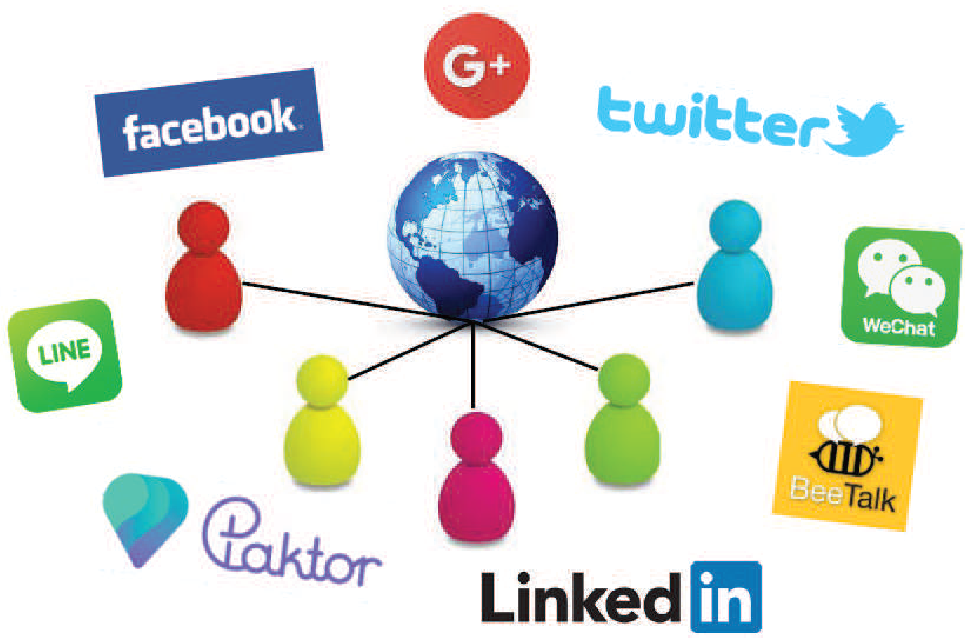 FIGURE 1: Representation of diverse OSNs requiring secure group management.
2. The Agreement Mechanism
Instead of using heavy scalar multiplications, the scheme uses a clever XOR-based "chaining":
- Each member computes a value based on the shared key with their neighbor and their private chaotic map value.
- Members multicast a public value .
- Because each member knows their own , they can use the values from others to "unlock" the full chain of values.
- The final Group Session Key (GSK) is a hash of all values: .
Experiments and Results
The authors validated the security using BAN Logic (a formal logic for authentication) and Proverif (automatic protocol verifier).
Performance vs. Security
The computational cost is dominated by the Chebyshev operations, but compared to traditional methods, the overhead is significantly lower.
 FIGURE 2: Proverif simulation results proving the secrecy of the session key.
- Execution Time: The group key agreement phase takes a mere 0.06ms.
- Functionality: Unlike previous work (e.g., Lou et al. or Vijayakumar), this scheme provides Fairness, Member Anonymity, and Formal Security Proofs simultaneously.
| Phase | Cost | Time |
|---|---|---|
| Authentication | 10 + 4 | 329.3 ms |
| Agreement | 3 | 0.06 ms |
Critical Insight & Conclusion
The true value of this paper lies in its Fairness mechanism. In many GKA schemes, the last member to join has more influence over the key, or an initiator holds all the cards. Here, every is equally necessary for the group key, ensuring no single entity "owns" the security.
Takeaway: As we move toward more decentralized social platforms, the shift from "Key Distribution" to "Chaotic Key Agreement" offers a high-security, low-latency path for preserving user privacy and organizational integrity.
Limitations: The chain-based organization requires an ordered structure. While efficient for moderate groups, very large groups might see increased latency in the predecessor-successor phase compared to tree-based structures.