
Provenance in Healthcare agents: Solving the "Island of Information" Problem
2973_Provenance in Agent-Mediated Healthcare Systems.
This paper introduces a provenance-aware architecture for Healthcare Multiagent Systems (HC-MAS), exemplified by the Organ Transplant Management Application (OTMA). It leverages the "Provenance Project" framework to trace causal dependencies in medical decisions, achieving a unified view of distributed patient histories across heterogeneous institutions.
TL;DR
Modern healthcare is fatally fragmented. This paper tackles the "disconnected islands of information" in medical systems by introducing Provenance-Awareness into Multiagent Systems (HC-MAS). By using a specialized framework of "p-assertions," the authors demonstrate how to reconstruct a patient's entire treatment history across different institutions—while keeping identity data strictly anonymous.
Background: Why Agent-Based Healthcare is Failing?
Healthcare institutions are naturally autonomous and heterogeneous. While Agent-Based Techniques are excellent at modeling these decentralized networks, they often fail to provide a unified view of the patient. Doctors frequently operate in the dark, relying on a patient’s memory to fill in gaps from previous treatments in different hospitals.
The core challenge isn't just data sharing; it's Provenance: the ability to trace why a decision was made, what information was available at each step, and who was responsible.
Methodology: The Anatomy of a P-Assertion
The authors build upon the "Provenance Project" (Grid-based SOA) to implement a four-phase lifecycle: Creation, Storage, Query, and Management. The secret sauce lies in three types of p-assertions:
- Interaction p-assertion: Records the content of messages sent between agents.
- Relationship p-assertion: Explains the logic—linking outputs to inputs (e.g., "Decision X was based on Test Result Y").
- Actor State p-assertion: Captures the "why"—internal reasoning or human-input justifications that aren't visible in simple message logs.
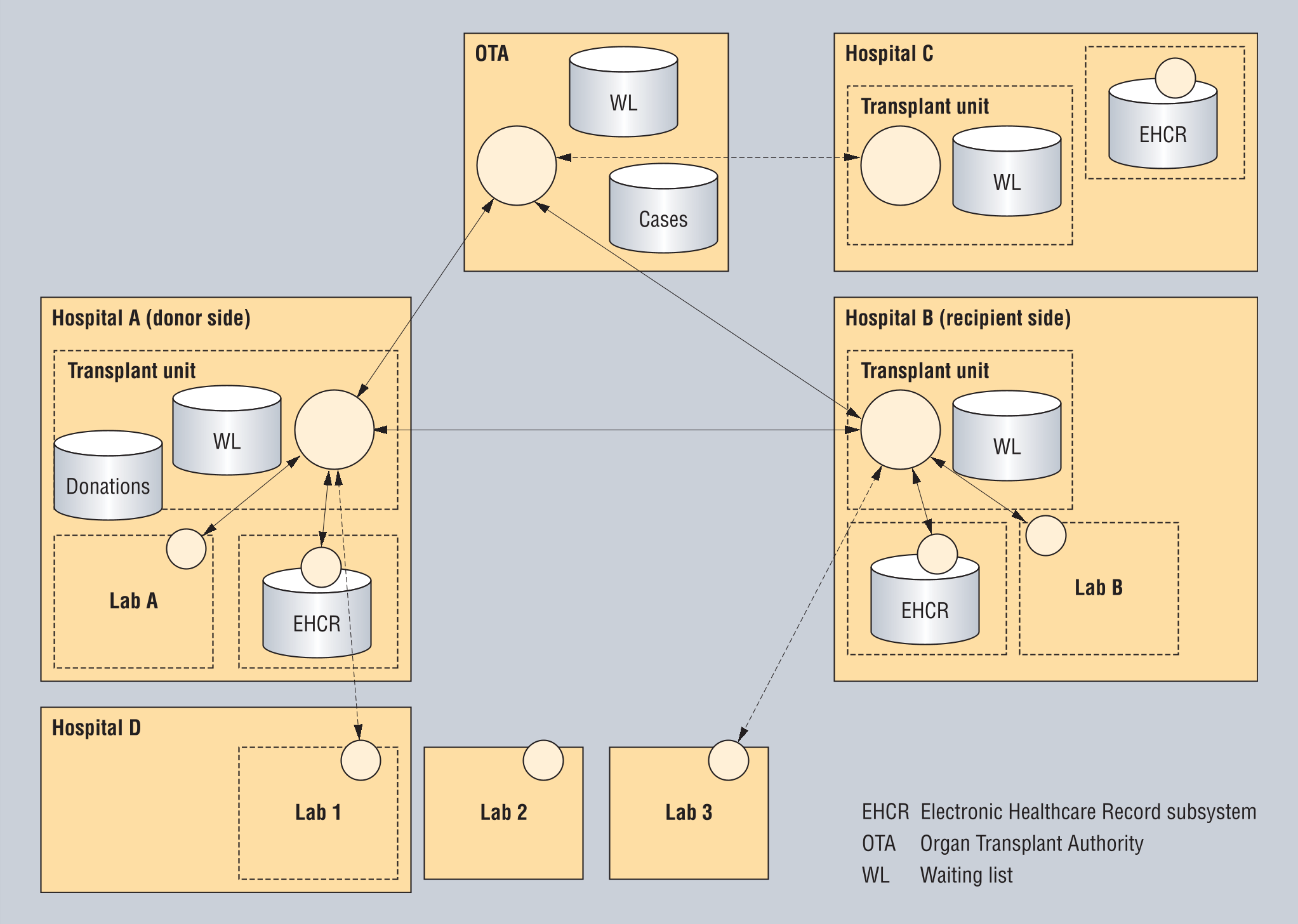 Figure 1: The OTMA framework where agents manage different administrative domains, from laboratory tests to Electronic Healthcare Records.
The "Latent Interaction" Challenge
One of the paper's most profound insights is the distinction between Strongly Connected and Weakly Connected processes.
- Strongly Connected: Doctors/Agents interact directly (e.g., a referral).
- Weakly Connected: Doctors treat the same patient at different times without ever speaking.
To bridge this gap without violating privacy, the authors propose an Anonymization Service. It acts as a "silent witness" that links disparate process sets in a Provenance Store using irreversible anonymized identifiers.
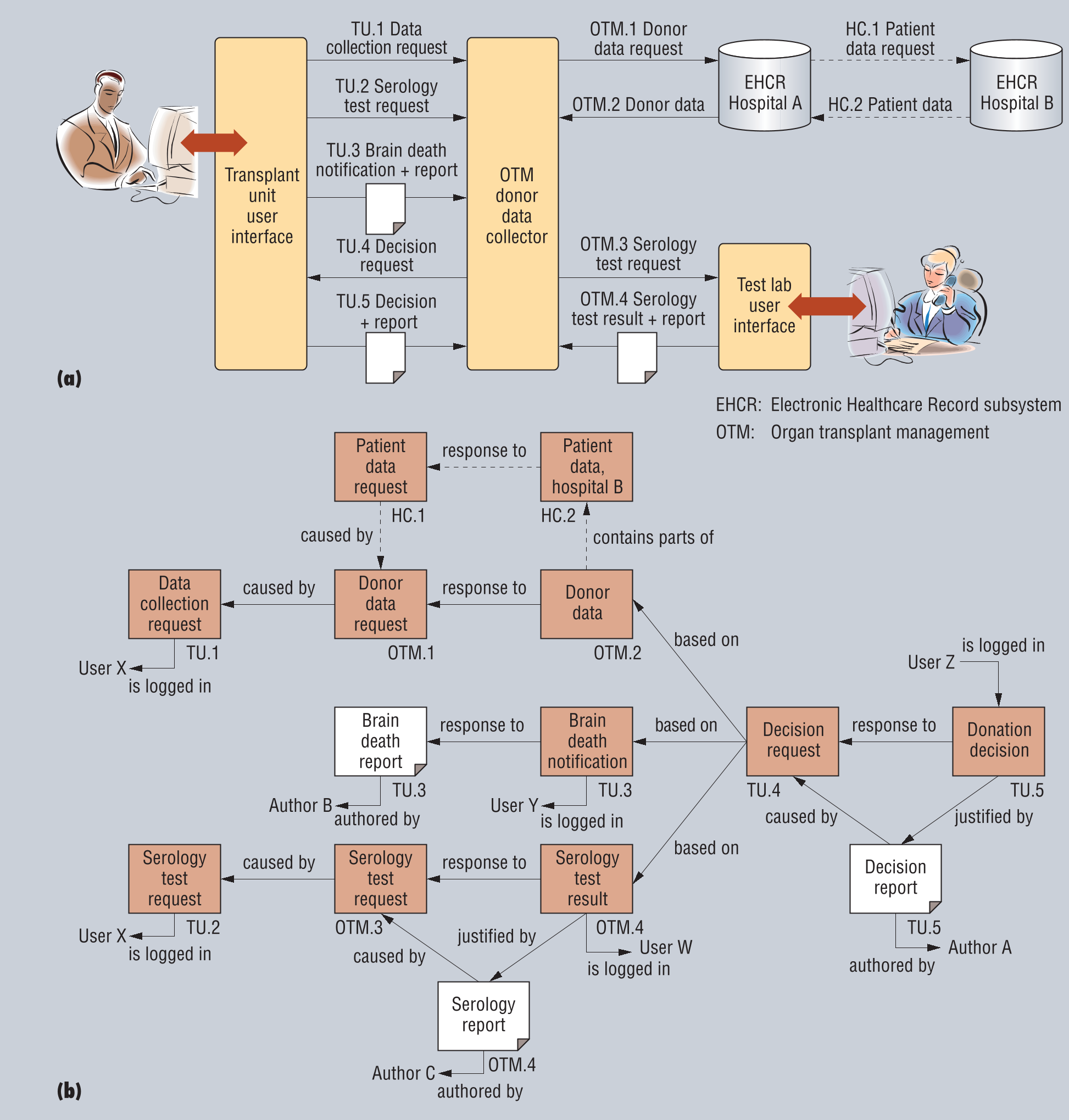 Figure 2: The result of the p-assertion model—a DAG that allows auditors to trace a donation decision back to every influencing report and actor.
Privacy vs. Provenance: The Paradox
How do you document everything ("Who did what?") without exposing sensitive data? The authors employ two critical strategies:
- Data Separation: The Provenance Store holds only the "skeleton" (the links and causal steps), while the actual sensitive medical data remains in the secure EHCR subsystem.
- Irreversible Anonymization: The mapping algorithm for patient IDs is never stored, ensuring that even if the provenance trail is accessed, it cannot be linked back to a real-world identity without the specific, non-trivial algorithm.
Critical Insight & Conclusion
This work shifts the focus from "data exchange" to "process documentation." By treating medical history as a directed graph of causalities, the system moves beyond mere logging. It provides a platform for Performance Analysis and Auditing, which are crucial for trust in high-stakes environments like organ transplantation.
Takeaway: Future distributed systems shouldn't just send data; they must assert their history. Provenance-awareness is the bridge between autonomous agents and accountable healthcare.
Limitations
- The scalability of the Anonymization Service as a "central interaction node" remains a potential bottleneck, though the authors suggest distributing its functionality.
- The manual overhead for human actors to record "Actor State" assertions in a high-pressure medical environment may face adoption hurdles.