
Trust in the Age of Uncertainty: A Provenance and Stochastic Approach to Social Recommendations
Provenance based Trust computation for Recommendation in Social Network
The paper introduces a provenance-based trust model for Online Social Networks (OSN) to validate friend requests using mutual friend interactions. It combines a Stochastic Differential Equation (SDE) model to handle human behavioral randomness with a Bayesian classifier to recommend "Accept" or "Reject" actions.
TL;DR
As Online Social Networks (OSNs) grow, so do the risks of "friend or foe" ambiguity. This paper presents a sophisticated trust computation framework that moves beyond static profiling. By utilizing Data Provenance to track interaction history and Stochastic Differential Equations (SDE) to model the erratic nature of human behavior, the authors achieve a 96.7% accuracy in identifying trustworthy social connections.
Problem & Motivation: The Identity Crisis in OSNs
In a world where digital interactions replace face-to-face contact, the "Friend of a Friend" (FOAF) mechanism is often exploited. The authors argue that:
- Authenticity Gap: Service providers offer no native mechanism to verify if a requester is real or a malicious actor.
- Behavioral Volatility: Human communication is psychologically dependent and carries inherent randomness (mood, time availability), which simple linear models fail to capture.
- Bias in Word-of-Mouth: Traditional recommendation systems are easily biased by subjective opinions rather than objective interaction data.
Methodology: Provenance Meets Stochastic Calculus
The core innovation lies in treating interaction data not just as a sum, but as a dynamic evolution.
1. Provenance Feature Extraction
The model tracks the "lifecycle" of an interaction through five dimensions:
- Who/Whom: The actors involved.
- What: The type of interaction (Chat > Comment > Like).
- When/How: Time-stamps and frequency/duration.
2. The SDE Model (The "How" of Randomness)
To account for the "noise" in human behavior, the researchers used the Itô Stochastic Differential Equation:
- Drift Coefficient (): Determines the nominal dynamics (the core trend of interactions).
- Diffusion Coefficient (): Represents how "noise" or temporal gaps impact the trust output.
- Wiener Process (): Models the random walk of human interaction frequency.
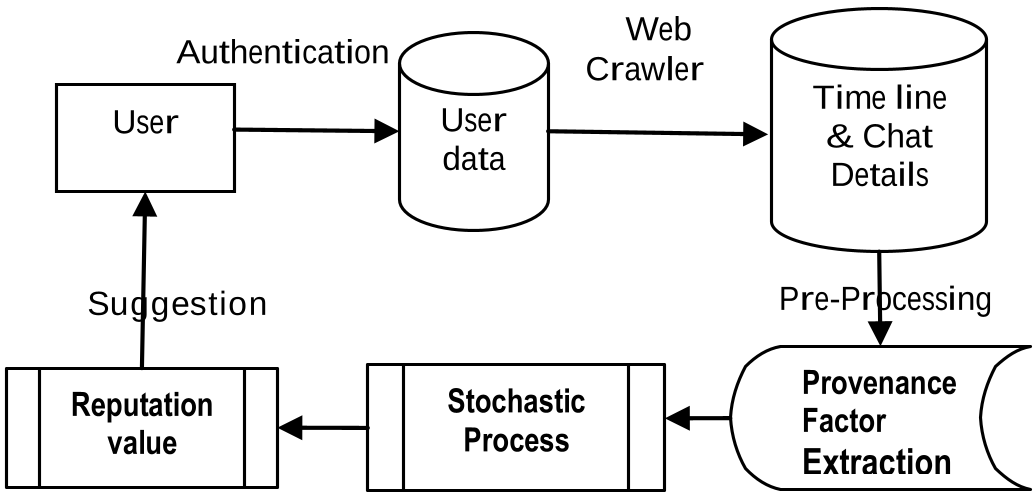
3. Statistical Refinement
After calculating the probabilistic interaction vector using SDE, the data is fed into a Naïve Bayesian Classifier. This categorizes the requester into "Accept" or "Reject" classes based on historical patterns of successful interactions.
Experiments & Results
The authors validated their model using a dataset of social interactions processed via MATLAB and the WEKA data mining tool.
| Metric | Achievement |
|---|---|
| Classification Accuracy | 96.7% |
| Incorrectly Classified | 3.3% |
| Validation Method | 10-fold Cross-Validation |
The study specifically noted that "Chat" interactions carry more weight than "Likes" or "Comments," a hierarchy maintained via Rank Order Centroid weighting. This alignment with real-world social intuition is what drives the high precision of the results.
 (Note: Image used for illustrative representation of the procedure logic)
Critical Insight & Conclusion
Takeaway
This paper successfully bridges the gap between Data Provenance (the "history" of data) and Stochastic Modeling (the "uncertainty" of data). It proves that trust is not a fixed attribute but a time-varying probability.
Limitations & Future Work
- Cold Start Problem: Like many interaction-based models, it requires a baseline of activity before trust can be accurately computed.
- Future Scope: The authors intend to extend this into a full-scale recommendation engine for new (unknown) friend requests by leveraging deeper network topology.
By viewing social trust through the lens of physics-inspired stochastic processes, the researchers provide a robust math-heavy alternative to the increasingly "gullible" recommendation algorithms of today.