
BT-Clan: Automating Empathy through Social Network Modeling in the NICU
Providing affective information to family and friends based on social networks
The paper introduces BT-Clan, a personalized communication system within the BabyTalk project designed to automatically generate and disseminate tailored medical updates about infants in Neonatal Intensive Care Units (NICU) to diverse social circles. By leveraging Natural Language Generation (NLG) and social network modeling, it provides varying levels of affective and clinical information based on the recipient's relationship with the parents.
TL;DR
When a newborn is admitted to the Neonatal Intensive Care Unit (NICU), parents are often too overwhelmed to keep their social circle updated. BT-Clan is a specialized system that uses Natural Language Generation (NLG) to automatically pull clinical data and "filter" it through a parent's social network map, ensuring the right people get the right level of detail without burdening the parents.
Background: The Communication Crisis in Crisis
Medical crises are social events. In a NICU setting, the "Clan"—a mix of relatives, colleagues, and friends—rightfully seeks updates. However, for parents, the repetitive task of explaining complex medical jargon or repeating "bad news" becomes a secondary source of trauma. Prior work like BabyLink provided basic reports, but as the authors note, a "one-size-fits-all" approach to medical data is insufficient when dealing with a grandmother versus a distant coworker.
The Core Insight: Spatial Distance as Data Filter
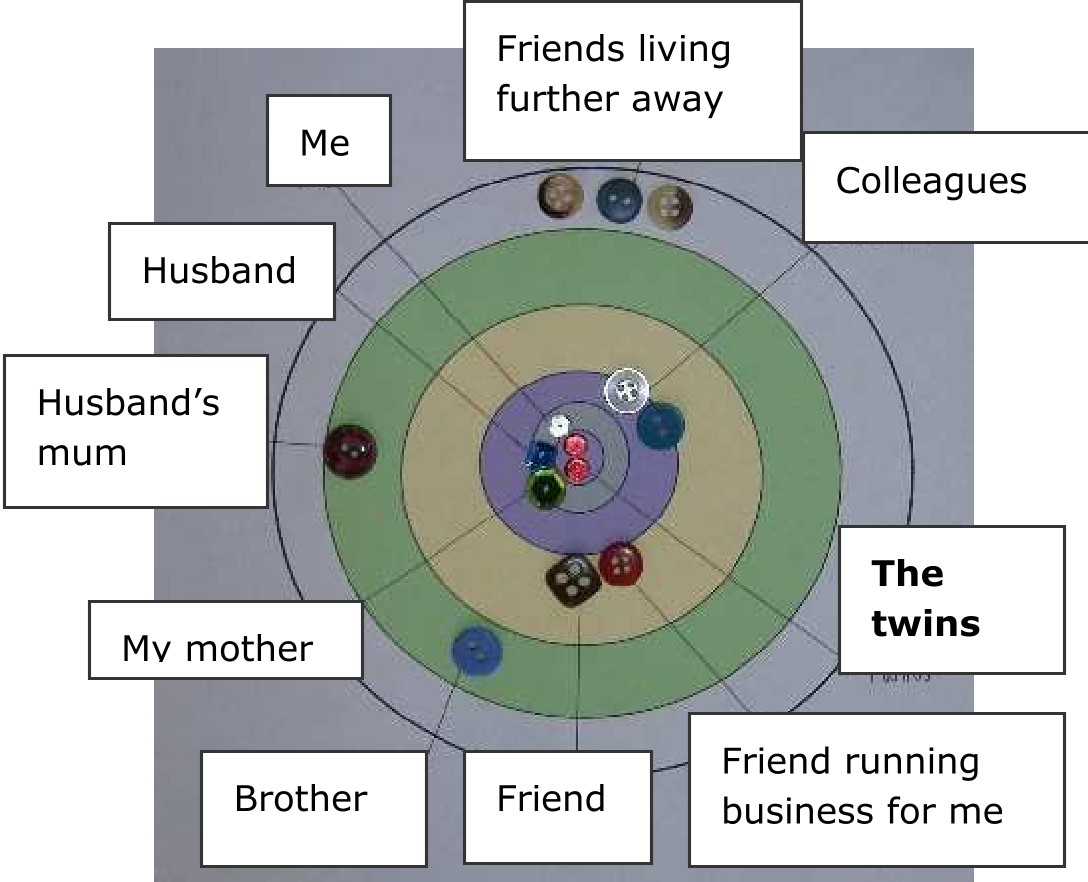
The authors suggest that the "who" is just as important as the "what." They introduced a mapping tool where parents place contacts on a set of concentric circles.
- The Center: The Baby.
- The Proximity: Reflects the perceived relationship.
- The Strategy: Use this spatial data to feed a multi-tiered information distribution model.
Methodology: The Five Bands of Information
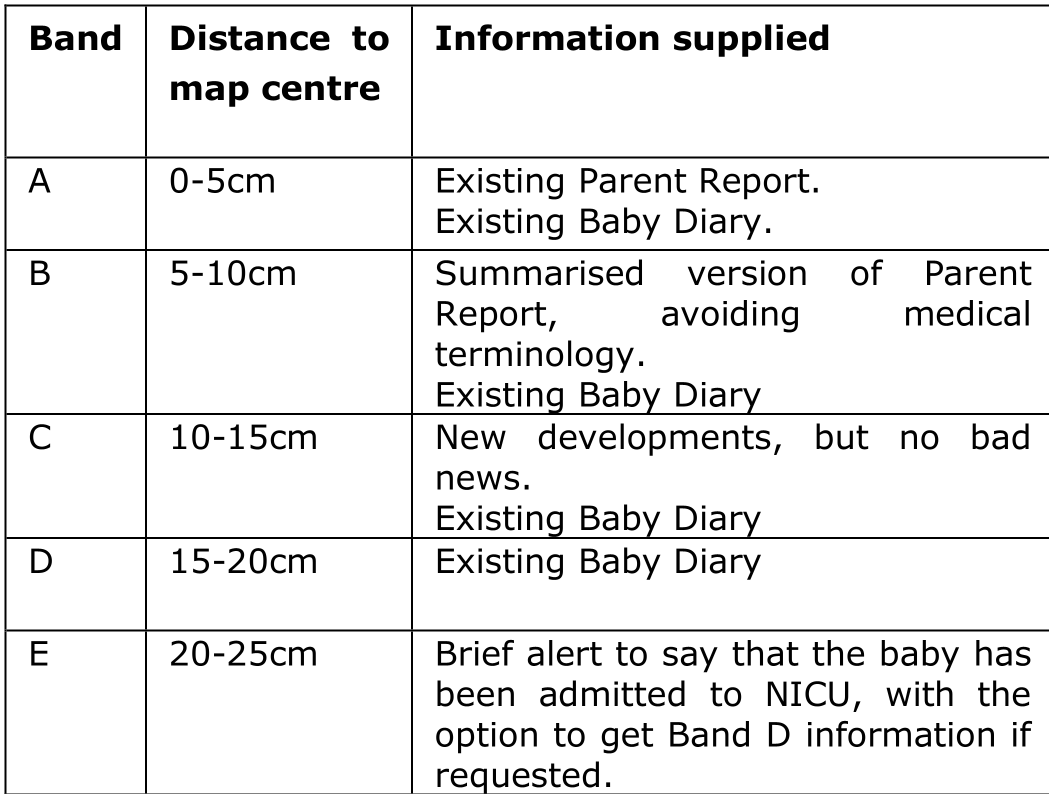
The system categorizes contacts into five "Bands" (A-E) based on their distance from the center. This isn't just about privacy; it's about cognitive and emotional load balancing.
| Band | Information Strategy | Purpose |
|---|---|---|
| Band A | Full Medical + Diary | For "Information Brokers" who handle technical details. |
| Band B | Summarized (No Jargon) | For close family who need the truth but aren't medical pros. |
| Band C | Updates (No Bad News) | To keep the wider circle optimistic and supportive. |
| Band D/E | Basic Alerts | For distant ties to prevent a "information vacuum." |
By using Natural Language Generation (NLG), the system transforms raw sensor readings (heart rate, oxygen levels) into these various narrative styles automatically.
Gendered Perspectives in Social Support
One of the paper's most intriguing findings is the gender disparity in how social networks are perceived during a crisis.
- Women's Maps: Highly nuanced, individual-centric, and included "official" supporters like clergy. They saw their mothers as the closest tier.
- Men's Maps: "Broadbrush" approach, often grouping diverse people into single nodes. Men were less likely to identify their own parents as "inner circle" in the context of the baby's care.
This insight suggests that automated systems must be flexible enough to accommodate different "mental models" of support based on the user's demographic and personal style.
Experimental Results & Social Impact
The study highlights that communication follows a "ripple effect." By providing high-quality data to Band A (Brokers), the information naturally filters down. Parents reported feeling a "sense of support" simply by knowing people were informed, without having to perform the labor of informing them.
Critical Perspective: Limits of Automation
While BT-Clan addresses the "barrage of enquiries," it faces the challenge of dynamic social shifts. A friend might move from Band C to Band A overnight based on their actions. The system requires low-friction ways for parents to "adjust the map" as their reality changes.
Conclusion
BT-Clan moves beyond simple data visualization into the realm of affective informatics. It recognizes that in healthcare, data is not just a set of numbers; it's a social currency that needs to be spent wisely to maintain the emotional health of the patient's family.
Takeaway for the Industry: Future AI-driven health assistants should prioritize "Social-Aware Filtering"—understanding the user's social topology to manage the flow of sensitive information.