
Proximal Normal Structure: Solving the Fixed Point Problem for Disjoint Sets
Proximal normal structure and relatively nonexpansive mappings by
This paper introduces the concept of "proximal normal structure" to establish best proximity point and fixed point theorems for relatively nonexpansive mappings. The authors prove that in uniformly convex Banach spaces, mappings T defined on the union of two subsets A and B satisfy the existence of points attaining the distance between the sets even when the sets are disjoint.
TL;DR
In the realm of functional analysis, the existence of a fixed point () typically requires the mapping to act upon a single set. But what happens when a mapping jumps between two disjoint sets and ? This paper by Eldred, Kirk, and Veeramani introduces Proximal Normal Structure, a geometric property that guarantees the existence of a "Best Proximity Point"—a point that minimizes the error between and when a solution to is mathematically impossible.
Background & Motivation: Beyond Nonexpansive Mappings
A mapping is nonexpansive if it doesn't increase the distance between any two points. While the Kirk's Fixed Point Theorem (1965) settled the existence of fixed points for such maps on weakly compact convex sets, it assumed the mapping stayed within the same set.
The authors tackle relatively nonexpansive mappings, where: The challenge arises when . You can't have if and . Instead, we look for such that the distance is the absolute minimum possible distance between the two sets, denoted as .
Methodology: The Geometry of Proximal Normal Structure
The core innovation is the Proximal Normal Structure.
1. Defining the Structure
A pair has this structure if for any smaller, closed, convex proximal pair , there exist points that are not "extreme" in terms of their distance to the opposing set. Specifically: This ensures we can always "shrink" our candidate sets toward a solution.
2. The Existence Theorems
The paper presents two landmark results:
- Theorem 2.1: If swaps the sets (), there is a point such that .
- Theorem 2.2: If stays within its set but is relatively nonexpansive across sets, and the space is strictly convex, then there exist fixed points which are also at the minimal distance from each other.

Uniform Convexity and Iterative Methods
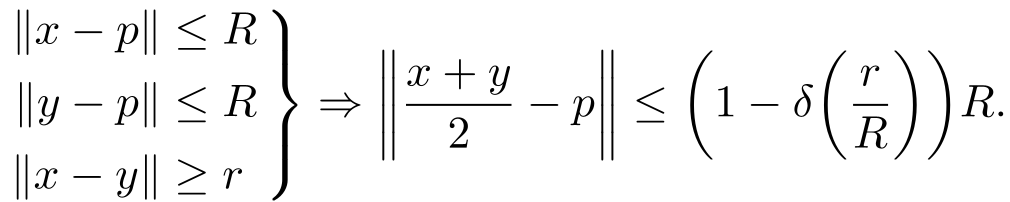
One of the most practical contributions is the proof that Uniformly Convex Banach spaces (like Hilbert spaces or spaces for ) automatically possess this proximal normal structure.
Furthermore, the authors prove that a Krasnosel’skĭı iteration: converges to the fixed point (if is compact), providing a computational path to find these optimal points.
Deep Insight: Why It Works in Hilbert Spaces
In a Hilbert space, the geometry is much "cleaner." The paper demonstrates that in this setting, the metric projection is relatively nonexpansive. The authors use the Pythagorean Theorem to show that relative nonexpansivity actually implies global nonexpansivity on once the sets are restricted to their proximal points ().
Critical Analysis & Conclusion
Takeaway
This paper provides the rigorous mathematical foundation for Best Proximity Point Theory. It extends fixed point theory to scenarios where constraints are mutually exclusive, a common occurrence in optimization and economic equilibrium modeling.
Limitations
- The second theorem requires Strict Convexity, which excludes spaces like or .
- The convergence of the iteration requires the mapping to be compact ( lies in a compact set), which may not always hold in infinite-dimensional settings without additional assumptions.
Future Work
The introduction of proximal normal structure opens the door to studying "Cyclic Mappings" and complex dynamical systems where a particle moves between different manifolds or regions of a state space.