
Find & Connect: Bridging the Gap Between Physical Encounters and Social Networks
Using Proximity and Homophily to Connect Conference Attendees in a Mobile Social Network
The paper presents "Find & Connect," a mobile social networking platform for academic conferences that integrates RFID-based indoor positioning with social homophily. Deployed at UbiComp 2011, it facilitates networking by recommending contacts based on shared interests and physical encounters, achieving a significant participation rate of 57% among attendees.
TL;DR
At major conferences, we meet dozens of people but rarely manage to convert those handshakes into lasting professional links. Find & Connect is a research-driven mobile platform that uses active RFID tracking and the "Homophily Principle" to help attendees discover and connect with peers based on where they stand and what they study. Tested at UbiComp 2011, the study proves that physical proximity is the ultimate catalyst for expanding your professional circle.
The "Business Card" Bottleneck
Despite the digital age, academic networking remains stubbornly manual. We rely on business cards, which are tedious to digitize, or LinkedIn, which lacks the real-time "context" of a conference. Previous attempts at location-based services failed because:
- GPS Accuracy: Standard GPS has a 50m error margin—useless for distinguishing between rooms in a convention center.
- Context Blindness: Knowing two people are in the same building doesn't mean they share interests.
The authors argue that for a network to be valuable, it must merge Proximity (physical interaction) with Homophily (similarity in interests).
Methodology: The Science of High-Precision Networking
The system architecture involves a specialized hardware/software stack:
- Physical Layer: Active RFID badges update the user's position using the LANDMARC algorithm, which uses signal strength to map (x,y) coordinates.
- Social Layer: A web-based UI categorizes attendees into "Nearby" (within 10m) and "Farther Away," while an "In Common" tab highlights shared research interests and sessions.
- Algorithmic Layer: The EncounterMeet+ algorithm recommends contacts by weighing historical physical encounters alongside social similarity.
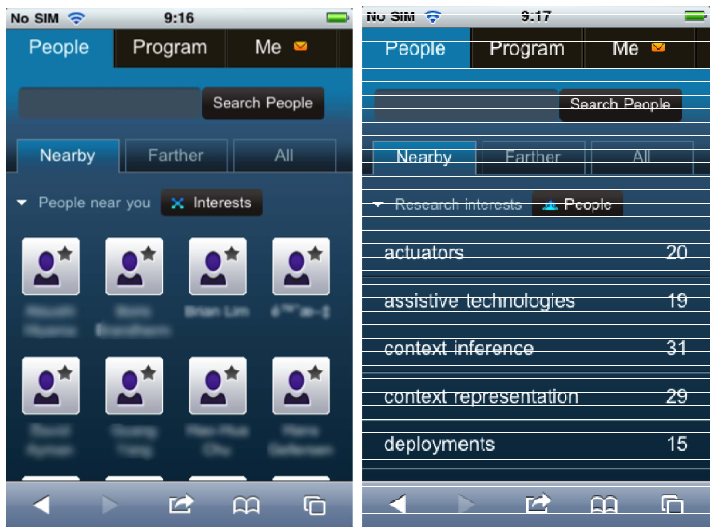 Figure 1: The visual interface showing how attendees can see people nearby and their shared interests.
Key Insights from the UbiComp 2011 Trial
The deployment among 241 participants yielded several fascinating behavioral insights:
1. The Power of "Encountered Before"
Through an acquaintance survey, the researchers found that "Knowing each other in real life" and "Having encountered before" were the top two reasons for adding a contact. This confirms that even in a digital app, the physical interaction is the anchor.
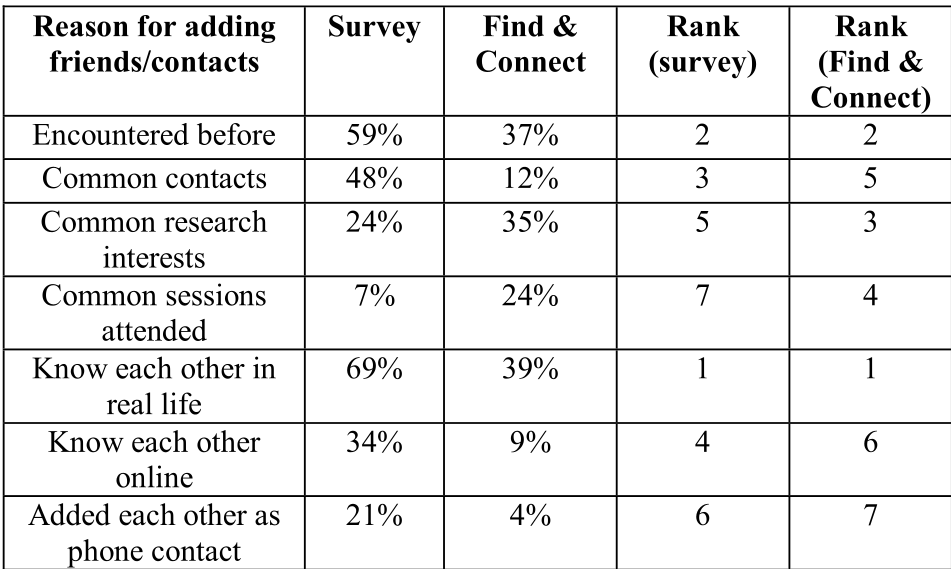
2. Network Topology: 3-4 Degrees of Separation
The conference network mirrored the "Small World" phenomenon. The contact network had a diameter of 4, while the encounter network had a diameter of 3. Essentially, you were never more than three people away from anyone else in the building.
3. The Recommendation Paradox
Surprisingly, while users accessed the "Nearby" page frequently (11.66% of views), they only converted 2% of automated recommendations into contact requests. Many participants preferred to manually browse profiles of people they saw in the room rather than trusting the algorithm's suggestions.
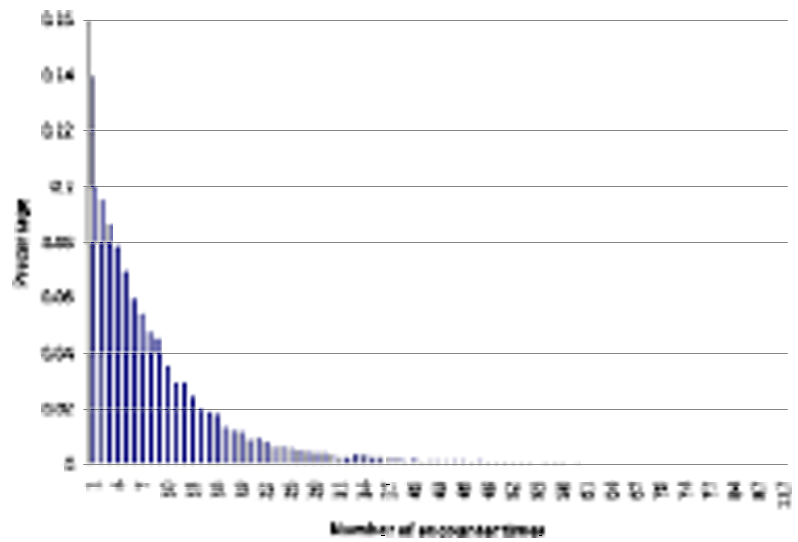 Figure 2: The encounter network was extremely dense, showing the "highly clustered" nature of conference interactions.
Critical Analysis & Conclusion
Find & Connect successfully demonstrated that an "Event-Based Social Network" behaves differently than a static one like LinkedIn. These networks are ephemeral and interaction-driven.
Limitations:
- The low recommendation conversion rate suggests that "Discoverability" isn't enough; the system needs to decrease the social friction of the first "Add" request.
- RFID infrastructure is hardware-heavy. Today, this would likely be replaced with BLE (Bluetooth Low Energy) or UWB.
Moving Forward: The future of networking lies in "Activity-Based Groups." Instead of just knowing who is nearby, future systems should identify sub-groups of people who attend the same niche sessions over multiple days, pinpointing potential collaborators before they even speak.
Takeaway: If you want to build a professional social app, focus on the "Why" (Homophily) but build it on top of the "Where" (Proximity).