
Proximity Measures in Social User-Item Networks: A Biased Random Walk Approach
A proximity measure for link prediction in social user-item networks
The paper proposes a novel proximity measure for link prediction in Social User-Item Networks (SUIN) by employing a biased Random Walk. This method integrates social graph and user-item bipartite graph information, optimizing two specific jumping probabilities () to achieve state-of-the-art recommendation accuracy on the DBLP conference dataset.
TL;DR
Predicting which conference an author will attend or which product a user will buy is no longer just about their history—it's about their social circle too. This paper introduces a specialized Random Walk method on a hybrid "Social User-Item Network" (SUIN). By tuning the probabilities of jumping between friends versus jumping back from items to users, the authors achieve high-precision link prediction that significantly outperforms standard collaborative filtering.
Problem & Motivation: The Gap in Hybrid Networks
Most recommendation engines treat the world as a Bipartite Graph (Users Items). However, real-world data is often a Social User-Item Network, where users are connected to each other (Social Network) AND to items (Bipartite Network).
Current proximity measures (like Jaccard's or simple Random Walks) face three critical failures:
- Type Blindness: They don't distinguish between a "Friend-to-Friend" jump and a "User-to-Item" jump.
- Sparsity: Cold-start users with few item interactions are hard to predict.
- Lack of Intuition: Model-based approaches (like Matrix Factorization) often produce latent features that lack clear physical meanings.
Methodology: The Biased Random Walk
The authors propose an absorbing Markov Chain characterized by two parameters: and .
The Two Rules of Movement:
- Rule (R1) - On a User Node: The walker has a probability to move to a friend (social link) and a probability to move to an item (interaction link).
- Rule (R2) - On an Item Node: The walker has a probability to move back to a user, and to be absorbed (ending the walk at that item).
The "Proximity" between a user and an item is defined as the Absorbing Probability. If a walker starting at User A is frequently absorbed by Item B, Item B is a top recommendation.
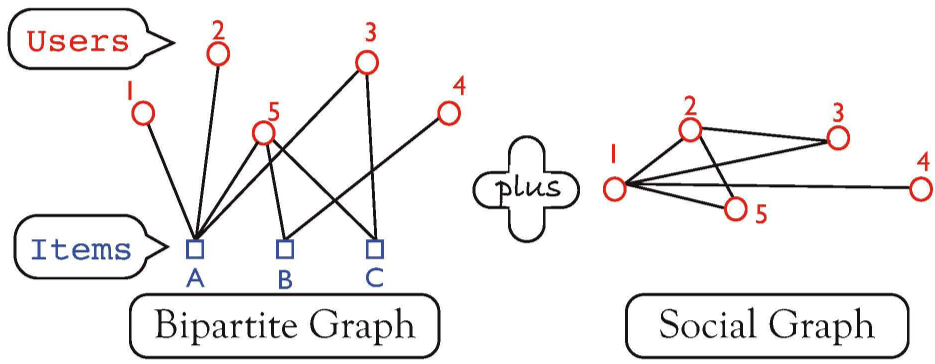
Figure 1: The hybrid structure combining social links (A) and user-item links (B).
The Proximity Inversion Problem
Computing this for every user requires inverting a massive matrix. To keep it scalable, the authors suggest a simulation-based approach: running 10,000 walks per user to estimate probabilities, avoiding the complexity of matrix inversion.
Experiments & Results: The Power of 3-5 Years
The model was tested using the DBLP dataset (Authors = Users, Conferences = Items).
1. The Temporal Effect
A fascinating insight from the study is the "Training Window." Predicting 2008 behavior using only 2007 data performed poorly—worse than random in some cases! This is due to "Negative Correlation": authors rarely publish at the same prestigious conference two years in a row.
- Sweet Spot: A 3 to 5-year training window provided the best RMSE (Root Mean Squared Error).
2. Parameter Tuning
The authors found that the best results occurred when (social jump) was low (0.2-0.4) and (item-to-user jump) was moderate (0.4-0.6). This suggests that while social links are helpful for "smoothing" the data, the direct user-item history still carries the most weight.
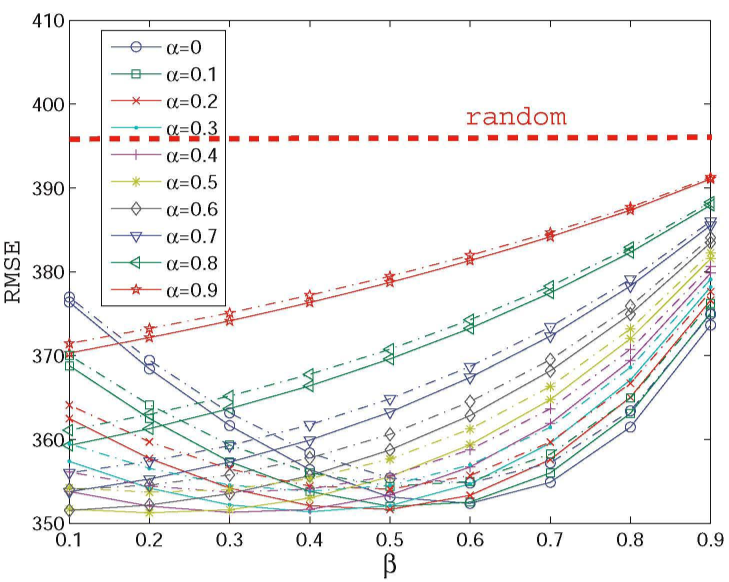
Figure 3: RMSE results showing the optimization landscape for the two jumping probabilities.
3. Performance Metrics
- Precision: ~25% for the Top-1 recommendation.
- Recall: ~60% for the Top-50 recommendations.
Critical Insight & Conclusion
Takeaway
The core value of this paper is the mathematical formalization of Node-Type Awareness in random walks. By allowing and to vary, the model effectively balances "Social Discovery" with "Personal History."
Limitations
- Computational Cost: Even with simulation, 10,000 walks per user for millions of users (like on Amazon) would be computationally expensive without heavy parallelization.
- Weighting Years: The paper notes that complex temporal weighting (giving more weight to recent years) only provided a marginal 0.7% improvement, suggesting a simple sliding window is often sufficient.
Future Outlook
This proximity measure isn't just for recommendations. It could be used for Community Detection (identifying research clusters) or Node Centrality (finding the most influential authors in a specific sub-field).