
Breaking Silos: The First Proxy-Free Federated Crowdsourcing via Blockchain
Enabling Proxy-Free Privacy-Preserving and Federated Crowdsourcing by Using Blockchain
This paper introduces the first proxy-free privacy-preserving and federated crowdsourcing system using blockchain. By integrating Rewritable Deterministic Hashing (RDH) and Puncturable Encryption, it enables secure, cross-broker task matching without relying on a centralized trusted authority.
TL;DR
Current crowdsourcing platforms like Amazon Mechanical Turk operate as isolated islands, where sensitive task and worker data are exposed to centralized brokers. This paper proposes a breakthrough: a Federated Crowdsourcing System that allows different brokers to share resources (tasks and workers) securely. By utilizing Blockchain, Rewritable Deterministic Hashing (RDH), and Puncturable Encryption, the authors eliminate the need for a "Trusted Third Party," making the system truly decentralized and "proxy-free."
The Core Motivation: The Trust Paradox
In the current landscape, if Broker A wants to let Broker B's workers solve its tasks, it would traditionally need a central authority to manage encryption keys. However, in a competitive market, finding a third party that everyone trusts—and who won't leak sensitive task specifications—is nearly impossible. Furthermore, once an authorization is revoked, how do you prevent a former partner from reading the "permanent" records on a transparent blockchain?
Methodology: The Cryptographic Trio
The authors solve the trust paradox using three pillars:
1. Federated Identity via RDH
The system uses Rewritable Deterministic Hashing (RDH) to enable cross-broker search. Instead of sharing a master key, Broker generates an authorization ticket for Broker . This allows the Smart Contract (SC) to transform a search query from into a valid trapdoor for 's encrypted index without the SC or ever seeing the underlying keywords.
2. Guarding the Ledger with Puncturable Encryption
Blockchain data is immutable and public. To handle revocation, the authors use Puncturable Encryption. When Broker 's access is revoked, Broker "punctures" the key space by adding 's unique tag to a revoked list. New task indices are encrypted specifically to exclude these punctured tags, ensuring that even if still has its old keys, it cannot decrypt any new data.
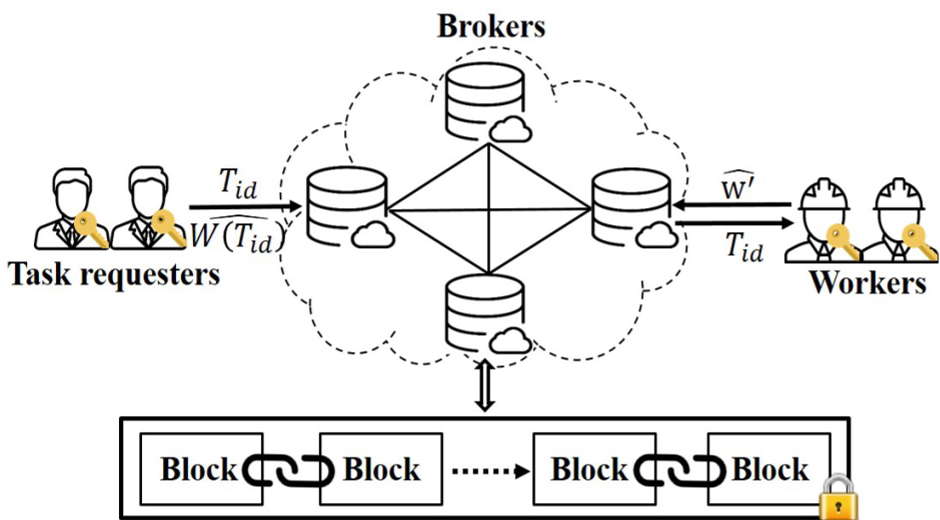
3. Model Architecture
The architecture moves the heavy lifting of task-worker matching to the Smart Contract, ensuring the process is verifiable and correct.
Experimental Results: Is it Practical?
The authors implemented the prototype on Ethereum. A critical concern with blockchain is usually the Gas Cost and Latency.
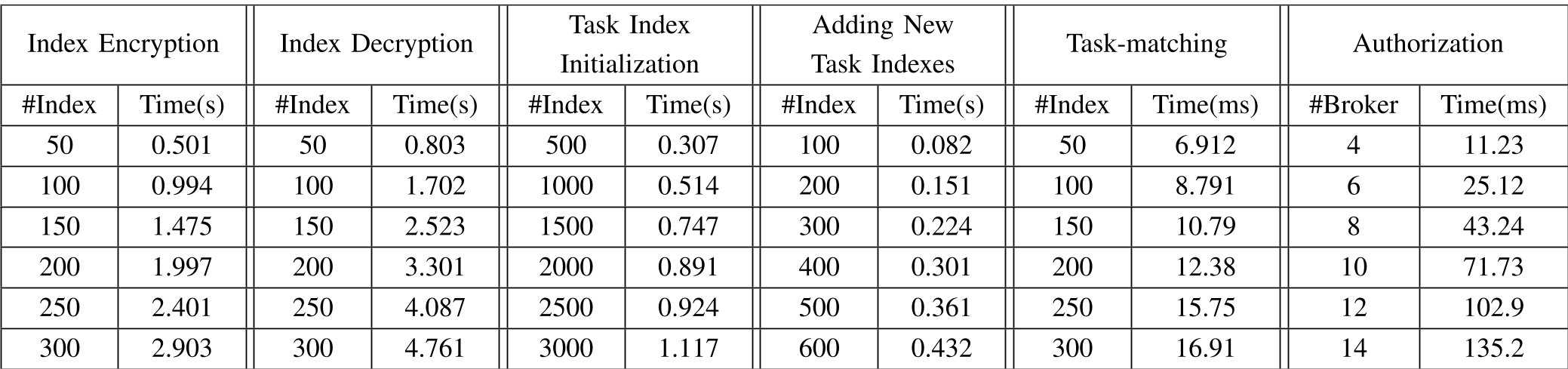
- Latency: The local processing time for 300 indices is under 5 seconds, meaning the bottleneck remains the block mining time (~1s in the experiment), not the cryptography.
- Scalability: The system scales linearly with the number of brokers. Even with 14 brokers, authorization confirmation on-chain stays under 4 seconds.
- Cost: At a gas price of 1 Gwei, authorization costs roughly 0.19 USD. This is remarkably affordable for enterprise-level crowdsourcing.
Critical Analysis & Conclusion
The true value of this work lies in achieving Proxy-Free operation. Most "decentralized" papers still hide a "trusted admin" in the shadows for key management. This paper kicks the admin out of the room.
Limitations: Currently, the system primarily supports exact keyword matching. For real-world crowdsourcing, stakeholders often need Range Queries (e.g., "Find workers within 5km") or Fuzzy Matching. The authors acknowledge this as the next frontier for their research.
Takeaway: By bridging advanced cryptography (Puncturable Encryption) with distributed ledgers, we can transition from "isolated silos" to a "unified global market" of collective intelligence, all while maintaining strict user privacy.