
Prying Data out of a Social Network: The Structural Fragility of Digital Privacy
Prying Data out of a Social Network
This paper investigates the vulnerability of Facebook's privacy architecture to large-scale data harvesting. It uncovers multiple technical vectors—ranging from public listing leaks to FQL vulnerabilities—and proves that an adversary can crawl 90% of a social graph with as few as 6 compromised accounts.
TL;DR
Is your Facebook profile truly private? Probably not. This seminal work from the University of Cambridge and Microsoft Research demonstrates that social networks are "leaky" by design. By exploiting minor technical oversights and the natural connectivity of human relationships, the researchers show that an attacker only needs to compromise a handful of accounts to map out an entire community. It’s not just a security flaw; it’s a structural reality of how social graphs work.
Problem & Motivation: The Illusion of Control
Social networks like Facebook market themselves as platforms where "you have control over your information." However, there is a fundamental disconnect between perceived privacy (what users think they share) and structural visibility (what an algorithm can see).
The authors argue that the centralization of intimae data makes these platforms a "gold mine" for malicious aggregators, scammers, and surveillance states. Prior works had crawled networks, but few had systematically analyzed how little effort it takes to "burst" the privacy bubble using the network's own features.
Methodology: The Adversary's Toolkit
The researchers identified five primary vectors used to pull data out of the silo:
- Public Listings: Exploiting the 99% of users who don't opt-out of search engine indexing.
- The FQL Vulnerability: Using Facebook's own query language (FQL) as a "capability" to brute-force User IDs (UIDs) and friendship links.
- Malicious Apps: Leveraging the "all-or-nothing" permission model where users grant apps full profile access.
- Phishing & Compromise: Training users to click on complex login URLs, effectively harvesting legitimate credentials.
- False Profiles: Using social engineering (and sometimes "risque" photos) to gain high-degree friendship connections.
Architecture of the Crawl
The authors demonstrated that FQL queries could be used to crawl the UID space in blocks of 1,000. While scraping the entire global graph this way might take years, targeted sub-networks (like university domains) can be mapped in mere hours using a single PC.

Experiments & Results: The "Network Break" Point
The most chilling part of the study is the simulation conducted on a sub-graph of 15,043 Stanford University students. The researchers tested how many "compromised" nodes it would take to see the rest of the network.
Key Findings:
- The Power of Randomness: Interestingly, "Random Compromise" (e.g., via a mass phishing botnet) is nearly as effective as "Targeted Compromise" for building a full graph.
- The Friend-of-Friend (FoF) Catalyst: If a network allows FoF visibility, discovery speed increases by 100x.
- The 90% Rule: In an FoF environment, you only need to compromise 0.03% of the users to see 90% of the friendship links.
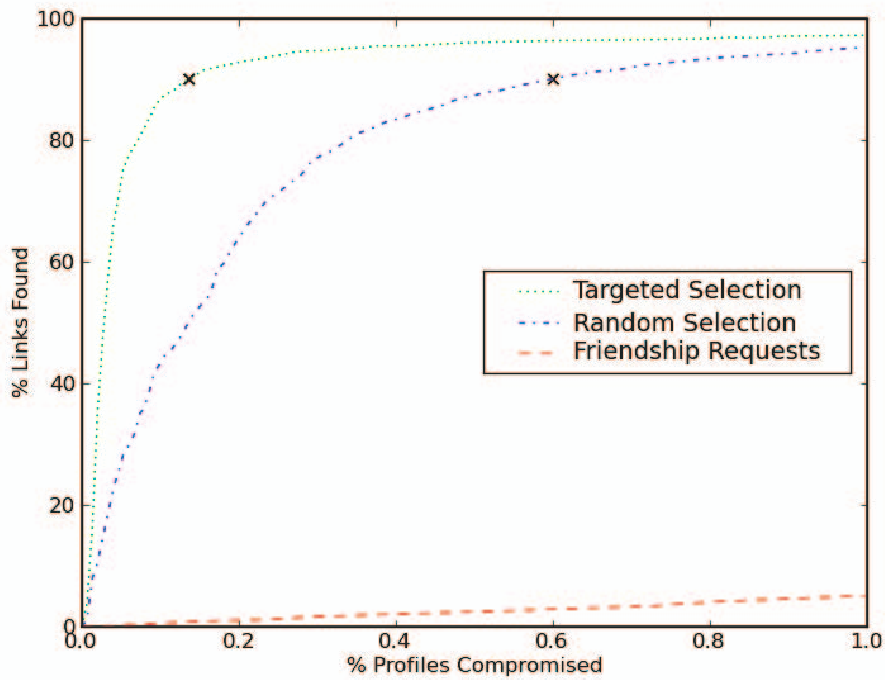 Figure 1 & 3: Comparison of profile and link discovery under "Friends-only" vs "Friend-of-Friend" settings.
The Cost Table
| Attack Scenario | Compromise needed for 90% of Links |
|---|---|
| Targeted Compromise (FoF) | 0.01% |
| Random Compromise (FoF) | 0.03% |
| False Friend Requests (FoF) | 0.14% |
Critical Analysis & Conclusion
The genius of this paper lies in proving that privacy is not an individual choice. Even if you have the strictest privacy settings (Friends-only), if your friends have "Friend-of-Friend" enabled, your connection to them is leaked to any adversary who compromises any of their other friends.
Limitations: The study was conducted in a specific era of Facebook's API. Modern "walled gardens" have since implemented more aggressive rate-limiting and removed FQL. However, the mathematical reality of graph traversal remains: social networks are "small worlds," and short path lengths mean that data remains vulnerable to any actor with even a tiny foothold.
Takeaway: To secure a social network, "limiting access" isn't enough. Platforms must eliminate the structural "lookahead" (friend-of-friend) and stop treating public listings as a default state. For the user, the lesson is simple: visibility is the price of connectivity.