
PS-LSTM: Solving the "New City" Dilemma in POI Recommendation
PS-LSTM:Popularity Analysis And Social Network For Point-Of-Interest Recommendation In Previously Unvisited Locations
This paper introduces PS-LSTM, a deep learning framework designed for Point-of-Interest (POI) recommendation in previously unvisited locations (e.g., traveling to a new city). It integrates spatiotemporal check-in sequences via LSTM, an attention-based social network module, and a dynamic popularity influence mechanism to achieve state-of-the-art accuracy on the Yelp dataset.
TL;DR
When you travel to a new city, your Netflix-style recommendation history is useless because you haven't visited any local spots yet. PS-LSTM solves this "unvisited location" problem by combining your global social ties with dynamic popularity analysis—calculating how popular a place is right now and how far it is from you—all processed through a sophisticated spatiotemporal LSTM network.
The "Cold Start" in Unfamiliar Territory
Most POI recommendation models rely on your historical patterns in your hometown. But what happens when you land in Las Vegas for a business trip?
- Data Sparsity: You have zero check-ins in the new city.
- Static Popularity Bias: Traditional models might suggest a famous bar at 10 AM or a breakfast spot at 9 PM.
- Social Noise: Not all your friends have the same taste; their "must-see" list might not match your preferences.
The authors of PS-LSTM argue that we need a model that transitions from "who you are" (history) to "where you are and what’s hot" (dynamic context).
Methodology: The Three Pillars of PS-LSTM
The architecture is a hybrid neural network that merges three distinct feature streams into a unified Multi-Layer Perceptron (MLP).
1. Dynamic Popularity Influence
Instead of treating a POI’s popularity as a static score, PS-LSTM calculates a Dynamic Popularity Influence Vector.
- Temporal Slotting: The day is divided into 3-hour blocks (e.g., 9:00-12:00).
- Distance Decay: A popular spot 50 miles away is less relevant than a moderately popular spot 5 blocks away. The model uses a power-law distance function to weigh popularity.
2. Attention-Based Social Impact
The model acknowledges that you trust some friends more than others. By decomposing user check-in matrices from your home city, the model learns your "interest representation." It then uses an Attention Mechanism to give more weight to friends whose interests align with yours when looking at their B-city check-ins.
3. Spatiotemporal Sequence Modeling
The core of the sequence module is an LSTM that embeds POI IDs, coordinates, and timestamps. It uses an attention layer to selectively focus on relevant past behaviors, ensuring the "last check-in" has a stronger influence on the next prediction.
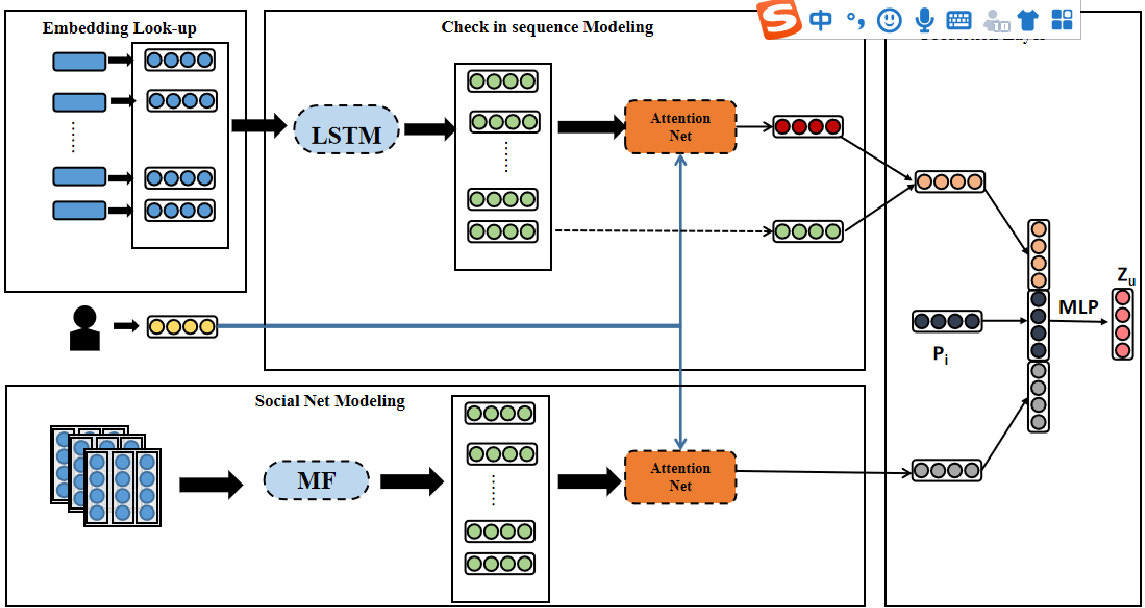 Figure 1: The PS-LSTM Framework, showing the fusion of Social, Popularity, and Sequence modules.
Experimental Insights
The model was tested using Yelp dataset records for Phoenix and Las Vegas.
- The MLP Depth Matters: The researchers found that increasing the MLP layers typically improves the model's ability to capture non-linear interactions between social and popularity cues. Performance peaked at 3 layers, providing the best trade-off between feature interaction and generalization.
- Social Limitation: Interestingly, the study noted that social information had a smaller impact than expected. Why? Because most users have very few friends who have also visited the specific new city being tested, highlighting why the "Popularity" module is the true hero of this paper.
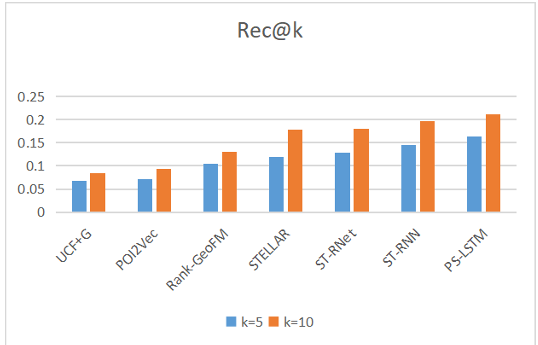 Figure 2: Performance comparison showing PS-LSTM outperforming baselines like ST-RNN and STELLAR across Precision and Recall metrics.
Critical Analysis & Conclusion
Takeaway
PS-LSTM successfully bridges the gap between personalized history and environmental context. By making popularity "dynamic" (time + distance), it mimics how humans actually choose locations when traveling.
Limitations & Future Work
The primary bottleneck remains the social data sparsity. While the attention mechanism is elegant, it lacks utility if the social graph is empty for the target city. Future research could investigate Cross-Domain Recommendation, perhaps using NLP to analyze POI reviews to better match user "vibe" preferences when hard check-in data is missing.
Final Thought: This work highlights that in the world of mobility, "the crowd" (popularity) is often a better compass than "the self" (history) when exploring the unknown.