
Secure Social Discovery: Balancing Privacy and Performance in Mobile Networks
Pseudo Anonymous and Hidden Attribute Comparison Based on Quick Friend Matching in Mobile Social Networks
The paper introduces a dual-authentication privacy-preserving matching scheme for Mobile Social Networks (MSN). It utilizes a Trusted Third Party (TTP) to perform efficient profile matching through a combination of one-way hash functions, asymmetric encryption, and symmetric key agreement to find potential friends with similar interests.
TL;DR
This paper presents a novel framework for privacy-preserving friend discovery in Mobile Social Networks (MSN). By combining identity authentication with key agreement and offloading intensive computations to a Trusted Third Party (TTP), the authors achieve robust protection against identity fraud and eavesdropping while maintaining high computational efficiency suitable for mobile devices.
Contextual Positioning
In the MSN landscape, "Profile Matching" is the engine of social discovery. However, the trade-off has always been academic: Privacy vs. Efficiency. While decentralized (TTP-free) methods offer autonomy, they drain mobile batteries. This work positions itself as an optimized TTP-based solution that specifically addresses the security gaps (Identity Fraud/Replay Attacks) that prior TTP-based works neglected.
Deep Dive: The Problem & Motivation
Most existing friend-matching protocols focus on the matching logic (e.g., how many interests Alice and Bob share) but ignore the authentication of the entities involved.
- The Vulnerability: Without identity access control, a malicious user can forge attributes or perform a "Sybil attack" to harvest others' data.
- The Insight: The authors realized that by using one-way hash functions, the TTP can perform the intersection of interest sets without ever seeing the raw text of the interests. Furthermore, by integrating Diffie-Hellman-based key sharing, the final friendship confirmation remains private between the two users.
Methodology: The Dual-Authentication Core
The architecture relies on a structured four-phase process:
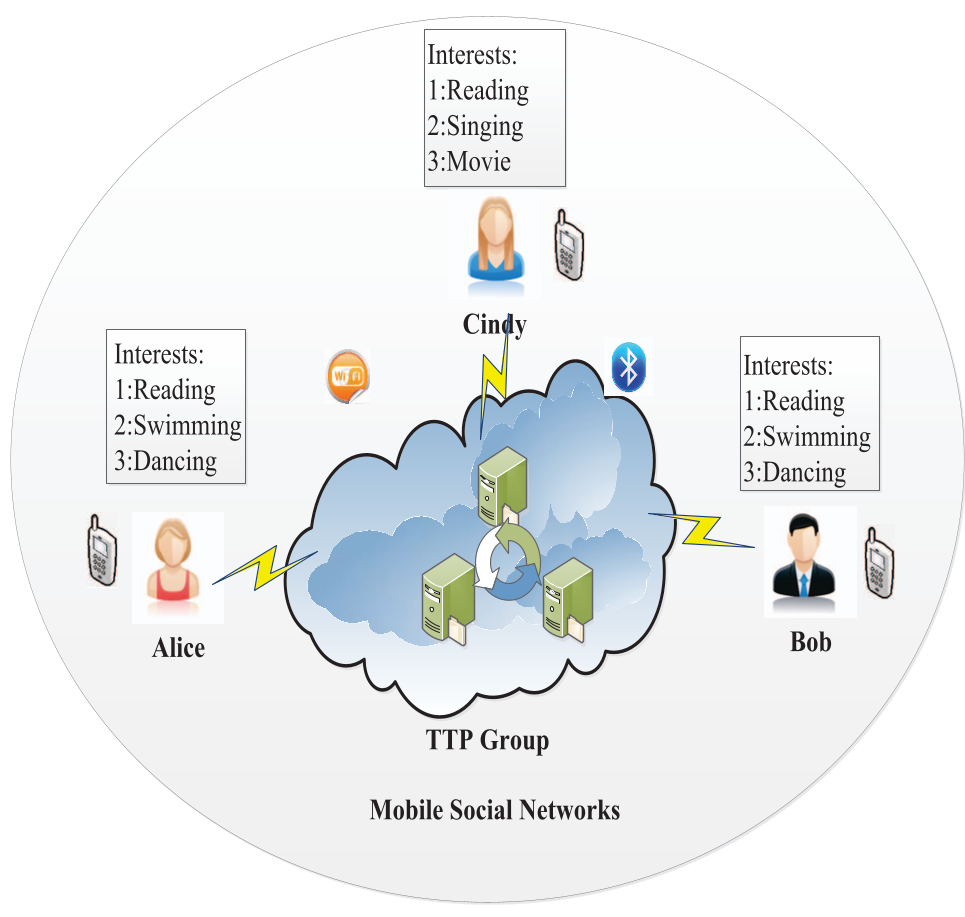
1. Model Architecture
The system involves three primary entities: the Initiator (Alice), the Responder (Bob), and the TTP.
2. The Technical Workflow
- Pseudo-Anonymity: Users register with the TTP and receive unique identity tokens. During matching, Alice generates a temporary "Anonymous Identity" () using XOR operations with a shared key component.
- Hash-Based Matching: Instead of sending interest "Skiing," Alice sends . The TTP calculates the intersection of these hashes, maintaining zero-knowledge of the actual hobbies.
- Two-Way Authentication: In the final phase, Bob recovers Alice's real ID only if he has the correct shared key material, effectively eliminating Middleperson attacks.
Performance & Experiments
The core achievement of this paper is the reduction of terminal workload. By utilizing symmetric encryption for the bulk of communication after the initial handshake, the protocol outperforms existing standards like WAS and Fine-grained schemes.
Performance Comparison
| Metric | WAS [9] | Fine-grained [8] | Proposed Protocol |
|---|---|---|---|
| Offline Computation | (Hash only) | ||
| Online Computation | |||
| Communication Cost | High (1024-bit fixed) | Moderate (2048-bit) | Low (Variable -bit) |
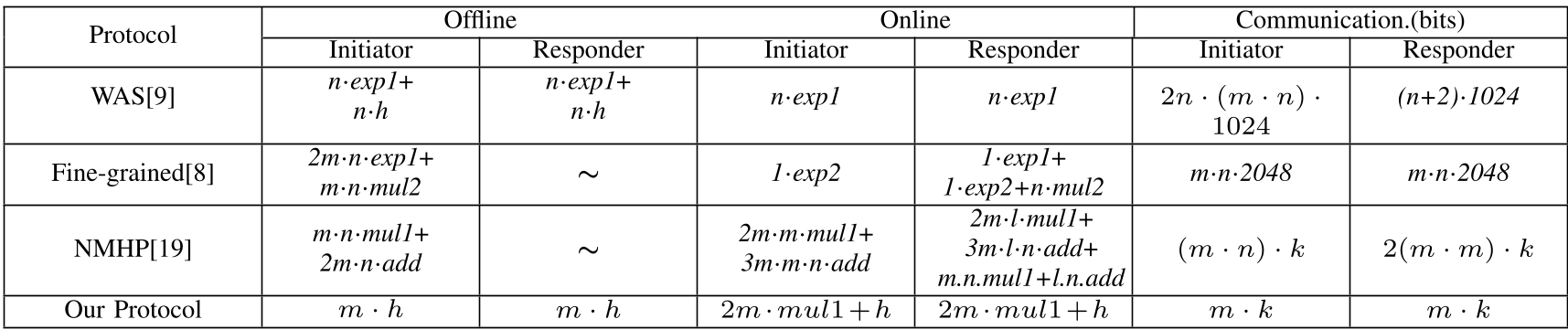
The simulation data confirms that the reliance on modular addition and hash functions rather than complex exponentiation leads to a lighter footprint on intelligent terminals.
Critical Analysis & Conclusion
Takeaway
The paper successfully bridges the gap between high-security cryptographic theory and the practical constraints of mobile devices. Its main strength lies in the dual-authentication mechanism, ensuring that even if an attacker intercepts a message, they cannot impersonate a user or decrypt the profile attributes.
Limitations
- The TTP Bottleneck: While the TTP is considered "Honest-but-Curious," a total compromise of the TTP's master keys could still pose a risk, although the one-way hash protects raw data.
- Attribute Simplicity: The current model assumes simple string/hash matching; it does not yet account for semantic similarity (e.g., matching "Cinema" with "Movies").
Future Outlook
This approach serves as a baseline for future MSN discovery protocols, potentially integrating Homomorphic Encryption or Trusted Execution Environments (TEEs) like Intel SGX to further secure the TTP processing phase.