
Pseudo-Bimodal Networks: Clarifying the Noise in Twitter Political Polarization
Pseudo-bimodal community detection in Twitter-based networks
This paper introduces BIMODCOMM, a novel community detection method that treats Twitter communication networks as "pseudo-bimodal" by separating influential "top" users from "regular" users. By projecting this bipartite structure onto unimodal graphs, the approach achieves significantly clearer clustering of users based on political stances and topical interests.
TL;DR
Researchers have developed BIMODCOMM, a community detection algorithm that treats Twitter users as two distinct classes: "top" users (agenda setters) and "regular" users (followers). By artificially creating a bipartite graph and projecting it back into a unimodal space, the method uncovers highly distinct political clusters that traditional algorithms often miss.
Context: Why Community Detection Fails in the "Flat" Twitter Graph
In social network analysis, we often treat all nodes as equal. However, Twitter is inherently hierarchical. A politician's tweet is fundamentally different from a random user's retweet. When we analyze these as a flat, unimodal graph, the structural signals of orientation and stance often get buried under the noise of cross-ideological mentions and diverse hashtag usage.
The authors argue that the "noise" comes from the fact that followers of different camps might use the same hashtags for different reasons. The real signal lies in who they listen to—the "top" users.
Methodology: The Pseudo-Bimodal Insight
The core innovation is the Pseudo-Bimodal construction. Since Twitter doesn't provide a natural "two-node-type" structure (like authors and papers), the authors force one by:
- Centrality Sorting: Using measures like PageRank or Betweenness to identify the top nodes ().
- Bipartite Splitting: Removing edges between top users and between regular users, keeping only the cross-tier interactions (mentions/retweets).
- Refined Projection: Applying Newman’s projection to link regular users based on their shared "top" interests, weighted by the uniqueness of those connections.
 The weighting formula for Newman's projection ensures that connecting via a niche "top" user carries more weight than connecting via a ubiquitous one.
Experiments and Results
The authors validated their approach using the DEC24 (Russian protests) and CON (US Elections) datasets. The results were compared against Semi-supervised Label Propagation (LP).
High Modularity Achievement
Across almost all thresholds of , BIMODCOMM produced clusters with significantly higher Modularity (). High modularity indicates a "cleaner" separation, where nodes within a group are densely connected and nodes between groups are sparse.
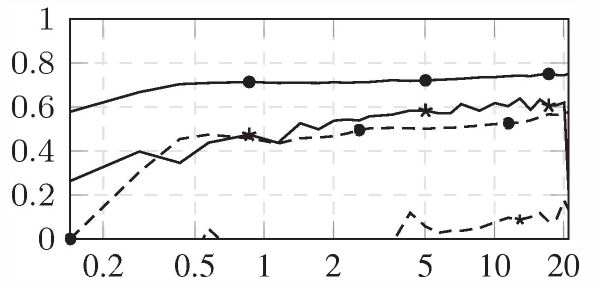 The comparison charts show that while Label Propagation (LP) struggles, BIMODCOMM consistently outperforms the original graph's baseline modularity.
The Best Centrality "Filters"
Not all measures of "importance" are equal. The study found that:
- PageRank and Betweenness are the most robust metrics for identifying the true "agenda setters."
- Indegree can be misleading as it may capture users who are mentioned for negative reasons rather than genuine followership.
Critical Analysis & Conclusion
Takeaway
BIMODCOMM proves that "less is more." By throwing away internal edges (top-to-top and bottom-to-bottom), the algorithm isolates the strongest indicator of user stance: the follower-leader relationship. This has immense utility for tracking political shifts or marketing segments in real-time.
Limitations
The primary challenge is the selection of the threshold . If is too small, the network becomes too sparse; if too large, the "pseudo-bimodal" distinction vanishes as the network returns to a unimodal state.
Future Outlook
As social media platforms move toward more complex recommendation algorithms (like the "For You" feed), the distinction between "creators" and "consumers" will become even sharper. This research provides a mathematical framework to leverage that social stratification for better data science.