
PSG-MAE: Towards a Unified Foundation Model for Robust Multichannel Sleep Event Monitoring
PSG-MAE: Robust Multitask Sleep Event Monitoring using Multichannel PSG Reconstruction and Inter-channel Contrastive Learning
This paper introduces PSG-MAE, a self-supervised pre-training framework based on masked autoencoders for Polysomnography (PSG) signals. It achieves state-of-the-art performance in multitask sleep monitoring, reaching 83.7% accuracy in sleep staging and 90.45% in obstructive sleep apnea (OSA) detection by leveraging multichannel reconstruction and inter-channel contrastive learning.
TL;DR
Current automated sleep monitoring struggles with data scarcity and poor generalization. PSG-MAE addresses this by using a Self-Supervised Learning (SSL) approach on 2,200 nights of unlabeled data. By employing a unique "Complementary Masking" and Inter-Channel Contrastive Learning (ICCL), the model captures deep relationships between different physiological signals (EEG, EOG, Airflow), achieving SOTA performance in both sleep staging (83.7% ACC) and OSA detection (90.45% ACC).
Problem & Motivation: The "Single-Task" Trap
Polysomnography (PSG) is the gold standard for sleep diagnosis, but manual annotation is a nightmare—experts spend 2-3 hours on a single 8-hour recording. While Deep Learning has shown promise, it faces two major hurdles:
- Data Scarcity: Many sleep disorders (like REM behavior disorder) have limited public data, making models fragile.
- Channel Neglect: Most models focus on single-channel (e.g., just EEG) and ignore the rich, synchronized interplay between brain waves, muscle activity, and airflow.
The authors' insight? If we can teach a model to "rebuild" missing pieces of multichannel signals, it will inherently understand the underlying physiology of sleep.
Methodology: The Architecture of Recovery
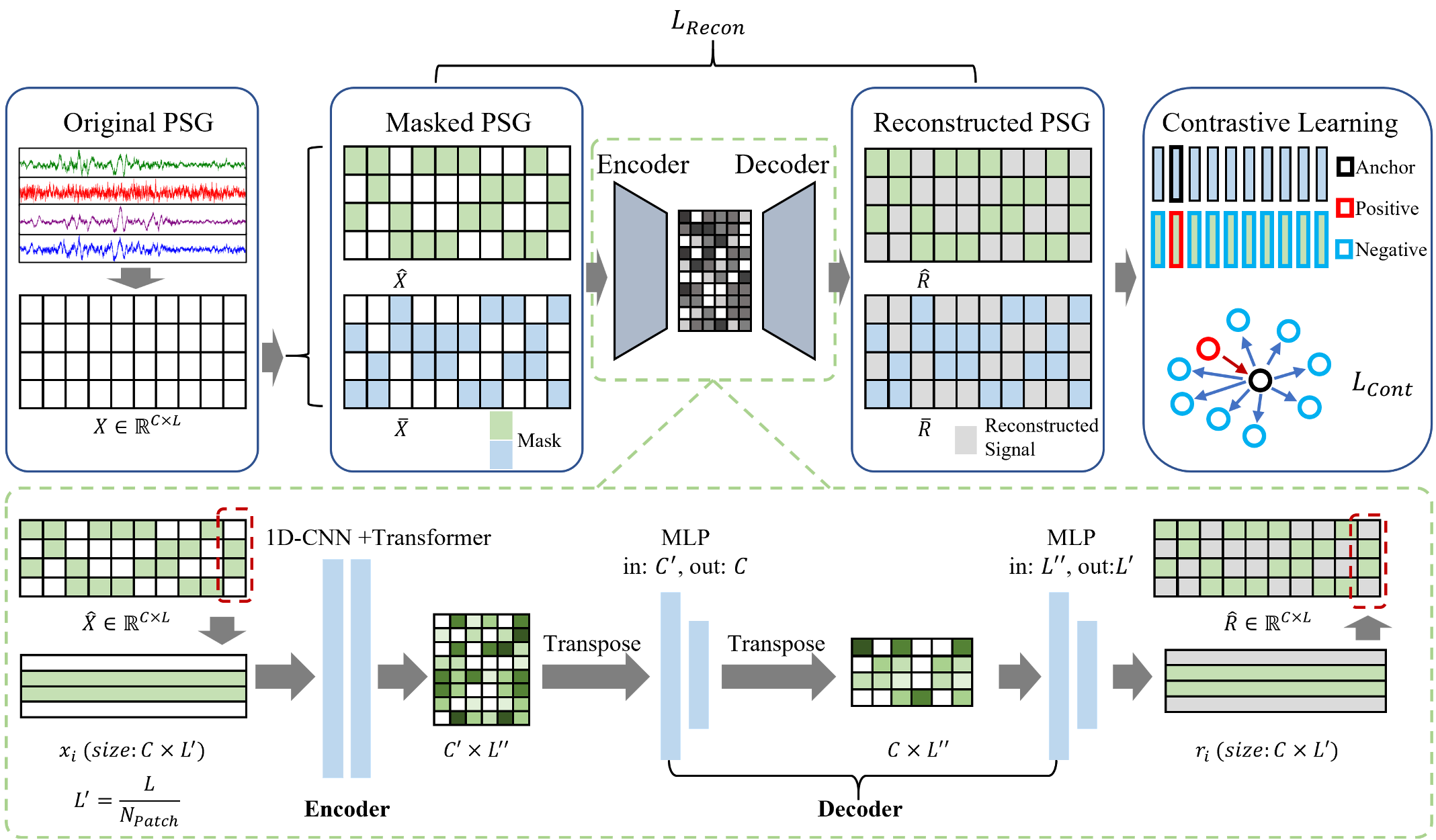
The core of PSG-MAE is the Masked Autoencoder (MAE) architecture adapted for 1D multichannel time-series.
1. Complementary Masking
Unlike standard MAEs that mask random patches, PSG-MAE generates a pair of complementary masks, and . This means if one version of the input "loses" the EEG channel, the other "loses" the EOG channel for that same time window. This forces the shared encoder to learn how to predict one channel's state based on others.
2. Inter-Channel Contrastive Learning (ICCL)
To prevent the model from just learning simple signal smoothing, the authors introduced ICCL. They use a Triplet Loss to ensure that reconstructed signal blocks from the same time frame (but different channels) stay close in the feature space, while blocks from different time segments are pushed apart.
Experiments: Proving Generalization
The model was pre-trained on a massive cross-hospital dataset (SHHS, PSG-audio, and Clinical-PSG) and then fine-tuned on two distinct tasks.
Sleep Staging (Multiclass)
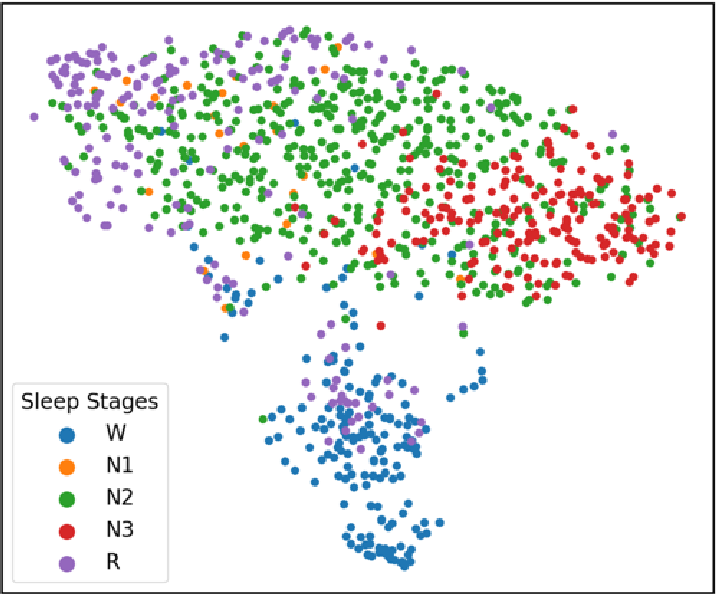
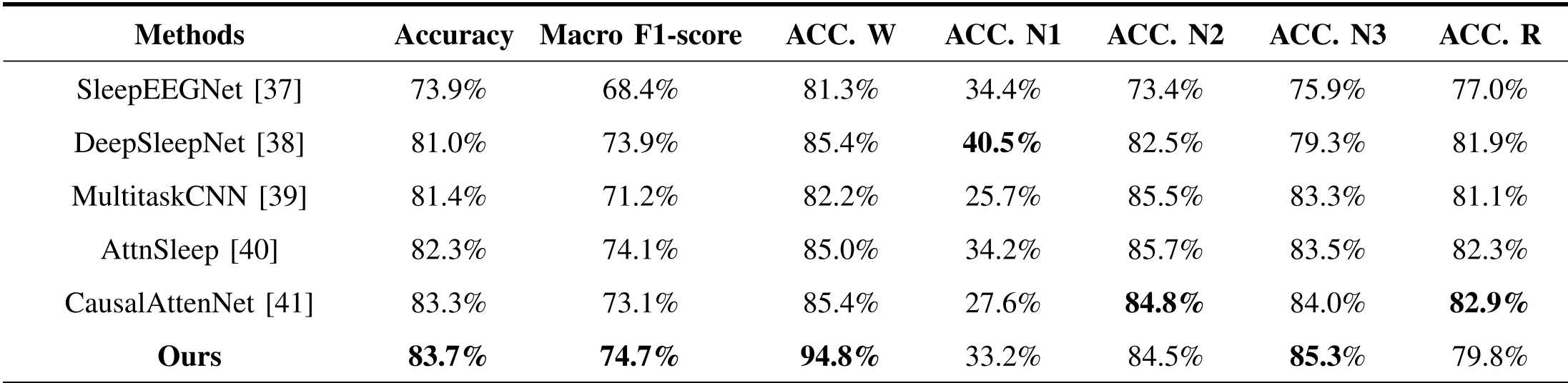
PSG-MAE achieved an accuracy of 83.7%, particularly excelling in the "Wake" and "N3" (Deep Sleep) stages. The visualization below shows how the encoder's features naturally cluster into sleep stages after fine-tuning.
OSA Detection (Binary)
Even with imbalanced data (apnea events are rare), PSG-MAE reached a 90.45% accuracy. It significantly outperformed standard 1D-CNNs and classical Machine Learning (RF/SVM), highlighting the value of the pre-trained feature extractor.
Critical Analysis & Conclusion
Takeaway: The real innovation here is not just the MAE, but the Inter-Channel Contrastive Learning. It solves the "noise" problem in PSG data—when the EMG (muscle) channel is messy, the model uses EEG/EOG correlations to "clean" the signal and maintain accuracy.
Limitations: The model still struggles with the N1 stage (a transition stage known for being difficult even for humans). Future work needs better data augmentation specifically for these minority classes.
In summary, PSG-MAE moves us closer to a "Foundation Model" for sleep medicine—one encoder that, once trained, can be adapted to any sleep-related diagnostic task with minimal labeled data.