
PsRec: Revolutionizing Social Recommendation by "Filling the Gaps" with Pseudo Ratings
Psrec: social recommendation with pseudo ratings
PsRec is a novel social recommendation model that utilizes trust networks to address data sparsity and cold start issues. Unlike traditional methods that use social data as regularizers, PsRec densifies the rating matrix by injecting "pseudo ratings" derived from friends' preferences, achieving state-of-the-art accuracy on Ciao and Epinions datasets.
TL;DR
PsRec (Pseudo-rating Social Recommendation) shifts the paradigm of social recommendation from simple regularization to active data densification. By intelligently predicting and injecting "pseudo ratings" derived from a user's social circle, it significantly mitigates the perennial issues of data sparsity and cold start, outperforming established baselines like TrustSVD.
The "Regularization" Bottleneck
In the world of Collaborative Filtering, data is gold. But the "rating matrix" is usually 99% empty. Most researchers solve this by adding social constraints—basically telling the model, "Hey, User A and User B are friends, so their latent feature vectors should be close."
While effective, this approach is passive. It only optimizes the parameters within the confines of the sparse data already provided. PsRec asks a more ambitious question: If a user hasn't rated an item, can we use their friends' behavior to synthesize a likely rating and use it as training material?
Methodology: The Art of Pseudo Ratings
PsRec is built on a fundamental social intuition: You tend to agree with your friends if most of them share the same opinion on something.
1. The Distance Function
To implement this, the authors track two critical variables:
- (Trust Density): How many of my friends have rated this item?
- (Taste Variance): Do my friends agree with each other on this item?
The core assumption is that the distance between your "true" rating and your friends' "average" rating is a function of and . The authors use a specialized Neural Network (based on Dugas's work) to model this, ensuring it respects physical constraints (e.g., as more friends agree, the distance to the average rating likely decreases).
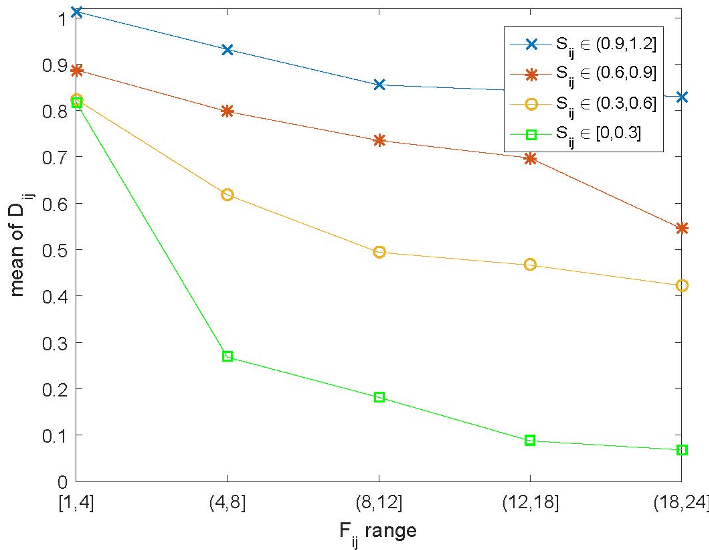 Figure 1: Validation of the assumption. As friends' agreement (low S) and frequency (high F) increase, the deviation from the average rating (D) decreases.
2. Weighted Matrix Factorization
Not all ratings are created equal. PsRec assigns:
- Weight 1.0 to actual user ratings.
- Weight to pseudo ratings.
This ensures the model learns from social inferences without being overwhelmed by the noise inherent in synthesized data.
Solving the Cold Start Dilemma
Cold start users (those with <5 ratings) are the bane of recommendation engines. PsRec handles them by lowering the bar. It injects more pseudo ratings for cold start users, even if the confidence is slightly lower. This is a classic "Bias-Variance Tradeoff": while the injected ratings might be slightly biased, they drastically reduce the variance of the model's predictions for users about whom it otherwise knows nothing.
Experimental Performance
The model was tested on Ciao and Epinions, two industry-standard datasets for social recommendation.
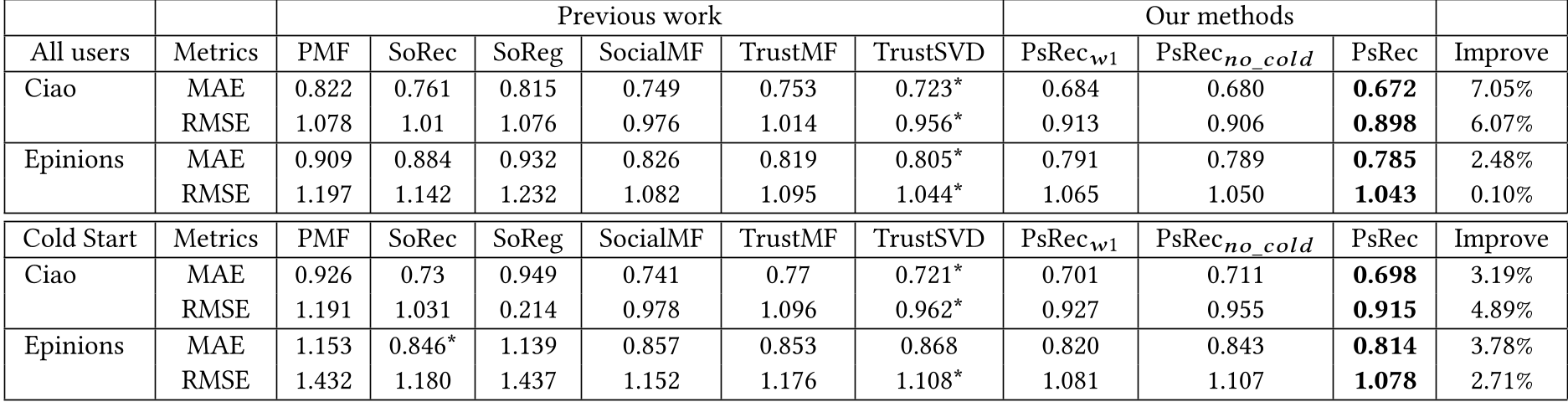 Table 1: PsRec vs. SOTA. Note the consistent leadership in both MAE and RMSE metrics.
Key Results:
- All Users: PsRec achieved a 7.05% improvement in MAE on the Ciao dataset compared to the best baseline.
- Cold Start: The "looser threshold" strategy for new users proved highly effective, beating competing models consistently.
- Ablation: The variant
PsRec_w1(which treated all ratings as equal weight) performed worse, proving that the confidence-based weighting is essential for stability.
Critical Insight & Future Outlook
PsRec proves that Data Augmentation is just as viable in recommendation systems as it is in Computer Vision. Instead of just "fixing the math" of Matrix Factorization, we can "fix the data" using the auxiliary signals provided by social networks.
Limitations: The current model uses first-order friends. In the future, utilizing multi-hop social relations (friend-of-a-friend) through Graph Neural Networks could likely refine these pseudo-ratings even further. Furthermore, automating the selection of injection thresholds () using Bayesian Optimization would make the system more robust for production environments.
Editor's Note: This paper is a significant milestone for practitioners looking to utilize social graphs not just as metadata, but as a primary source of synthetic training signal.