
Digital Shadows: Unmasking the Psycho-Sociological Profile of ISIS Patronizers on Twitter
10818_Understanding Psycho-Sociological Vulnerability of ISIS Patronizers in Twitter.
This paper presents a computational framework to identify the psycho-sociological profiles of ISIS patronizers on Twitter. By developing five classifiers (Personality, Values, Optimism, Age, and Gender) and applying network centrality measures, the authors identify key traits—such as high neuroticism, power orientation, and pessimism—that distinguish extremist sympathizers from general users.
Executive Summary
TL;DR: This research moves beyond simple keyword tracking to analyze the "mental DNA" of online extremism. By classifying 88,000 Twitter users based on personality, values, and network influence, the authors uncover that ISIS patronizers are not just random followers—they share a specific psychological signature characterized by high neuroticism, a hunger for power, and systemic pessimism.
Academic Positioning: This work bridges the gap between Social Network Analysis (SNA) and Psycholinguistics. It transitions the study of radicalization from "what they say" to "who they are," providing a data-driven foundation for what the authors call the Social Vulnerability Index (SoVI).
The "Why" Behind the Radicalization
Previous attempts to curb online recruitment often focused on surface-level metrics: which hashtags are trending or which accounts have the most followers. However, these methods fail to capture the vulnerability of the individual.
The authors argue that an individual's behavior is a product of their psycho-sociological background. To understand why someone is lured into a militant organization, we must analyze their intrinsic motivations—their ethics, their outlook on life (optimism vs. pessimism), and their personality traits (the "Big Five").
Methodology: Building the Psychological Mirror
The research team constructed five distinct classification models, leveraging various psycholinguistic features (LIWC, MRC, NRC Lexicons) and syntactic patterns.
The Five Pillars of Vulnerability:
- Personality: Detecting Openness, Conscientiousness, Extroversion, Agreeableness, and Neuroticism (Big Five).
- Values & Ethics: Mapping users to the Schwartz theory of basic human values (Universalism, Achievement, Power, etc.).
- Optimism/Pessimism: Assessing the general life outlook reflected in content.
- Age & Gender: Demographic profiling through linguistic cues.
Model Performance
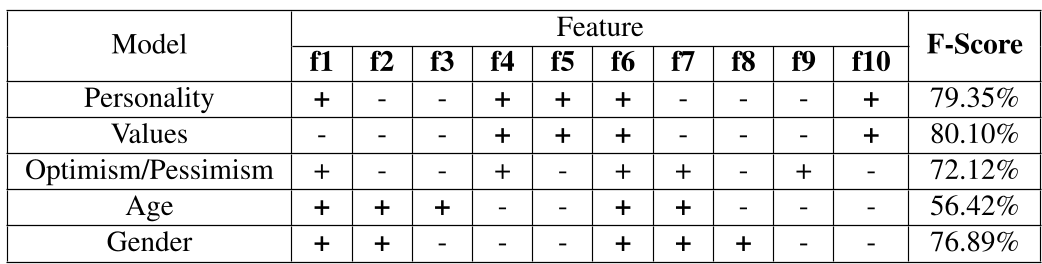
As shown in the table below, the models achieved high F-scores, particularly in Personality (79.35%) and Values (80.10%), outperforming or matching existing state-of-the-art (SOTA) benchmarks:
Insights from the Extremist Network
By comparing the ISIS-associated network to a random sample of 20,000 users, the researchers found stark differences that define the "extremist persona."
Key Findings:
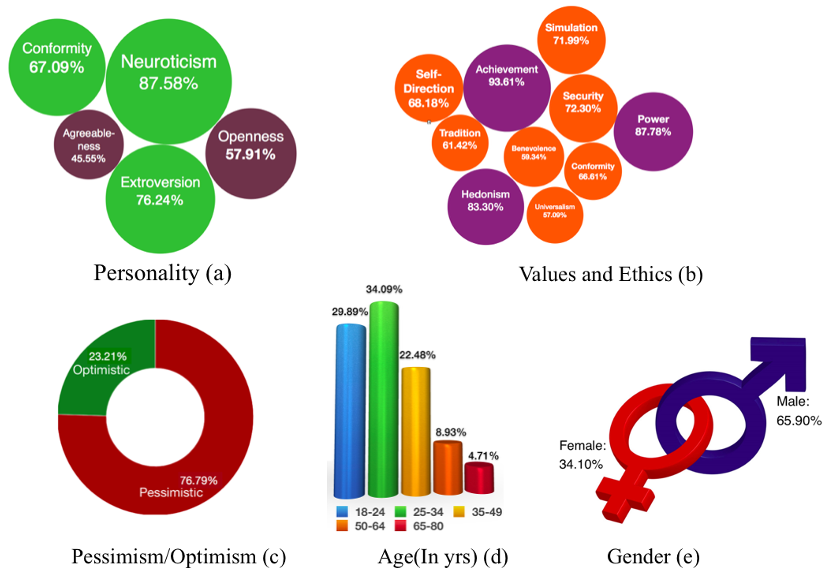
- Neuroticism is a Red Flag: A staggering 87.58% of the ISIS network scored high on Neuroticism, characterized by emotional instability and anxiety, compared to a much more balanced distribution in the random sample.
- The Power Triad: Patronizers were predominantly Achievement-oriented (93.61%), Power-oriented (87.78%), and Hedonic (83.30%). This suggests a rebellious profile seeking status and gratification through defiance.
- The Gender Gap: The organization remains heavily androcentric, with 65.90% identified as male.
- Pessimism as a Driver: 76.79% of users were pessimistic, likely fueled by the constant consumption and sharing of "wrongdoings" and grievance-based content.
Network Centrality: The "Influencer" Profile
The study applied Betweenness Centrality (nodes that act as bridges) and Eigenvector Centrality (nodes connected to other influential nodes).
An interesting discovery occurred when analyzing high-centrality nodes: The official BBC News Twitter account was identified as a central hub (likely due to everyone following/mentioning it). Interestingly, the classifier (which is automated and focused on linguistic style) predicted BBC News to be an "optimistic young woman"—a quirk that highlights the difference between institutional branding and human personal accounts, but also reveals how "unobtrusive" nodes can sit at the center of radical networks.
For the true patronizers, those with high Betweenness Centrality displayed the most "strident" extremist traits—even higher levels of power-seeking and neuroticism than the peripheral members of the network.
Critical Analysis & Conclusion
Takeaway
The study successfully proves that there is a quantifiable psychological profile associated with extremist sympathy. This moves the conversation from reactive censorship to proactive identification of vulnerable individuals.
Limitations
The age and gender classifiers, while comparable to the state-of-the-art, show lower F-scores (56-76%) than the personality/value models. Identifying age on social media remains notoriously difficult due to slang evolution and "age-masking" behaviors. Furthermore, the reliance on a seed list from @CtrlSec may introduce a selection bias toward the most vocal or "clumsy" extremists, potentially missing the more sophisticated, "quiet" radicalization agents.
Future Outlook
The proposed Social Vulnerability Index (SoVI) could become a vital tool for social media platforms to trigger "counter-narrative" interventions. Instead of just banning accounts, platforms could direct resources and support toward users who score high on the vulnerability index before they are fully radicalized.