
The Architecture of Addiction: Why Personality Trump Demographics in Social Media Use
Psychological predictors of addictive social networking sites use: The case of Serbia
This study investigates the psychological and socio-demographic predictors of addictive Social Networking Site (SNS) use through a representative sample of 2,014 Serbian users. Using path analysis, the research identifies low self-esteem, introversion, and low self-efficacy as the primary drivers of addictive tendencies, supporting the "social compensation hypothesis."
TL;DR
Is social media addiction a product of our environment or our internal wiring? A large-scale representative study from Serbia (N=2014) reveals that personality traits—specifically low self-esteem, introversion, and low self-efficacy—are significantly more potent predictors of addictive SNS use than age, gender, or even traditional media consumption. The findings provide strong empirical support for the Social Compensation Hypothesis.
Problem & Motivation: Beyond the Digital Native Myth
In the early days of the internet, "addicts" were often stereotyped as technologically sophisticated, highly educated males. However, as SNS penetration rates have skyrocketed (reaching 43.3% in Serbia, exceeding the European average), the profile of the "at-risk" user has shifted.
The core tension in current research lies between two competing theories:
- The "Rich Get Richer" Hypothesis: Extraverts use SNS to amplify their existing social success.
- The "Social Compensation" Hypothesis: Introverts and those with low self-esteem use virtual worlds to compensate for what they lack in real-life social capital.
This paper aims to settle this debate by moving beyond small, convenient student samples to a robust, representative national population.
Methodology: Mapping the Psychological Path
The researchers constructed four competing path analysis models to determine the most accurate predictor of addictive SNS use. They measured:
- Self-Esteem: Using the Rosenberg 10-item scale.
- Extraversion: A subscale of the Big Five Inventory (BFI).
- General Self-Efficacy: A measure of a person's belief in their ability to execute life plans.
- Addiction Metrics: Measuring interference with life activities (e.g., sleep loss) and the domination of virtual over real relationships.
 Table 5: Different model fit indices showing that Model C (Psychological + Media) outperformed exhaustive models including demographics.
The Core Finding: The Dominance of Internal Traits
The results were striking. Socio-demographic variables (age, gender, urban/rural) were weak predictors. Instead, the "Best Fit" model (Model C) showed that psychological traits reigned supreme.
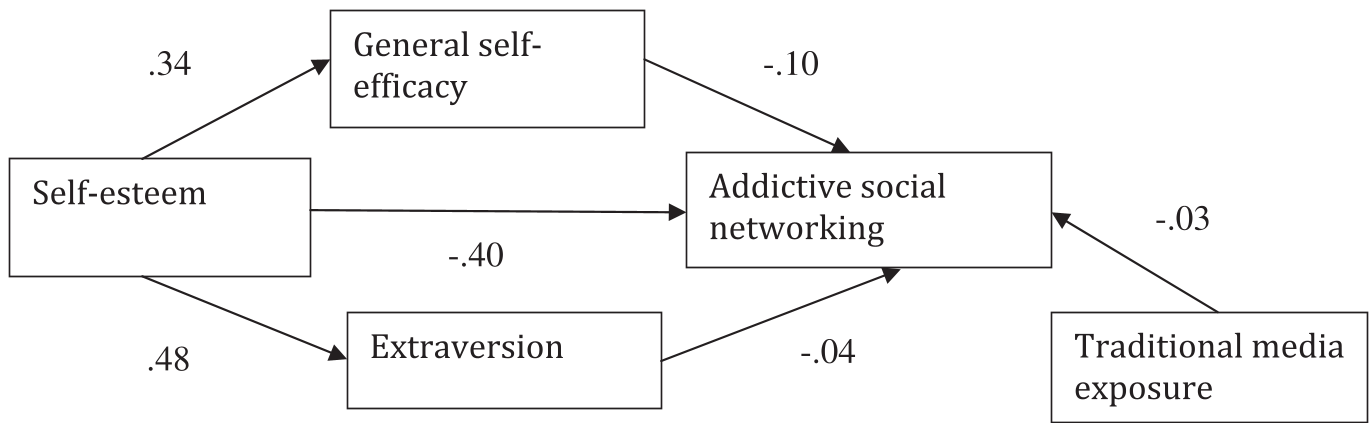 Fig 2: The structural path showing how Self-Esteem serves as the primary driver, influencing addiction both directly and through its effect on Extraversion and Self-Efficacy.
Key insights from the path analysis:
- Direct Impact: Low self-esteem has the strongest direct correlation (r = -0.35) with addictive tendencies.
- The Mediator: General Self-Efficacy acts as a critical link. Those who feel less capable of managing their real-life plans are more likely to seek refuge—and lose control—within social networks.
- Introversion vs. Extraversion: Higher introversion was consistently linked to addictive patterns, reinforcing the idea that digital platforms serve as a "crutch" for those who find face-to-face interaction taxing.
Experimental Results & Interpretation
Despite the high penetration of Facebook in Serbia, the study found a low incidence (3.2%) of high addictive tendencies. Most users handle SNS as a functional tool. However, for the small group that does struggle, the indicators were clear:
- Sleep Deprivation: This was the most commonly reported negative impact.
- Virtual Over Real: Scores were lowest for the item "I have better time with people I met online than in person," suggesting that even for addicts, the virtual world is often an unsatisfactory substitute.
 Table 2: Breakdown of factor loadings for addiction indicators, highlighting sleep interference and performance deterioration.
Critical Insight & Future Outlook
The study concludes that SNS is a neutral tool that amplifies existing psychological predispositions. For the well-adjusted, it is a "social enhancer." For the vulnerable (low self-esteem, low self-efficacy), it becomes a mechanism for "social compensation" that easily slips into addiction.
Limitations: The study relies on self-reported data. As the authors note, people often underestimate their own addictive behaviors compared to objective screen-time tracking.
Future Directions: As algorithms become more "persuasive" (e.g., AI-driven feeds), the burden of resilience falls increasingly on the user's psychological state. Future research must examine whether modern AI-driven platforms exacerbate these tendencies in introverted users more aggressively than the Facebook-era platforms studied here.