
GFCM-OCS: Bridging Psychology and Soft Computing for Reliable Mental Diagnosis
Psychology with soft computing: An integrated approach and its applications
The paper introduces GFCM-OCS (Genetic Fuzzy C-Means with Optimal Completion Strategy), an integrated soft computing framework for the automatic diagnosis of mental retardation levels. By hybridizing Genetic Algorithms (GAs) for feature selection and parameter optimization with Fuzzy C-Means (FCM) for robust classification and data imputation, the method achieves SOTA performance in clinical psychological assessment.
TL;DR
Diagnosis of mental retardation is often hindered by the complexity of psychometric scales and the high prevalence of missing data. This paper presents GFCM-OCS, a hybrid algorithm that combines Genetic Algorithms (GA) and Fuzzy C-Means (FCM). It doesn't just classify patients; it intelligently fills in missing test scores and selects the most relevant psychological subtests to reduce clinical workload by up to 66%.
Background: The "Floor Effect" and Uncertainty
In clinical psychology, measuring intelligence in mentally retarded individuals using standardized Wechsler scales (WAIS-R/WISC-R) often results in a "floor effect"—where scores cluster at the bottom range, making differentiation difficult. Traditional "hard" classification ignores the nuances of these borderline cases. Furthermore, clinical records are rarely complete. The authors recognize that Fuzzy Logic is perfectly suited for this domain because it quantifies the "degree of truth" in a diagnosis rather than forcing a binary label.
Methodology: The GFCM-OCS Framework
The core of the approach is the Genetic Fuzzy C-Means (GFCM). It operates as a feedback-controlled system where the GA acts as the "optimizer" for the FCM "classifier."
1. Feature Selection and Weighting
Instead of a simple "yes/no" selection for subtests (like vocabulary or arithmetic), the GA assigns real-valued weights to each feature. This allows the model to prioritize subtests that carry the most diagnostic weight for specific pathologies.
2. Handling Missing Data (OCS)
The Optimal Completion Strategy (OCS) treats missing values not as static averages, but as variables to be optimized during the clustering process. It estimates missing scores by looking at the patient's membership in fuzzy clusters and the centroids of those clusters.
3. Achieving "Consistency"
A diagnosis is useless if it is not reliable. The authors incorporate the Xie-Beni Index into the fitness function to ensure that the resulting clusters are both compact and well-separated.
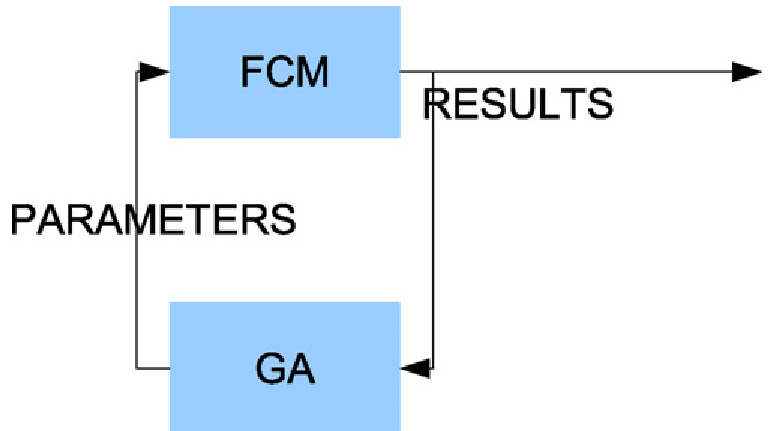 Figure 1: The feedback loop between Genetic Algorithms and FCM for parameter tuning.
Experimental Results: Better, Faster Diagnosis
The authors tested their method on a real-world database from the IRCCS Oasi of Troina, including 187 adults and 261 children.
- Classification Accuracy: On the adult dataset, GFCM reached an accuracy of 86%, beating established methods like Discriminant Analysis and C5.0.
- Imputation Superiority: In pediatric cases, even when other classifiers used the data completed by GFCM-OCS, their accuracy improved, proving that the OCS mechanism provides a more "psychologically accurate" estimation than standard EM algorithms.
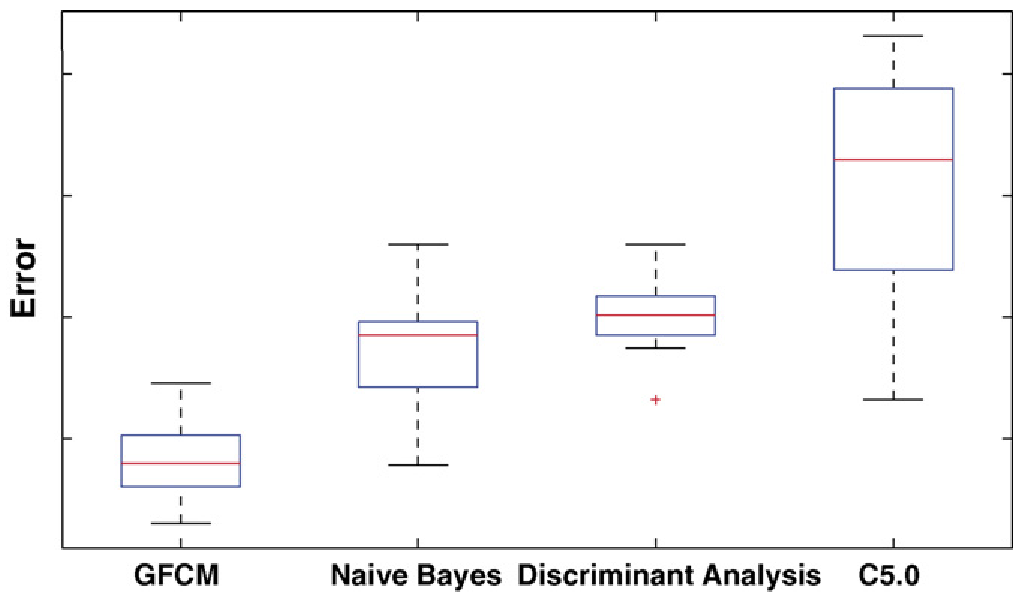 Figure 2: Performance comparison showing GFCM's lower error rate compared to Naive Bayes and C5.0.
Deep Insight: Why it Works
The "secret sauce" lies in the synergy between global search and local refinement. The GA explores the complex, non-linear space of feature weights and distance metrics (global search), while the FCM handles the specific data structure (local clustering). By evolving a Minkowski distance metric specifically for this data, the model adapts to the unique distribution of psychological "raw scores" rather than relying on standardized norms that might not apply to the retarded population.
Clinical Takeaway
For practitioners, the most significant result is Feature Selection. The study found that by using only 4 key subtests (instead of 11), they could maintain 79% accuracy. This translates to saving over an hour of clinical observation time per patient, allowing for faster intervention and resource allocation.
Conclusion and Future Directions
GFCM-OCS bridge the gap between "black box" AI and interpretable clinical tools. While effective, the current approach relies on a pre-defined number of clusters (retardation levels). Future research could explore evolving the number of clusters (K) automatically to discover new sub-types of developmental disorders.
Original Paper: "Psychology with soft computing: An integrated approach and its applications" by Alessandro G. Di Nuovo et al.