
Beyond Isolated Tweets: Mining Product Features through Conversational Context
Towards Using Public Conversations to Mine Product Features in Twitter
Towards Using Public Conversations to Mine Product Features in Twitter proposes a novel conversation-based framework for extracting product attributes from tweets. The method reconstructs "reply trees" and integrates Anaphora Resolution (AR) to link pronouns to their intended product features, achieving a significant boost in feature mining performance.
TL;DR
Social media monitoring often fails because it looks at tweets in isolation. This paper introduces a conversation-centric approach that reconstructs reply trees and uses Anaphora Resolution (AR) to track what "it" or "this" refers to across multiple messages. By doing so, the authors improved the recall of product feature extraction from 57.96% to over 80%.
The "Context Gap" in Twitter Mining
Most opinion mining tools act like a person reading a book one random sentence at a time. In the world of Twitter, this is a disaster. Consider a reply: "It's great, but the battery dies too fast." Without the parent tweet (e.g., "Just got the new iPhone!"), the system has no idea what "it" is. This is known as the Anaphora Resolution problem.
The authors argue that previous works have overlooked the "conversational aspect" of Twitter, which actually accounts for the vast majority of posts. By ignoring the links between tweets, we ignore the very context that makes sense of the data.
Methodology: The Reply-Tree & Backtracking
The proposed pipeline consists of four distinct stages, designed to turn noisy streams into structured insights.
1. Conversation Reconstruction
Unlike simpler models, this approach builds a User-Based Tree Model. It doesn't just look for direct "@" replies; it uses the in_reply_to_status_id metadata to find the root message and then identifies indirect connections through shared hashtags and URLs, as well as cosine similarity between message contents.
2. Intelligent Filtering
Not all "chatter" is useful. The system filters conversations based on two pillars:
- Content Relevance: Uses the Flesch Readability Formula and average length to ensure the text is informative.
- Social Influence: Measures engagement through retweets, favorites, and the volume of replies.
3. Feature Extraction with Anaphora Resolution
This is the "special sauce" of the paper. After identifying candidate product features (nouns and noun phrases like "battery life"), the system applies a backtracking mechanism.
- If a tweet contains an opinion but no explicit feature, the system looks at the previous tweet in the reply tree.
- It uses the CogNIAC algorithm to resolve pronouns, effectively "binding" the sentiment to a noun found earlier in the conversation.
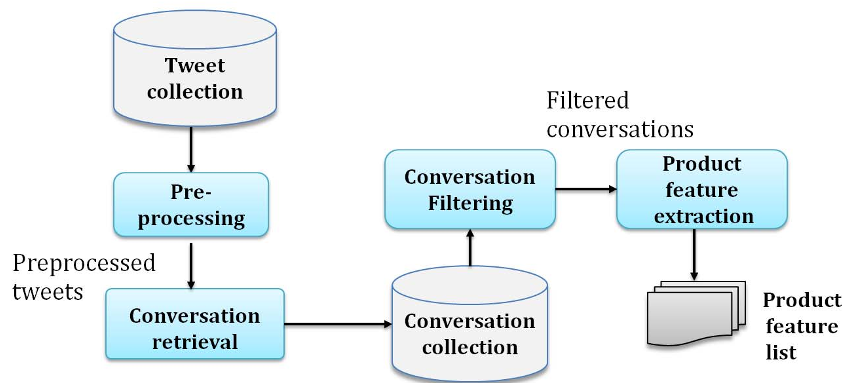 Figure 1: The proposed approach pipeline from raw tweets to feature extraction.
Why It Works: Performance Analysis
The authors tested their system on a dataset of over 200,000 tweets regarding electronics. The results demonstrate a clear "Conversational Advantage":
| Method | Precision | Recall |
|---|---|---|
| Individual Tweet Analysis | 63.44% | 57.96% |
| Conversational Method (This Paper) | 74.90% | 80.03% |
The massive jump in Recall (from 57% to 80%) confirms that a huge portion of user opinions are hidden behind pronouns. By resolving these references, the system "recovers" data that was previously invisible.
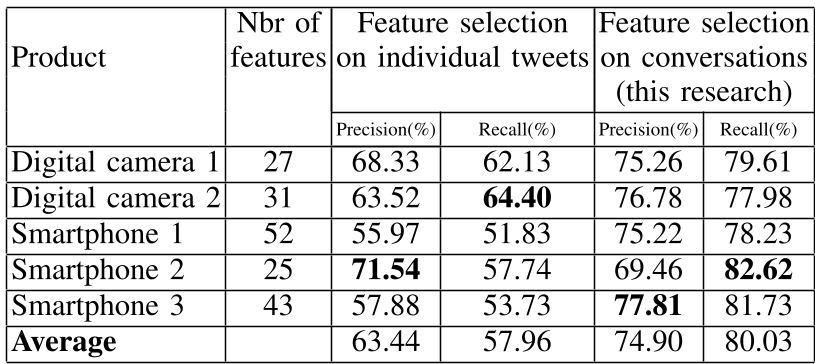 Table: Comparison of feature selection on individual tweets vs. conversations.
Critical Insight & Future Directions
The core philosophy here is that structure implies meaning. While the paper relies on rule-based AR (CogNIAC), which can struggle with complex or ambiguous antecedents, the move from "text mining" to "conversation mining" is a significant paradigm shift.
Limitations:
- Grammar Sensitivity: The system relies on POS tagging. Since Twitter users have... creative... approaches to grammar, the parser sometimes fails.
- Backtracking Depth: Resolving pronouns becomes exponentially harder as conversations grow longer and involve more participants.
Future Outlook: The next logical step is applying Transformer-based models (like BERT or GPT) to these reply trees. LLMs are naturally better at understanding context, and combining the structural "reply tree" logic of this paper with the semantic power of modern AI could essentially solve the feature-linkage problem.
Conclusion
This work serves as a vital reminder for technical architects: before building a complex NLP model, ensure your data ingestion logic respects the natural structure of the source. On social media, that structure is a conversation, not a list.