
Social Rewiring: How Comparison and Network Change Reshape Public Goods
Producing public goods in networks: Some effects of social comparison and endogenous network change
2012-06-06
Summary
Problem
Method
Results
Takeaways
Abstract
This paper investigates the production of public goods in social networks using agent-based simulations. It introduces a model where social comparison transforms a standard n-player Prisoner’s Dilemma into a coordination game, exploring how endogenous network changes affect cooperation across both forward-looking (optimizing) and backward-looking (adaptive) agent models.
## TL;DR
Why do some groups successfully provide public goods while others succumb to free-riding? This paper argues the answer lies not just in who we are, but in **how easily we can change our friends**. By transforming the classic "Prisoner's Dilemma" into a "Coordination Game" via social comparison, the research shows that the ability to effortlessly rewire social ties—rather than rigid group cohesion—is the true engine of sustained cooperation.
## The Social Logic: From Dilemma to Coordination
The traditional **Prisoner's Dilemma** suggests that rational actors will always free-ride on public goods (like a clean office kitchen or a group-funded project) because the individual cost outweighs the individual benefit.
However, the author, Johannes Zschache, introduces **Social Comparison**. Humans don't just value the public good; they value *behavioral confirmation*. If your friends contribute, you feel a psychological "bonus" for doing the same. If you are the only one contributing while your friends free-ride, you feel "punished." This shifts the logic: it becomes a **Coordination Game**. It is no longer about "winning" at the expense of others, but about matching the behavior of your local network.
## Methodology: The Architecture of Choice
The paper employs Agent-Based Modeling (ABM) to test two types of human decision-making:
1. **Forward-Looking Agents**: Myopic optimizers who calculate the best immediate payoff for their next move, assuming others stay the same.
2. **Backward-Looking Agents**: Adaptive learners who look at past payoffs and change their behavior only when they feel "dissatisfied" compared to their neighbors' average wealth.
### The Payoff Mechanism
The utility $u_i$ is defined by the sum of the public good, minus costs, plus the sum of behavioral confirmation from friends.

## Key Insights from Simulations
### 1. The "Rewiring" Paradox
Counter-intuitively, the study finds that **high costs of network change (high cohesion)** are bad for cooperation. When it is expensive to leave a group or drop a friend, cooperators get "stuck" with free-riders who drain their resources and dampen their morale. In contrast, when network update costs $c_2$ are low, cooperators can quickly disconnect from free-riders and find each other, forming "fortresses of cooperation."
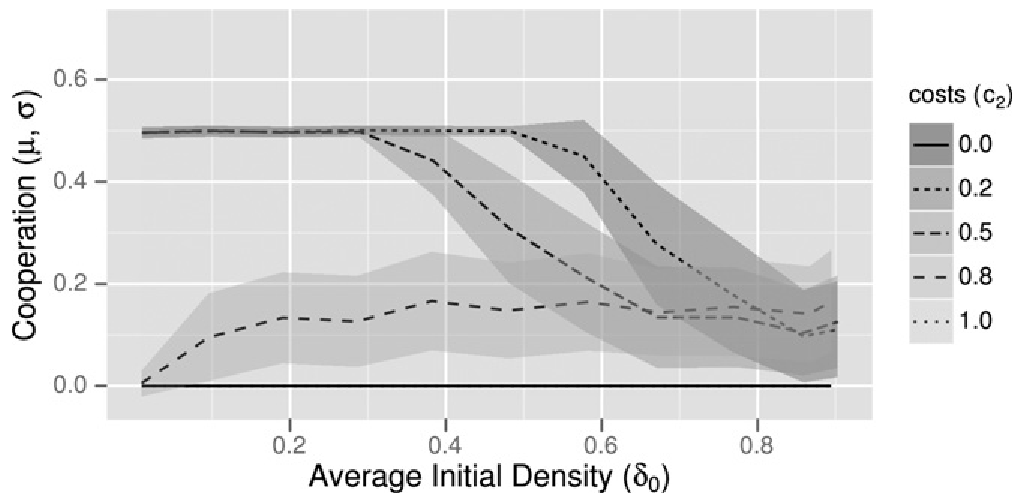
*Fig 1: As density increases, the ability of cooperators to isolate themselves decreases, leading to lower overall cooperation.*
### 2. Strategy Segregation
If a group is already segregated—meaning contributors mostly hang out with contributors—cooperation is highly stable. The study reveals that endogenous network change naturally leads to **complete segregation**. Over time, the network splits into two "bubbles": one where everyone contributes and one where everyone free-rides. Only the existence of update costs prevents this total split.
### 3. Adaptive Learning vs. Optimization
For "backward-looking" learners, the conditions for a successful public good are much steeper. They require an initial "critical mass" (around 70% cooperators) to spark a positive feedback loop. These agents succeed only if they can **change their friends faster than they change their strategies** (Relationship learning rate $l_2 >$ Strategy learning rate $l_1$).
## Critical Analysis: Is "Bubbeling" the Solution?
The paper offers a provocative takeaway: the "echo chambers" or "bubbles" we see in social networks might be the very structures that allow altruistic behaviors to survive. By disconnecting from those who do not share our contribution norms, we protect our internal motivation.
### Limitations
* **Parameter Sensitivity**: The model assumes one unit of behavioral confirmation is exactly equal to one unit of the public good. Changing this ratio could significantly alter the "Coordination Game" threshold.
* **Homophily**: The model assumes friends provide the same level of confirmation regardless of the strength of the relationship or personal history.
## Conclusion
Zschache’s work reminds us that social structure is not a fixed stage but a dynamic participant in collective action. To promote public goods, we should perhaps focus less on "forcing" people to stay in diverse but conflicting groups, and more on enabling the fluid formation of cooperative sub-communities.
**Final Takeaway**: To save the public good, let the cooperators find each other—and let them leave the free-riders behind.