
PPI: Quantifying the Value of Healthcare Datasets through Publication Dynamics
A Publication-Based Popularity Index (PPI) for Healthcare Dataset Ranking
This paper introduces the Publication-based Popularity Index (PPI), a quantitative metric designed to rank healthcare datasets based on their research utility. By integrating citation counts and usage trends from PubMed, the PPI successfully identifies high-value datasets, providing a standardized "goodness" measure for health informatics researchers.
TL;DR
In the world of health informatics, choosing the right dataset is often a shot in the dark. A new study from the University of North Carolina at Charlotte proposes the Publication-based Popularity Index (PPI)— a mathematical framework that ranks healthcare datasets by analyzing their research "footprint" in PubMed. It doesn’t just count mentions; it measures the momentum of research.
Background: The "Goodness" Dilemma
Data is the lifeblood of modern medicine, yet health-related datasets are notoriously opaque. Unlike standard benchmarks in Computer Vision, healthcare data (survey, claims, EHR) varies wildly in accessibility, design, and plausibility.
The core problem is that data quality is often invisible. Traditional assessment frameworks are qualitative and focused on internal consistency. They ignore the most practical indicator of a dataset's value: Can researchers actually use it to produce publishable results?
Methodology: Beyond Simple Counting
The authors argue that "Popularity" is a natural proxy for both intrinsic quality and extrinsic value. If a dataset is popular, it implies it is accessible, understandable, and scientifically robust.
The PPI formula is designed to reward two things:
- Volume (): The average number of publications over years.
- Trend (): The slope of the usage growth.
To prevent a sudden "flash in the pan" from skewing the results, the authors use a logarithmic adjustment:
This ensures that a dataset must have both a solid foundation of work and a positive trajectory to climb the ranks. They also introduced Weighted Least Squares (WLS), giving more "weight" to recent years to prioritize timeliness—crucial in a field where data can become obsolete quickly.
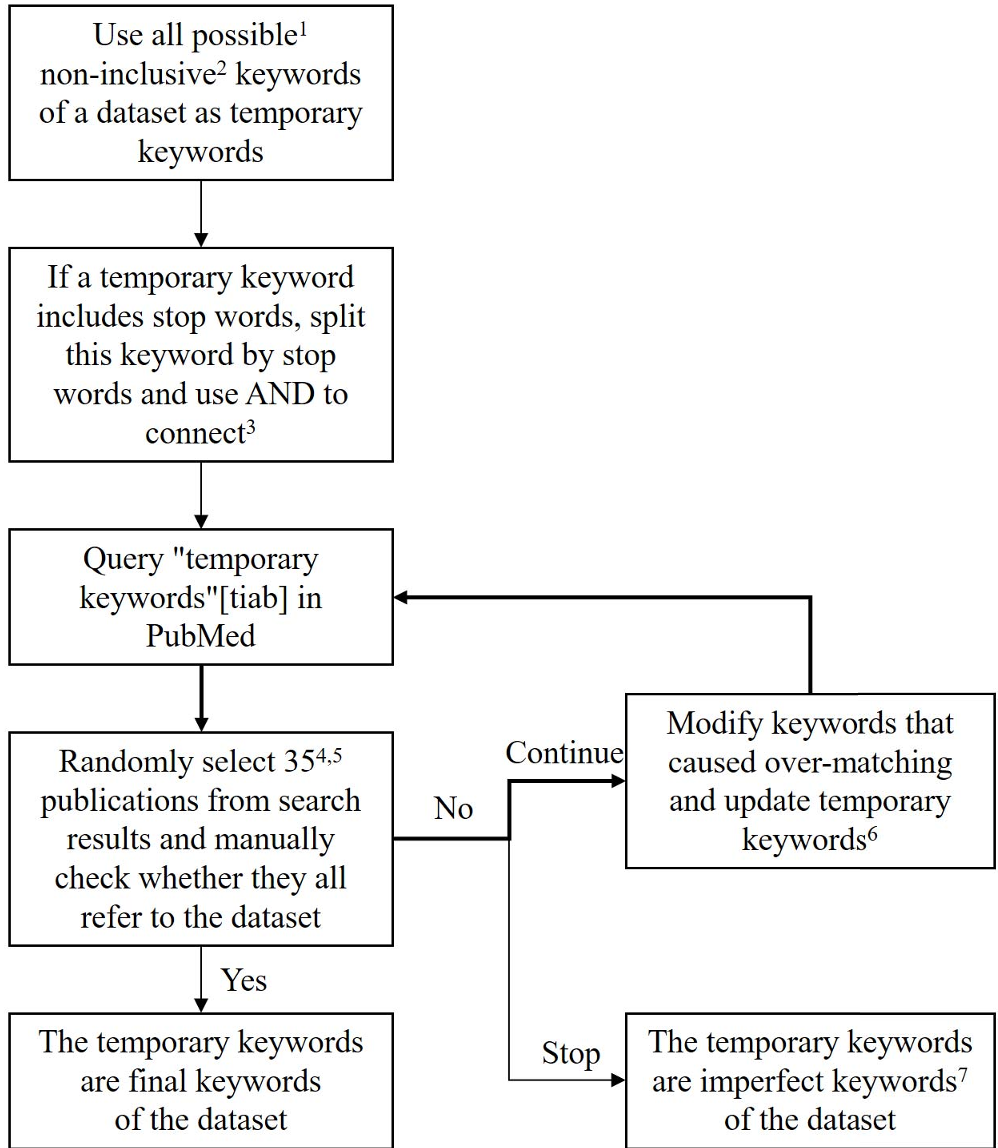 Figure: The systematic workflow for identifying dataset-specific keywords to ensure accurate PubMed retrieval.
Experiments: The Leaderboard of Data
The researchers applied the PPI to 14 foundational datasets (including NHANES, MIMIC, and MarketScan). The results offered some fascinating insights into "hidden" trends:
- The Trend Advantage: The MDS (Minimum Data Set) had a higher publication average than HCUP. However, HCUP ranked higher in PPI because its usage was trending upward, while MDS was plateauing.
- The Dominance of NHANES: With a PPI of 1880.9, NHANES remains the undisputed king of public health research, significantly outperforming proprietary datasets.
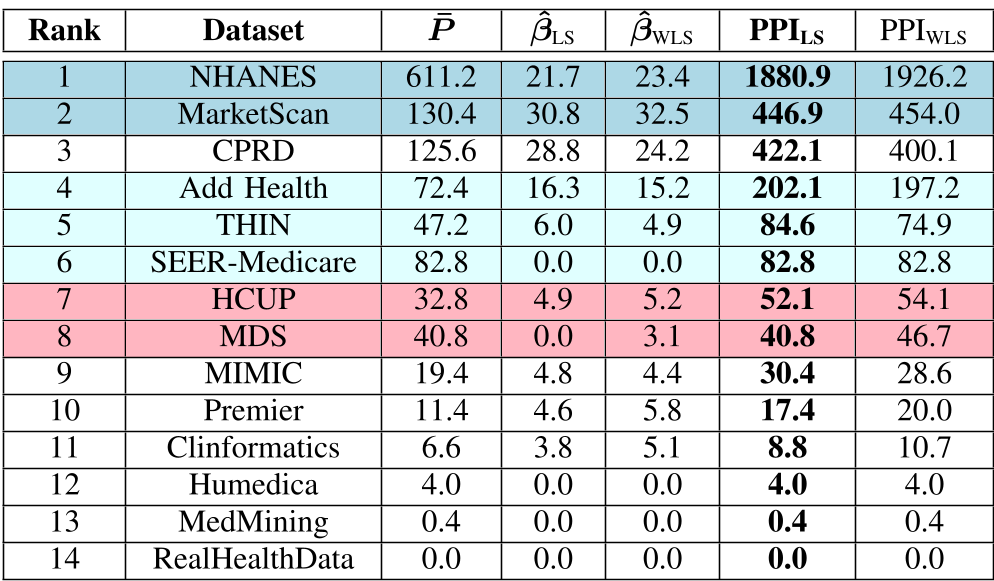 Table: Ranking of 14 representative datasets by PPI, showing the impact of the trend coefficient (beta).
Critical Insight: Popularity as a Quality Proxy
The most profound takeaway from this work is the shift from internal validation to external verification. By using the PPI, a researcher can objectively say, "Dataset A is more valuable than Dataset B because it has supported 300% more successful peer-reviewed outcomes in the last three years."
Limitations
- Keyword Sensitivity: The method relies on researchers mentioning the dataset in their title or abstract. If a dataset is widely used but rarely cited by name (a common issue in "shadow" data usage), the PPI will undercount it.
- Disease Prevalence Bias: Datasets covering common diseases (like diabetes) naturally attract more researchers than those covering rare conditions, which the current PPI does not normalize.
Future Outlook
The PPI is a vital step toward a "Google PageRank for Data." Future iterations could incorporate Text Mining to extract citations from full papers and Coverage Analysis to adjust for disease-specific research bias. For now, it provides a much-needed compass for novices and experts alike navigating the vast sea of healthcare big data.