
Scaling Privacy: High-Utility Eigenspectrum Publishing for Massive Social Networks
Publishing Social Network Graph Eigenspectrum With Privacy Guarantees
The paper introduces a "Random Matrix Approach" for publishing the eigenspectrum of large-scale Online Social Networks (OSNs) with differential privacy guarantees. By combining random projection to reduce dimensions with Gaussian random perturbation, the method enables efficient storage and computation of top eigenvectors while maintaining formal privacy.
TL;DR
Social network graphs are goldmines for analysis (clustering, ranking), but they are also privacy nightmares. This paper introduces a Random Matrix Approach that allows companies to publish the "essence" of their social graphs (the top eigenvectors) without revealing individual edges. By using Random Projections, the authors reduce the computational burden of trillion-edge graphs and achieve Differential Privacy with significantly less utility loss than previous methods.
The Scalability-Privacy Paradox
Analyzing a social network typically involves the Adjacency Matrix . For Facebook-scale data, is billions by billions.
- The Problem with Anonymization: Simply removing names is vulnerable to de-anonymization attacks (think Netflix/AOL scandals).
- The Problem with Naive Differential Privacy: Adding noise directly to a matrix of this size usually results in a dense matrix that is impossible to store (petabytes of data) or noise so loud that the results (clusters, rankings) become useless.
The authors identify a critical gap: Prior Art (like LNPP) adds noise to eigenvectors directly, but the sensitivity of eigenvectors is so high that the required noise obliterates the signal.
Methodology: The Power of Random Projection
The paper's core insight is that you don't need to perturb the whole graph if you only care about its spectral properties. They propose a three-step routine:
- Dimension Reduction: Project the adjacency matrix into a lower space using a Gaussian random matrix .
- Strategic Perturbation: Add a small amount of Gaussian noise to this lower-dimensional matrix.
- Publication: Publish the resulting matrix .
Why this works:
- Efficiency: Storing (where is small, like 200) is much cheaper than .
- Privacy Projection: Based on the Johnson-Lindenstrauss transform, the projection itself spreads out information, reducing the "sensitivity" of individual edges. This means you need much less noise to satisfy the -differential privacy requirement.

Theoretical Proofs: Small Noise, Big Utility
A highlight of this work is the rigorous proof that the error in approximating eigenvectors is bounded by . Effectively, as the social network grows larger (), the approximation of the top eigenvectors becomes more stable, even with privacy noise.
Experimental Results: Real-World OSN Data
The authors tested their approach on three massive datasets: Facebook, Pokec, and LiveJournal.
1. Node Clustering (Community Detection)
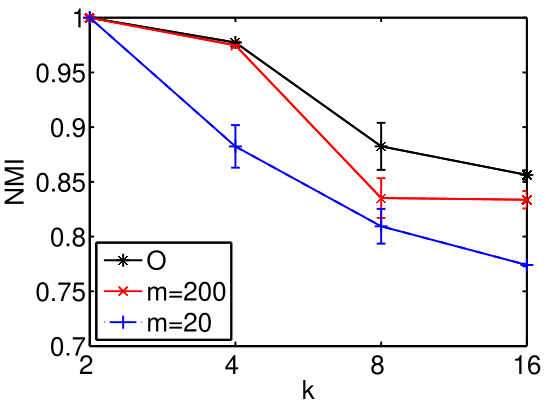
Using Spectral Clustering on the published data, they measured Normalized Mutual Information (NMI).
- Finding: Even with noise variance , the NMI stayed above 0.7, meaning identified communities were highly consistent with the original graph.
- Comparison: The baseline (LNPP) results were so poor they essentially flatlined at zero utility.
2. Node Ranking (Influencer Identification)
To identify "hubs" in the network, they used Principal Component Centrality (PCC).
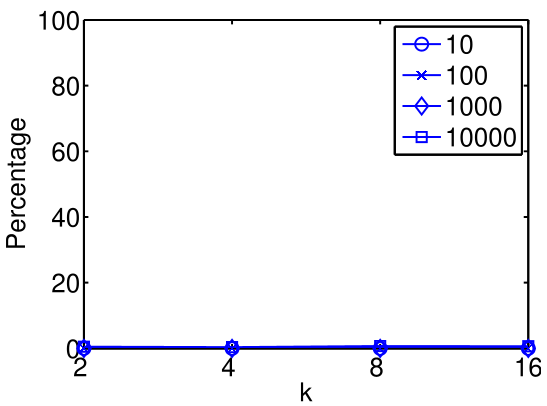
- Success: The random matrix approach recovered 80% of top-10,000 influencers correctly.
- Fail: LNPP failed to recover even 1% of the top-ranked nodes.
Critical Insight & Conclusion
Most privacy research treats "efficiency" as a secondary concern. This paper proves that dimensionality reduction is a first-class citizen of privacy. By reducing the footprint of the data before adding noise, we effectively lower the "surface area" an attacker can exploit, allowing for a much better trade-off between privacy and utility.
Takeaway for Practitioners: If you are tasked with sharing graph statistics (like community structures or influential users) from a sensitive database, don't just add noise to the final result. Project the data into a latent space first—it's faster, cheaper to store, and mathematically more private.