
Trust and Culture: Why Your Social Commerce Strategy Fails Across Borders
Intention to purchase on social commerce websites across cultures: A cross-regional study
This study investigates how social interactions (closeness and familiarity) and trust in a social network community influence purchase intentions on social commerce platforms. Utilizing Trust Transference Theory and Hofstede’s cultural dimensions, it examines cross-regional differences between East Asia and Latin America through a Facebook-based experimental study.
TL;DR
Social commerce is not a "one-size-fits-all" global phenomenon. New research reveals that while social interactions drive buying behavior, the mechanism varies by culture. In East Asia, emotional closeness directly moves the needle, whereas in Latin America, purchase intentions are strictly gated by trust developed through long-term familiarity.
The Problem: The Inconsistency of "Social Proof"
Why do some Facebook users buy products recommended by friends while 73% of others refuse? Academic literature has long struggled with this inconsistency. The missing link, as this study points out, is twofold:
- Trust Transference: Does trusting your friend automatically mean you trust the store they recommend?
- Cultural Inductive Bias: How do regional values like Individualism or Uncertainty Avoidance change the way social interaction translates into sales?
Methodology: Bridging Sociology and E-Commerce
The researcher constructed an experimental social commerce site on Facebook, tracking "1st-level" and "2nd-level" friend interactions across Taiwan, Thailand (East Asia), and Guatemala/Honduras (Latin America).
The core of the study lies in its structural model, which tests two types of social impact:
- Closeness (Affective): The emotional bond and "intimacy" felt with online friends.
- Familiarity (Cognitive): The understanding of others based on the frequency and history of interactions.
The Research Model
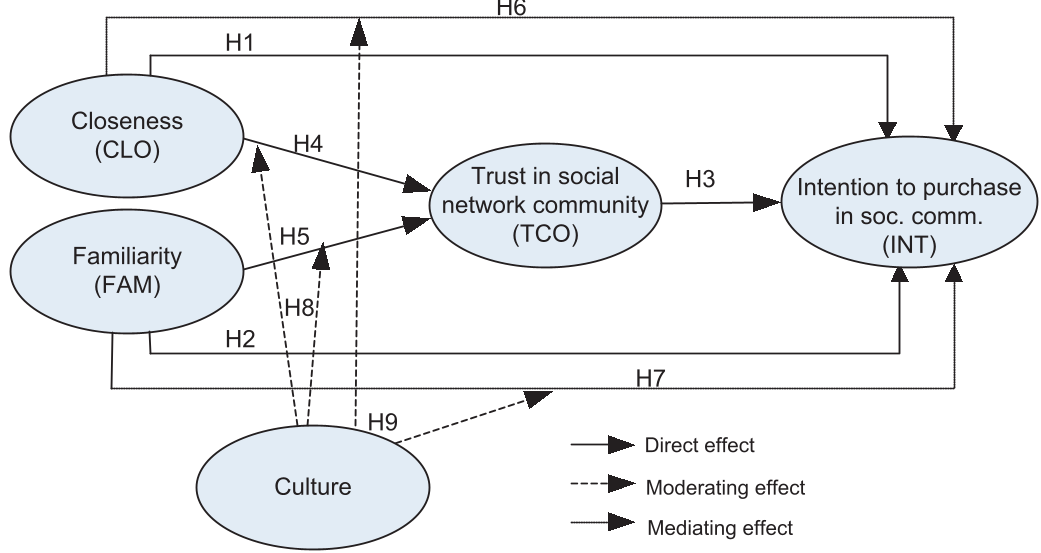 Figure 1: The hypothesized relationships between social interactions, trust, and purchase intention.
Key Insights: East Asia vs. Latin America
The study’s most striking find is the Conditional Mediation of trust.
1. The East Asian Context: Closeness is King
In East Asian countries (scoring higher on Individualism compared to Latin America in this sample), Closeness was a powerful direct predictor of purchase intention. Even though trust in the community played a role, the emotional bond with the recommender was often enough to prompt a "buy" decision. This suggests a lower barrier to entry for brands that can foster high-intensity social engagement.
2. The Latin American Context: The Trust Gatekeeper
Latin American participants, coming from cultures with higher Uncertainty Avoidance, were far more cautious. Here, Familiarity was the dominant driver, but it only worked if it first built a high level of Trust. There was almost no direct path from social interaction to buying without that trust filter.
3. Trust Transference
The data confirms that trust is "transferable." If a user trusts their social circle (the source), that trust extends to the sellers (the target) within that ecosystem, provided they are perceived as part of the community "moving in the same direction."
Experimental Analysis
The CBSEM analysis demonstrated high validity, with factor loadings ranging from 0.74 to 0.98. Notably, the model explained 56% of the variance in trust, proving that social interactions are indeed the primary engine of community reliability.
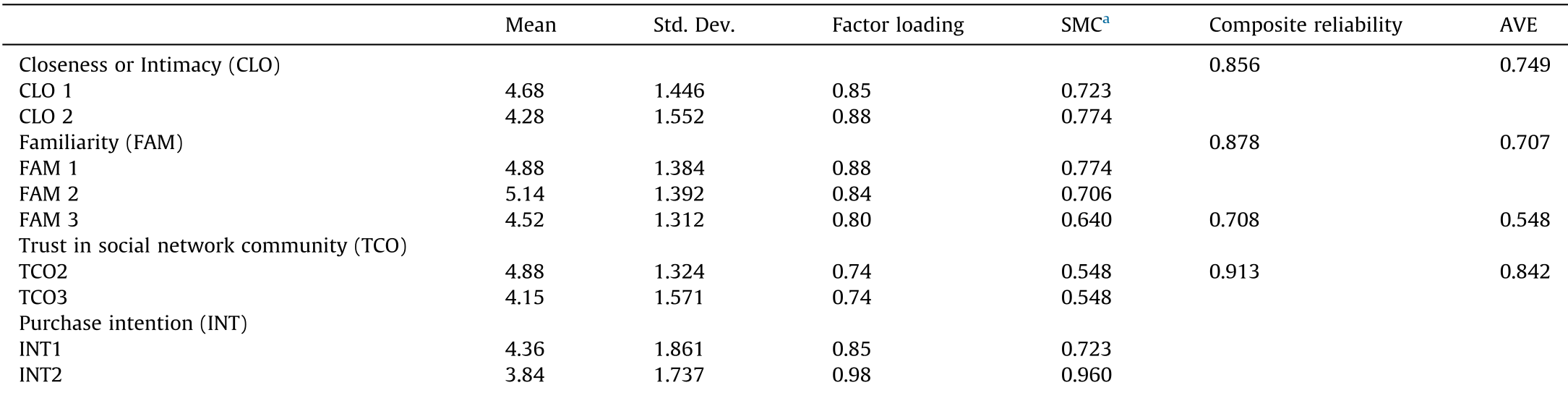 Table: Factor loadings and validity metrics for the study's constructs.
Conclusion and Takeaways
The study concludes that social commerce penetration is likely easier in East Asia due to fewer social-cultural barriers. For practitioners, the message is clear:
- In East Asia: Focus on "Intimacy." Use influencers or community managers who can build emotional rapport and high-frequency "closesness."
- In Latin America: Focus on "Reliability." Strategies must emphasize long-term presence, reducing perceived risk, and fostering deep familiarity before pushing for a transaction.
Limitations
The study relies on Hofstede’s dimensions, which are evolving. Future research should look at the GLOBE approach or longitudinal data to see how trust fluctuates during economic shifts or the rise of new platforms like TikTok Shop.
Final takeaway: Don't just build a store; build a community where trust can be transferred.