
In Pursuit of Social Capital: The Science of Upgrading Your Social Circle
In Pursuit of Social Capital: Upgrading Social Circle Through Edge Rewiring
The paper introduces a formal egocentric model of "Social Capital" to evaluate how individuals can upgrade their social circles through edge rewiring. It proposes three greedy strategies—Global, Local, and Community-based—to maximize Bridging Social Capital (information access) while preserving Bonding Social Capital (trust and solidarity), identifies the Community-based strategy as the optimal balance for network growth.
TL;DR
Is it better to be a "big fish in a small pond" or a "small fish in a big pond"? This paper provides a mathematical framework for "Edge Rewiring"—the process of strategically swapping old social ties for new ones. By defining Bonding (trust) and Bridging (information) social capital, the authors prove that a Community-based strategy allows individuals to gain the most information access without sacrificing the social support of their core group.
Background: The Dual Nature of Social Success
In social network theory, success isn't just about how many friends you have; it's about the topology of those connections. Social capital is generally split into two types:
- Bonding Social Capital: The trust, solidarity, and support found in dense, closed groups (strong ties).
- Bridging Social Capital: The power, new ideas, and info-access gained by connecting to diverse, distant groups (weak ties).
The paper addresses a vital constraint: Dunbar's Number. Since we have limited time and energy, we cannot simply add friends indefinitely. To get a "better" friend, we must "fire" an old one—a process known as Edge Rewiring.
Methodology: Formalizing the "Social ROI"
The authors propose a framework to measure the "Return on Investment" (ROI) of a social tie:
- Bonding Capital (): Modeled as an "Expected Return Score." If you invest goodwill into your neighbors, how much eventually flows back to you? This is calculated using a Personalized PageRank-style random walk.
- Bridging Capital (): Modeled using the Independent Cascade (IC) model. It measures the probability that a random piece of information starting anywhere in the network will eventually reach you.
Strategic Rewiring
Because calculating these metrics for every possible move is computationally expensive, the authors use Closeness Centrality as a greedy heuristic. They compare three strategies based on "Scope":
- Global (gg): You can see the whole network and connect to anyone (e.g., following celebrities on Twitter/X).
- Local (lg): You only see "friends of friends."
- Community (lc): You see people within your detected social community and their immediate neighbors.
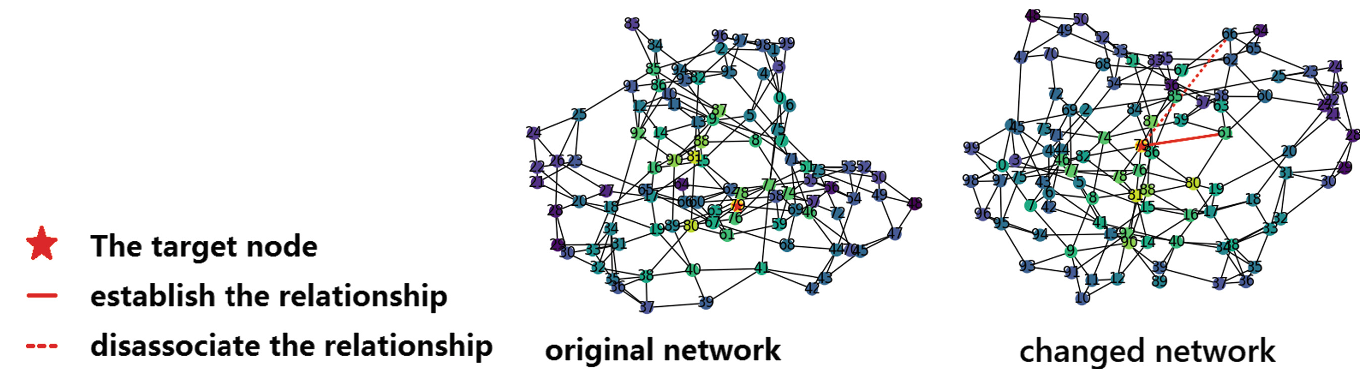 Figure 1: The ego-node v selects a new node 'u' to connect to while severing a tie with 'w' to stay within capacity limits.
Experiments and Insights
The researchers tested these strategies on diverse datasets, including Facebook, Youtube, and BlogCatalog.
Key Discovery: The Community Advantage
The results revealed a fundamental trade-off.
- The Global Strategy is the most effective at turning you into an information broker (highest bridging capital), but it causes your bonding capital to plummet. You become a "global connector" with no home base.
- The Local Strategy keeps your trust levels high but leaves you in an "echo chamber," making it hard to find new information.
- The Community Strategy is the "Goldilocks" solution. It leverages the community structure to find bridge nodes that are far enough to provide new info but close enough to maintain structural integrity.
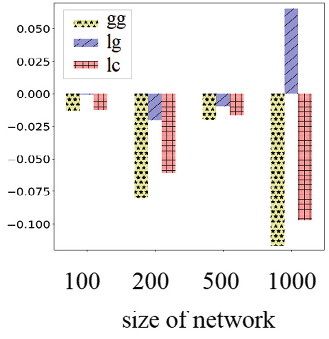 Figure 2: Changes in Bridging () and Bonding () Capital across different network models. Note how the Community strategy (lc) tracks the Global strategy (gg) in Bridging gains while maintaining higher Bonding scores.
Critical Analysis: Why This Matters
The most profound insight here is the correlation between Centrality and Bridging, and Embeddedness and Bonding. By showing that community-based rewiring is nearly as effective as global rewiring for information access, the paper justifies the "neighborhood" approach used by modern platforms like Nextdoor or Slack.
Limitations
The study assumes a static environment—the target node moves, but other nodes stay still. In the real world, everyone is rewiring simultaneously. This "Social Arms Race" could lead to different equilibrium states that weren't captured in this single-agent simulation.
Conclusion
This paper elevates social capital from a vague sociological concept to a measurable engineering metric. It tells us that to "level up" in a network, you don't need to look at the whole world; looking at the outskirts of your own community provides the best balance of new opportunities and old-fashioned trust.
Takeaway: If you want to increase your professional influence without losing your friends, start by connecting with the "influencers" in your adjacent sub-communities rather than trying to reach the global elite.