
PV-OWL: Revolutionizing Pharmacovigilance through Semantic Big Data Integration
PV-OWL — Pharmacovigilance surveillance through semantic web-based platform for continuous and integrated monitoring of drug-related adverse effects in open data sources and social media
PV-OWL is a semantic web-based platform designed for continuous pharmacovigilance (PV) monitoring by integrating heterogeneous data sources including FAERS, medical literature, and social media. Using the MOMIS data integration framework, it generates a unified global risk score to identify and prioritize Adverse Drug Reactions (ADRs) with high efficiency.
TL;DR
The PV-OWL project introduces a breakthrough web platform that shifts drug safety monitoring from manual, siloed reporting to integrated, real-time surveillance. By leveraging the MOMIS framework, it merges structured clinical databases with unstructured data from social media and scientific literature, providing a unified Global Risk Score to identify Adverse Drug Reactions (ADRs) faster and more accurately than ever before.
Context & Motivation: The "Big Data" Challenge in Drug Safety
Pharmacovigilance (PV) has reached a critical juncture. Traditional methods—relying on healthcare professionals to manually report side effects—are no longer sufficient in an era of rapid drug release and digital connectivity.
The EU Regulation 1235/2010 now mandates that pharmaceutical companies monitor not just medical literature, but also social media. However, the sheer volume of "Big Data" creates a massive bottleneck:
- Heterogeneity: Data is a mess of structured codes (ATC, MedDRA) and unstructured text (patient tweets, Facebook posts).
- Volume: Manually screening thousands of forum posts is economically unfeasible.
- Fragmentation: Vital signals are often scattered across proprietary clinical records and open public databases like FAERS.
Methodology: The Semantic Bridge
PV-OWL doesn't just collect data; it understands it. The core engine is the MOMIS (Mediator environment for Multiple Information Sources) system, an open-source integration framework that uses a "virtual approach" to preserve the autonomy of original sources while creating a unified view.
1. The Domain Thesaurus
The researchers built a specialized Pharmacovigilance Thesaurus. This acts as a "Rosetta Stone," mapping medical standard codes (ICD-9, MedDRA) to the colloquial language used by patients on social media. This allows the system to recognize that a patient's tweet about "severe stomach pain" might be linked to a clinical diagnosis of "Gastritis."
2. Multi-Source Fusion via Dempster-Shafer
How do you trust a signal from Twitter compared to a signal from a clinical trial? PV-OWL employs the Dempster-Shafer Theory, a probabilistic approach to combine evidence from different sources. Each source is assigned a "confidence weight," which are then merged into a single Global Risk Score.
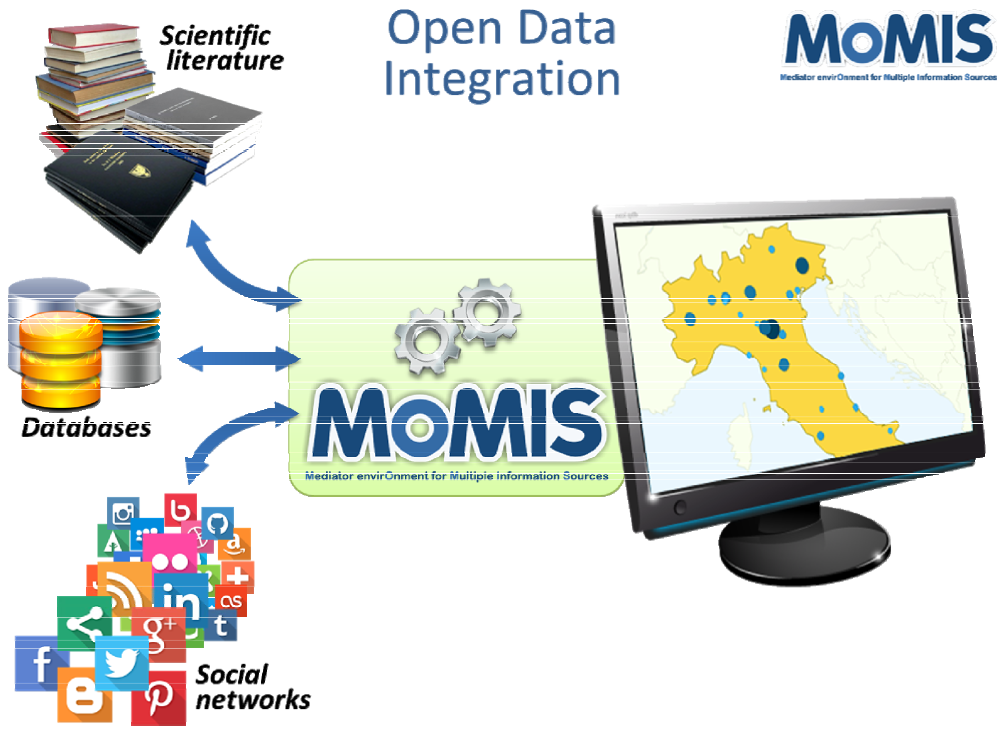 Figure 1: The PV-OWL architecture showing the integration of Open Data, Proprietary Data, and Social Media via the MOMIS framework.
Experiments & Results: Efficiency and Accuracy
The project validated its approach by testing known drug-reaction pairs (e.g., Metformin and long-term risks).
Key Performance Metrics:
- Cost Reduction: The platform is estimated to reduce post-market surveillance expenditure by nearly 50% by automating labor-intensive queries.
- Early Detection: By integrating social media, the "time to first appearance" of a safety signal was significantly reduced compared to traditional spontaneous reporting.
- User Accessibility: The complex mathematical models are distilled into an intuitive dashboard with visual risk indicators, designed for both regulatory experts and clinicians.
Note: The system identifies the specific contribution of each data source (provenance tracking) to ensure transparency in signal generation.
Critical Insight & Future Outlook
The true innovation of PV-OWL lies in its Semantic Virtual Integration. Unlike traditional data warehouses that require moving all data into one pile, MOMIS queries the sources where they reside, ensuring data privacy and real-time accuracy.
Limitations: Despite its power, the "Social Media" component faces ethical and regulatory hurdles. Determining the "actual clinical value" of a tweet remains more challenging than analyzing a hospital record. Furthermore, the Dempster-Shafer weights require constant refinement to avoid false positives in a noisy digital environment.
Conclusion: PV-OWL represents a paradigm shift. It moves the industry away from "waiting for reports" toward "actively hunting for signals." For patients, this means safer drugs; for regulators, it means a more responsive public health infrastructure.