
QLIM: Reimagining the Questionnaire as a Tool for Collective Innovation
15898_QLIM - A Tool to Support Collective Intelligence.
This paper introduces QLIM (Questionnaire en Ligne Interactif et Malléable), an interactive web-based tool designed to support collective intelligence. Unlike static surveys, QLIM allows participants to dynamically add new questions and answer choices in real-time, fostering a collaborative "e-brainstorming" environment.
TL;DR
Questionnaires have long been the "boring" dead-end of data collection. This paper introduces QLIM, a tool that transforms the static survey into a living, breathing "e-brainstorming" platform. By allowing participants to add their own questions and options, QLIM leverages tailorability to turn a simple data-entry task into a structured engine for collective intelligence.
The Problem: Why Static Surveys Kill Creativity
Traditional questionnaires suffer from several fatal flaws when applied to innovation:
- Rigidity: The creator assumes they already know the right questions to ask.
- Lack of Interaction: Participants are isolated; they cannot see or react to the "pulse" of the group.
- One-Way Flow: Information goes into a database but rarely sparks a secondary conversation.
Prior attempts like the Delphi method focus on reaching a consensus among experts, which often suppresses the "audacious" ideas crucial for true brainstorming. Conversely, online forums offer too much freedom and fail to provide the synthesis needed for decision-making.
Methodology: The Power of "Malléable" (Tailorable) Design
The core insight behind QLIM is that the solution to a problem often lies in the wording of the question. By making the questionnaire "malleable," QLIM allows the group to redefine the problem as they solve it.
1. Functional Architecture
QLIM breaks the hierarchy between the researcher and the subject. Key features include:
- Dynamic Expansion: Participants can add a new answer choice if none of the existing ones fit, or pose an entirely new question to the group.
- Feedback Loops: Automatic emails summarize daily creations, pulling participants back into the debate.
- Social Proof: With the "Score" feature enabled, participants can see the percentage of the group that chose each option, highlighting trends and shifts in opinion.
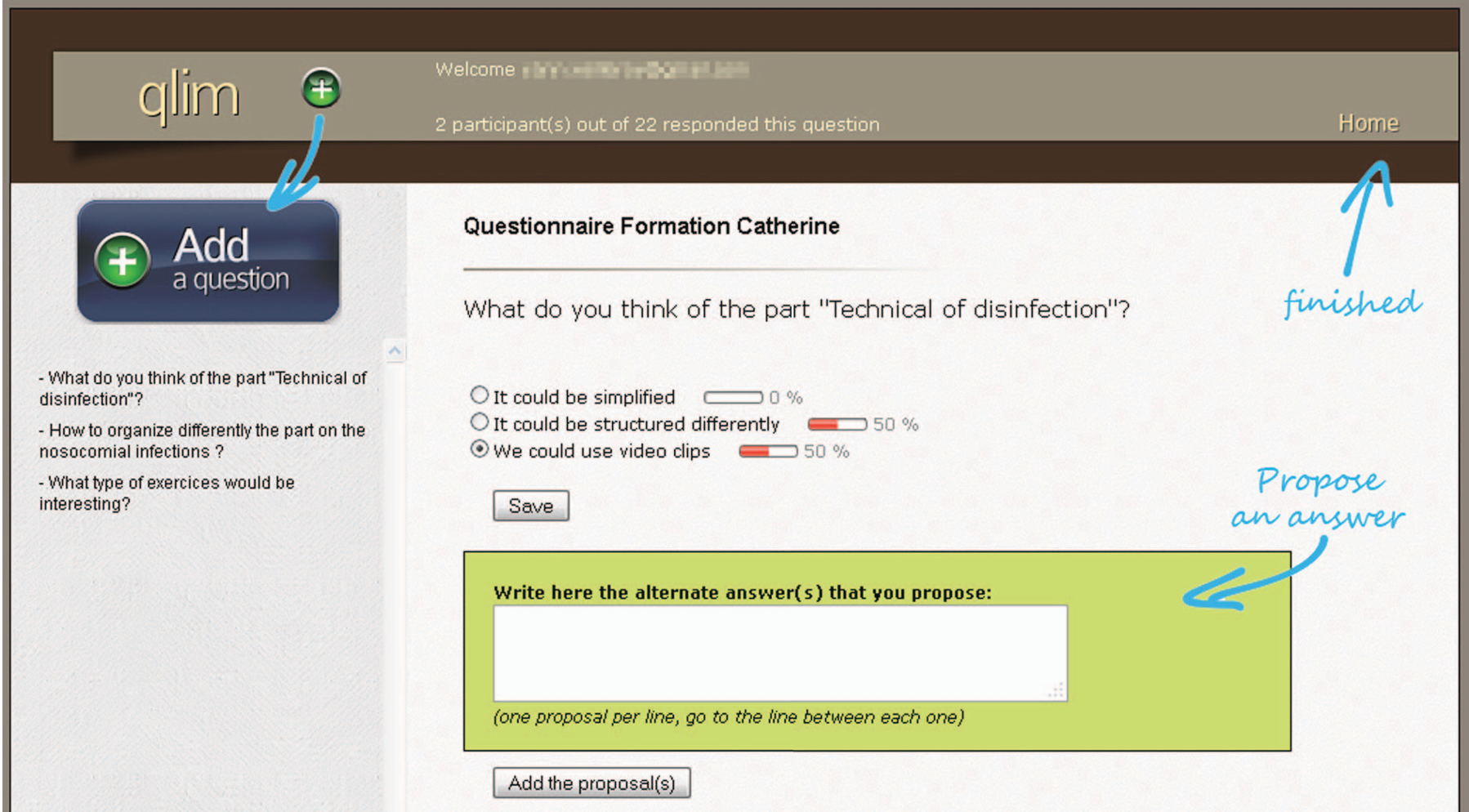 Figure 1: The QLIM interface allowing participants to respond to and expand the survey simultaneously.
2. Trace Logging and Temporal Analysis
Crucially, QLIM doesn't just record the final answer; it logs the process. By tracking "who did what and when," the system can generate temporal charts that show how an idea gained momentum or how a new question shifted the group's focus.
Experimental Results: When Does It Work?
The authors tested QLIM on 16 different groups. The contrast between groups was stark:
- Involved Groups (g01-g04): These students were invited by a teacher during active training. They showed high participation (75%+) and high "creative" rates—meaning they didn't just answer; they built the survey.
- Classic Groups: Those contacted via email after the fact showed significantly lower engagement (as low as 8-20%).
 Figure 2: Performance metrics across 16 groups, highlighting the "Participation Rate" (C/A) and "Individual Involvement" (D/A).
Critical Insight: The "Involved" vs. "Classic" Behavior
The research highlights that the tool alone isn't enough; the context of interaction matters. When QLIM was used as an extension of a face-to-face training session, it acted as a "digital catalyst." The ability to tailor the questionnaire allowed students to express frustrations or insights about their course rhythm and balance between theory and practice that a standard survey would have missed.
Conclusion & Future Outlook
QLIM proves that the "Questionnaire" can be a legitimate interface for Collective Intelligence. By providing a structured frame (unlike a forum) but keeping the content open (unlike a poll), it strikes a balance that encourages synthesis.
Limitations: The study notes that too many participants might lead to "information overload" and confusion. Future work should focus on how to manage QLIM at scale, perhaps utilizing AI to cluster similar questions added by different users.
Final Takeaway: To innovate, don't just ask your users questions—give them the power to change the questions you're asking.