
Collective Intelligence: Turning SNS into a Network Control Plane for Disaster Management
QoE Control of Network Using Collective Intelligence of SNS in Large-Scale Disasters
This paper presents a network-failure-detection and autonomous control system that leverages the collective intelligence of Twitter (X) during large-scale disasters. By integrating SNS data with a Deeply Programmable Network (DPN) environment called FLARE, the system achieves real-time traffic rerouting based on user-reported QoE issues.
TL;DR
When disasters strike, physical network monitors often go blind. This paper introduces a system that treats Twitter users as "social sensors" to detect localized telephony failures. By feeding this collective intelligence into a Deeply Programmable Network (DPN), the system can automatically reroute traffic around degraded areas, ensuring critical communication remains active when it's needed most.
Problem & Motivation: The Blind Spots of Physical Infrastructure
In the aftermath of the 2011 Great East Japan Earthquake, telecom providers faced a paradox: their internal monitoring systems were overwhelmed by congestion and physical damage, yet Social Networking Services (SNS) like Twitter remained functional and filled with real-time user reports.
The authors identified two major gaps in existing systems:
- Observability Gap: Traditional internal sensors cannot capture the "last-mile" user experience (QoE) during extreme congestion.
- Granularity Gap: Existing SNS-based disaster detection usually identifies the event (e.g., "an earthquake occurred") but fails to provide the specific status of infrastructure at a municipality level.
The motivation was simple: if users are already proactively reporting "I can't make a call in Sendai," why not use that data to programmatically fix the network?
Methodology: From Tweets to Traffic Rules
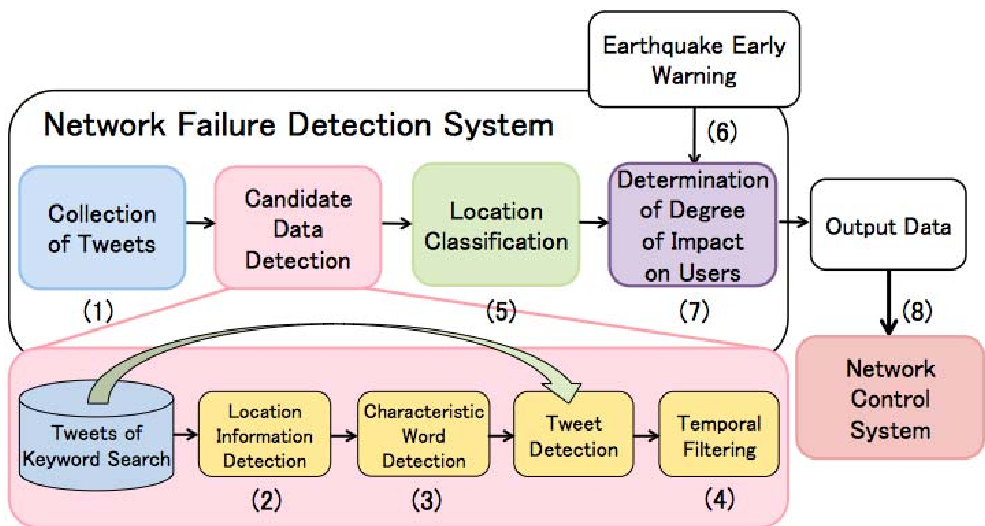
The proposed architecture is split into a detection pipeline and a control loop.
1. The Detection Pipeline
Instead of just looking for keywords, the system employs several sophisticated filtering layers:
- Temporal Filtering: The system fits tweet frequency to an exponential distribution. This allows it to distinguish between a sudden surge of relevant reports and background noise, focusing on a 60-minute "real-time" window.
- Location Classification: It doesn't just look for "Miyagi" in a tweet. It uses morphological analysis (MeCab) to determine if the user is in Miyagi reporting a local failure, or if they are in Tokyo trying to call Miyagi. This distinction is crucial for accurate routing.
- Impact Determination: By comparing current tweet volume () against a normal distribution ( or ), the system identifies "abnormal" failure states for specific municipalities.
2. Deeply Programmable Networks (DPN)
The real innovation is the integration with FLARE. Unlike standard OpenFlow (which only handles the control plane), FLARE is "deeply programmable," allowing control over the data plane up to the application layer. The system acts as a feedback loop:
- Step A: Detect municipality failure via Twitter.
- Step B: Update "cost values" for routes passing through the affected area.
- Step C: Use Dijkstra's algorithm to compute and push new routing rules to switches.
Experiments & Results
The authors validated the system using real datasets from 2014 earthquakes in Hokkaido, Ibaraki, and Nagano, as well as logs from the 2011 Great East Japan Earthquake.
- Detection Performance: The system maintained high precision (87% - 96%) and a solid F-value of ~85%, proving that "social data" is a reliable proxy for hardware failures.
- Testbed Simulation: Using the JGN-X (Japan Gigabit Network eXtreme) testbed, the authors demonstrated a successful autonomous reroute. When failure reports spiked in a specific region, the FLARE controller instantly switched traffic to a "longer but safer" path, bypassing potential congestion points.

Critical Analysis & Conclusion
Takeaway
This work shifts the paradigm of network management from reactive (waiting for hardware alarms) to proactive and human-centric. By treating users as distributed sensors, the network becomes aware of its own quality of service through the lens of human experience.
Limitations & Future Work
- Connectivity Paradox: If the Internet itself is completely down, users cannot tweet. The authors argue that 3G/LTE or users outside the zone can provide data, but a total blackout remains a challenge.
- Information Authenticity: The system currently trusts the "collective intelligence" of tweets. Future iterations might need to account for misinformation or "noise" generated by bots during crises.
- Advanced Control: The authors note that while they used basic routing cost updates, the next step is leveraging the full "application-aware" power of DPNs to prioritize emergency traffic (like VoIP) over background data (like video streaming).
In conclusion, this research provides a blueprint for a more resilient, "social-aware" internet that can listen to its users to heal itself during the world's worst moments.