
Crowdsourcing Perception: A New Paradigm for HD Video QoE Evaluation via Social Networks
A QoE Evaluation Methodology for HD Video Streaming Using Social Networking
This paper proposes a novel methodology for Quality-of-Experience (QoE) evaluation of HD video streaming by leveraging social media platforms (specifically Facebook). The method utilizes an Absolute Category Rating (ACR) framework within a native social application to capture subjective user feedback in real-world environments, achieving high statistical significance (95% confidence intervals) through large-scale demographic crowdsourcing.
TL;DR
In an era where video streaming dominates internet traffic, traditional laboratory-based quality assessments are becoming an expensive bottleneck. This paper introduces a novel methodology that migrates Quality-of-Experience (QoE) testing from the lab to the social network. By embedding HD video tests within Facebook, the researchers accessed a diverse, global audience in natural environments, proving that crowdsourced social data can match—and even exceed—the statistical reliability of traditional ITU-standardized tests.
Problem & Motivation: The "Lab vs. Reality" Gap
For decades, the gold standard for video quality assessment has been governed by ITU-T Recommendations (P.910, P.911). These mandate strictly controlled lighting, viewing distances, and professional-grade monitors. However, the authors argue that this approach has two fatal flaws:
- Ecological Validity: People don't watch Netflix or YouTube in a gray lab; they watch in offices, bedrooms, and on the move. Lab results often suffer from "systematic deviation" because the context—expectations and comfort—is artificial.
- Statistical Scale: Recruiting 30 people for a 60-minute lab session is slow and expensive. In the fast-evolving world of internet streaming, developers need rapid feedback to optimize bitrates.
The researchers’ core insight: Social Networks provide the ultimate "living lab." By using the Facebook Social Graph, they can not only reach thousands of users instantly but also filter results by age, education, and geographic location to understand who is watching and how they perceive quality.
Methodology: Social-Streaming Architecture
The proposed system bridges the gap between social interaction and technical performance. The authors built a Facebook application that seamlessly integrates video streaming with the Absolute Category Rating (ACR) method.
1. Technical Framework
Instead of complex RTMP streaming, the system uses HTTP "pseudo-download." This ensures that every user watches the exact same encoded file once it buffers, removing network jitter as a variable while allowing the study to focus purely on the impact of video bitrates and content type on perceived quality.
2. Experimental Design
The researchers selected two high-motion content classes: Soccer and Action Movies. These were encoded using H.264/AVC at five distinct bitrates (800 kbit/s to 2000 kbit/s).
- Duration Control: To prevent "test fatigue," sessions were capped at 5 minutes for 10 clips.
- Demographic Filtering: The app requested permission to access profile data (age, gender, social status), providing a "multidimensional" dataset that lab tests simply cannot provide.
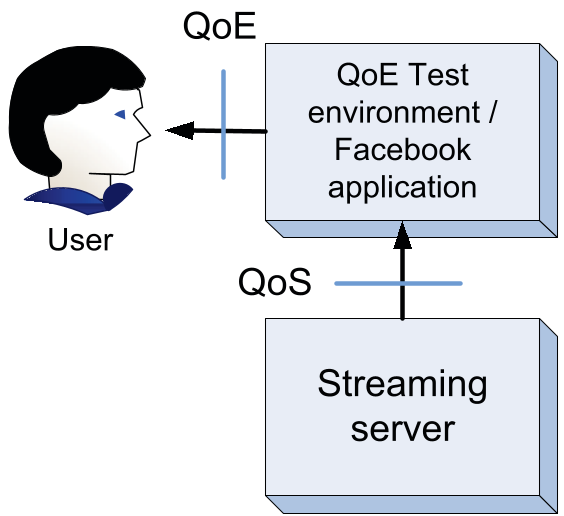 Figure 1: The triad of QoE—User, Application, and Network context.
Results: Does Social Testing Hold Up?
The most critical question was: Can a random Facebook user provide data as reliable as a trained lab subject?
The answer is a resounding Yes. By applying Student’s distribution to calculate the minimum sample size, the authors found that 32-36 participants per sequence provided a 95% Confidence Interval (CI) of roughly 0.25 MOS points—matching the precision of high-end lab studies.
Key Findings:
- Content Sensitivity: Soccer sequences generally received lower scores than Action Movies at the same bitrate, suggesting that sports fans may have higher expectations for motion clarity.
- Efficiency Frontier: For action movies, the difference between 1700 kbit/s and 2000 kbit/s was negligible (only 0.08 MOS points). This insight allows providers to save significant bandwidth without a perceptible drop in user satisfaction.
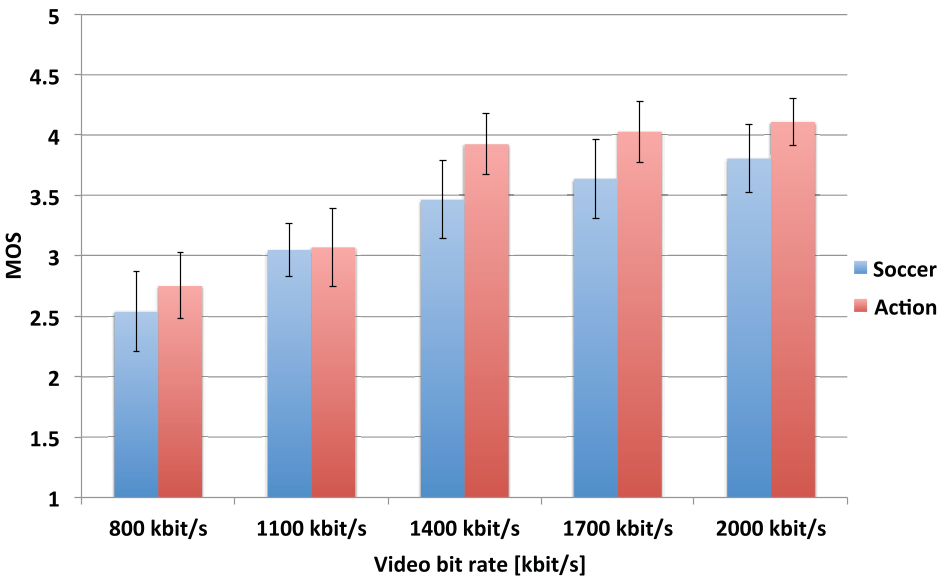 Figure 2: Statistical results showing a clear correlation between bitrate and Mean Opinion Score (MOS).
Critical Analysis & Conclusion
Takeaway
This methodology proves that the Social Graph is a valid tool for technical research. It bypasses the recruitment hurdles of traditional academia and places the "test subject" back into their natural digital habitat. For service providers (like IPTV or YouTube), this offers a way to perform "A/B testing" for quality settings with real-time statistical significance.
Limitations
While the study excels at demographic and content analysis, it acknowledges that End User Devices (varying screen resolutions from 1024x768 to 1080p) introduce noise. While the authors can track these via browser metadata, the lack of hardware control remains the primary trade-off for the gain in sample size.
Future Outlook
As we move toward VR/AR and 8K streaming, the "social lab" approach will become even more vital. Future iterations could leverage mobile social apps to evaluate QoE for 5G-enabled mobile streaming, where the environment is even more dynamic than the desktop scenarios studied here.