
Balancing the Scales: Achieving Energy Fairness and Data Quality in Crowdsourcing
Toward QoI and Energy Efficiency in Participatory Crowdsourcing
This paper proposes a novel network management framework for participatory crowdsourcing to balance Quality-of-Information (QoI) with energy efficiency. By extending the Gur Game mathematical paradigm, the authors developed a distributed decision-making algorithm that reaches near-optimal information contribution levels while maintaining energy consumption fairness among participants.
TL;DR
Researchers have developed a distributed framework for participatory crowdsourcing that solves the conflict between high-quality data (QoI) and smartphone battery life. By using an extended Gur Game (a type of automated trial-and-error game), the system allows devices to independently decide how much data to contribute, ensuring no single user's battery is drained unfairly while keeping the platform's costs low via a reverse-auction incentive scheme.
The Dilemma of "Citizen Science"
Participatory crowdsourcing—where everyday users collect data via smartphone sensors—is a goldmine for "Citizen Science." However, it faces a fundamental hurdle: Energy. Smartphones are not dedicated sensors; they are lifelines for calls and messages. If a crowdsourcing task drains a user's battery unevenly compared to their peers, they will quit the platform.
Current solutions often rely on centralized servers to calculate the "optimal" contribution for every user. This doesn't scale well and fails to respect individual privacy or varying real-time energy levels.
Methodology: The Extended Gur Game
The researchers' core insight was to use the Gur Game. In its classic form, an agent (smartphone) only chooses between "Active" or "Idle." This paper extends this to Multiple Steady States, allowing a device to choose how much to contribute (e.g., sending 1, 3, or 6 survey responses).
1. The Two-Step Decision Logic
The framework operates through two distinct phases to ensure balance:
- Q-step (Quality): The system prioritizes reaching the threshold of information required for statistical significance.
- V-step (Variance): Once the quality is met, the devices shift their behavior to minimize the energy consumption variance across the whole group. If your phone has less juice than the average, the game pushes you to do less.
2. Architecture & Payoff Structure
Each device runs a finite-state automaton. The "Network Platform" (living in the cloud) only sends back a simple "Payoff" value—a reward or penalty—based on the collective data received.
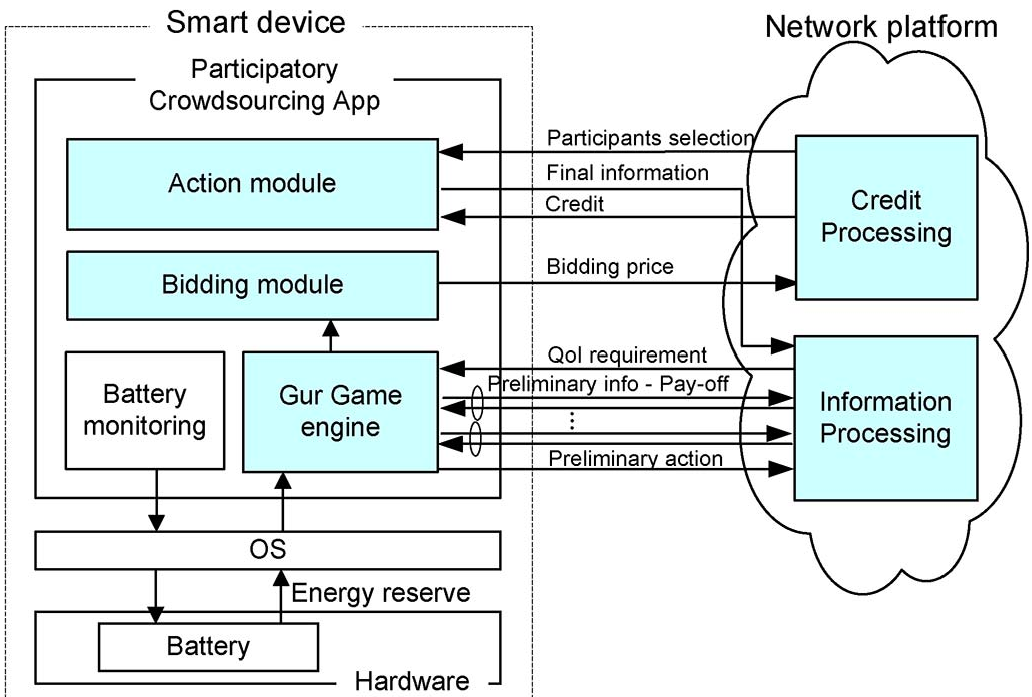 Fig 1: The overall architecture showing the interaction between the Cloud Information Center and the distributed Gur Game engines on smartphones.
Experiments: Real-World Validation
The authors didn't just use synthetic data; they tested their algorithm using the MIT Social Evolution dataset, which tracks the phone usage of 80 students over 9 months.
Rapid Convergence
The system proves remarkably fast. In a scenario requiring 148 answers, the distributed group converged to a stable, fair state in approximately 200 iteration steps. Because the data exchanged during these steps is just metadata (task IDs and payoff values), the bandwidth overhead is negligible (around 62 KB for 40 users).
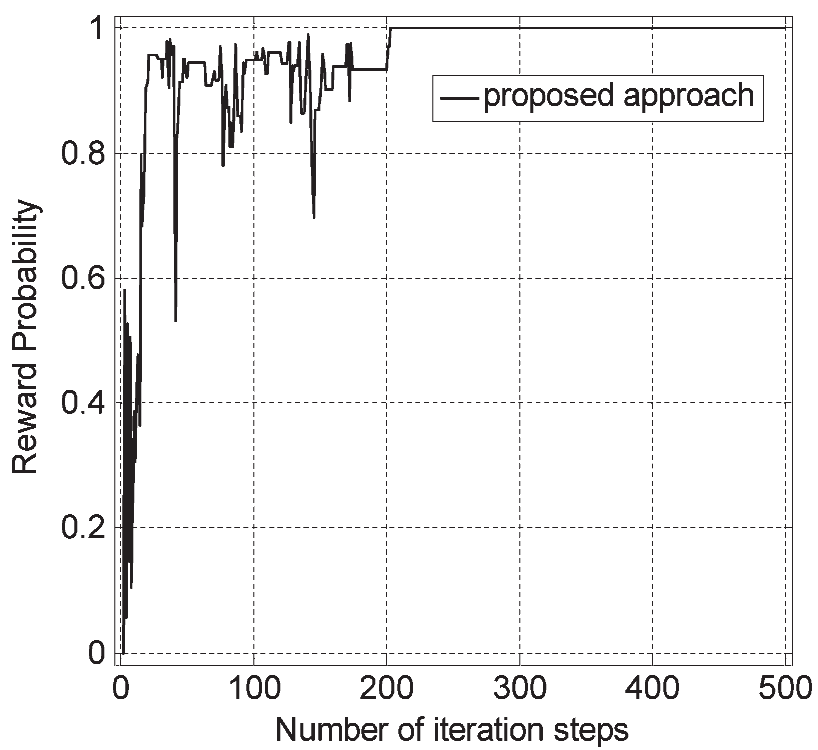 Fig 2: System convergence showing how the variance of energy consumption is minimized over iteration steps while keeping QoI satisfied.
The Auction: Fighting Greed
To keep users motivated, the platform uses a Reverse Auction. Users bid the price they want for their data. The platform cleverly "removes" users who bid too high but still have a high impact on the group's total energy variance. This "Incentive-Based Selection" forces users to bid truthfully and prevents greedy participants from overcharging the platform.
Critical Insight: Why Gur Game?
The beauty of this method lies in its transparency. The individual smartphone doesn't need to know the complex math of the information fusion algorithm or the energy states of other users. It simply reacts to a global "reward" signal. This makes the system robust: if the platform changes its data requirements, the "swarm" of smartphones adapts automatically without a single line of code being changed on the devices.
Conclusion & Future Outlook
This work moves us closer to sustainable crowdsourcing. By treating the network of participants as a self-organizing system rather than a set of slaves to a central commander, we can build Citizen Science applications that are both cost-effective and respectful of the user's personal resources.
Future Step: Integrating Trustworthiness. While this paper solves energy and cost, verifying that the actual data submitted is accurate (and not just low-energy noise) remains the next frontier for autonomous crowdsourcing systems.