
BC-CQAM: Reshaping Crowdsourcing Quality with Blockchain and Improved EM
A Quality Assessment Model for Blockchain-Based Crowdsourcing System
This paper introduces BC-CQAM, a blockchain-based quality assessment model for crowdsourcing that integrates a reputation-based worker selection algorithm (BC-WS) and an improved Expectation-Maximization algorithm (BIV-EM). The model achieves higher truth discovery accuracy and decentralised reliability by leveraging smart contracts on the Ethereum network.
TL;DR
The paper presents BC-CQAM, a decentralized framework that solves the lack of trust in centralized crowdsourcing. By combining a Reputation-based Worker Selection (BC-WS) mechanism with a Boosting Initial Value EM (BIV-EM) algorithm, it ensures that even in a trustless environment, the quality of submitted tasks can be accurately assessed and malicious actors can be efficiently penalized.
Background & Motivation
Current crowdsourcing giants like Amazon Mechanical Turk (MTurk) suffer from a fundamental "centralization tax" on trust. Requesters may cheat workers out of payments by claiming low quality, and malicious workers may submit "junk" answers for easy profit. Most importantly, the quality control is often a "black box" managed by the platform.
The authors identify two technical gaps:
- Systemic Trust: Centralized platforms are vulnerable to Single Points of Failure (SPoF) and bias.
- Algorithm Accuracy: Simple algorithms like Majority Vote (MV) fail because they treat every worker as equally reliable, while advanced EM algorithms are notoriously sensitive to their starting points.
The BC-CQAM Architecture
The system is built on a four-layer architecture (Storage, Blockchain, Interface, and Application). To solve the storage limitations of blockchain, the authors use IPFS for heavy data while keeping metadata and evaluation logic (Smart Contracts) on-chain.
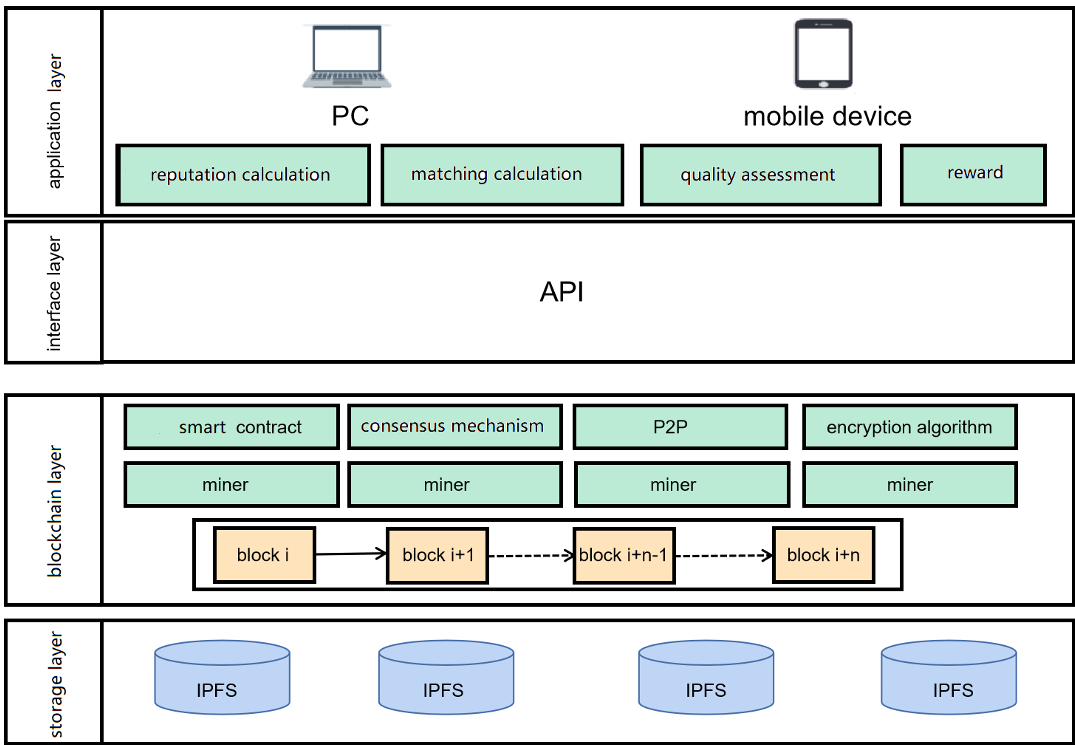
Key Roles
- Requester: Posts tasks and deposit funds.
- Worker: Executes tasks; their selection is determined by a Node Matching Degree (NodeP).
- Judger: Independent third-party nodes that execute the BIV-EM algorithm to provide unbiased quality scores.
Methodology: High-Precision Qualitative Assessment
The heart of this paper is the BIV-EM Algorithm. The standard EM algorithm often gets stuck in local optima if the initial guess of "who is a good worker" is wrong.
The authors fix this by calculating a Node Matching Degree ( ):
- CreP (Reputation): Calculated based on historical performance and the size of the security deposit.
- FamiP (Familiarity): Based on the interaction frequency between the worker and the requester.
By using as a weight for the initial "Majority Vote," the EM algorithm starts much closer to the global optimum (the "Ground Truth"), resulting in significantly higher final accuracy.
Experiments and Results
The model was tested on the Ropsten Ethereum testnet using the income94crowd dataset.
1. Accuracy Gains
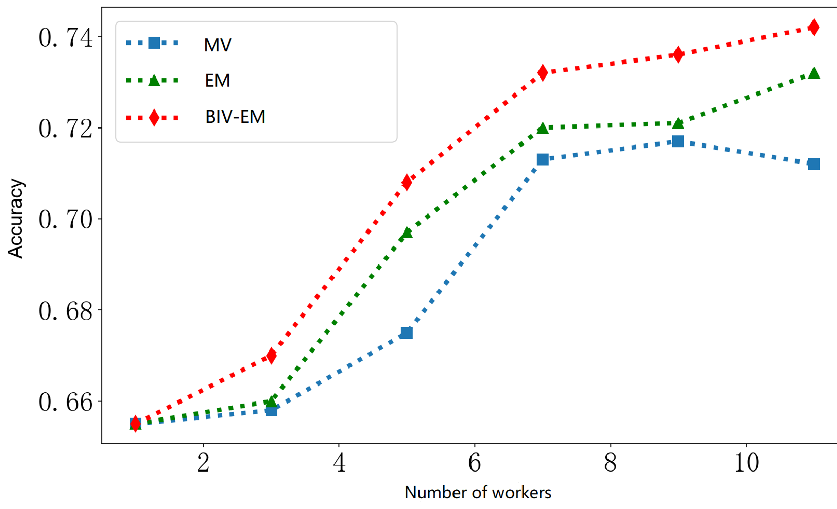
As shown below, BIV-EM consistently yields higher accuracy than both Majority Vote and standard EM. This confirms that a "smart start" based on reputation and familiarity prevents the algorithm from being misled by early noise.
2. Malicious Actor Suppression
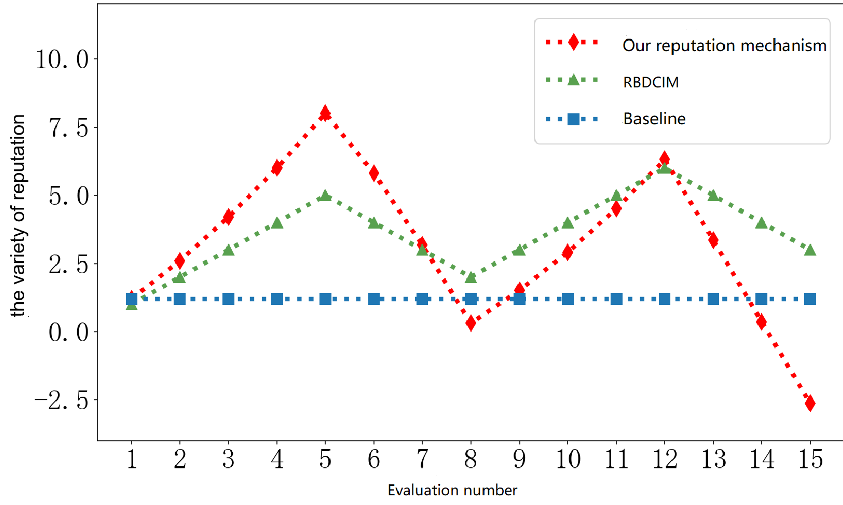
The reputation model includes a Persistence Factor (for rewards) and a Sigmoid-based Penalty Factor. The experiment shows that a worker's reputation drops below the participation threshold much faster than in baseline models if they submit poor-quality work consistently, making the cost of "malicious behavior" prohibitively high.
Deep Insight & Conclusion
BC-CQAM proves that blockchain is more than just a ledger; it is a verification layer. By moving the "Judger" role from the requester to a decentralized smart contract, the authors eliminate the conflict of interest inherent in traditional crowdsourcing.
Takeaway: If you are building crowdsourcing systems, the "initialization" of your truth-discovery algorithm is as important as the decentralization of your database. Using historical reputation to weight initial votes is a simple yet powerful heuristic to ground iterative models in reality.
Limitations: The paper notes that BIV-EM, being iterative, consumes more time than Majority Vote as the number of workers grows. Future work should focus on optimizing the gas costs and computational efficiency of these smart contracts for large-scale deployments.