
QAOTA: Ensuring High-Quality Results in the Dynamic World of Mobile Crowdsourcing
ality-aware Online Task Assignment in Mobile Crowdsourcing
The paper introduces QAOTA (Quality-aware Online Task Assignment), an online framework for mobile crowdsourcing that maximizes task result accuracy using a probabilistic quality model and a "hitchhiking" worker movement model. It achieves a proven competitive ratio of 7/10 compared to the optimal offline solution.
TL;DR
Mobile Crowdsourcing (MCS) is power-hungry for data but vulnerable to unreliable workers. QAOTA (Quality-aware Online Task Assignment) addresses this by modeling task quality through probabilistic majority voting and worker movement as "hitchhiking." The breakthrough is a greedy online algorithm that guarantees at least 70% of the optimal offline performance, even when workers and tasks appear unpredictably.
Background: Why "Bipartite Matching" isn't Enough
Most existing crowdsourcing platforms treat task assignment as a simple bipartite graph matching problem: Match Worker A to Task B to minimize distance. However, this ignores two harsh realities:
- Worker Unreliability: In the real world, "crowd" means "noisy." Without tracking worker history (due to privacy), how do you ensure the reported data is correct?
- Movement Dynamics: Mobile workers aren't floating points; they are commuters with specific destinations and limited detours (the "Hitchhiking" behavior).
The Core Challenge: Tracking Quality Without Tracking People
The authors define task quality as the probability of getting a correct answer from workers using majority voting.
The mathematical headache? This function is non-monotonic. Adding a second worker to a task doesn't necessarily improve quality over one worker because an even number of votes increases the chance of a tie.
The Research Insight
To fix this, the team designed an auxiliary metric, , which smooths out the quality increments. By proving this new metric is monotonic and submodular, they could leverage greedy optimization theory to provide a "worst-case" performance guarantee—a rarity in complex online spatial problems.
Methodology: The QAOTA Framework
The system follows a three-step logic:
- Task Arrival: Estimate task difficulty based on historical data.
- Worker Arrival: When a worker ϖi appears with a destination and a "detour budget" , the system needs to find a path.
- HSWA (Hitchhiking Single Worker Assignment): A Branch and Bound algorithm searches for the sequence of tasks that maximizes the potential quality gain () without blowing the worker's travel budget or capacity.
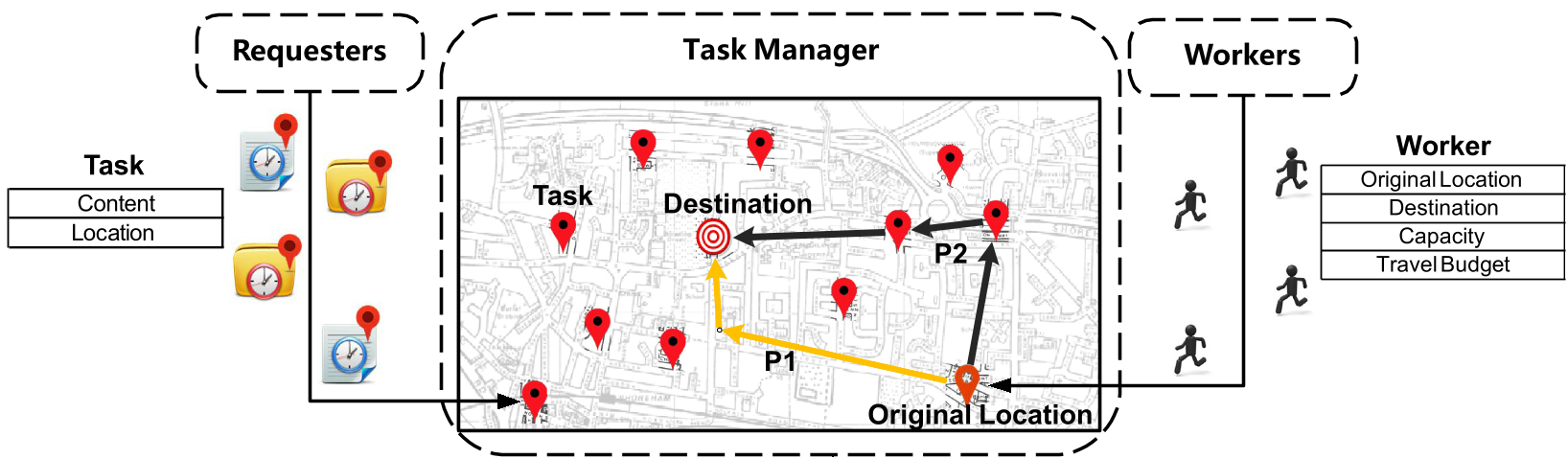 Figure 1: Architecture of a mobile crowdsourcing platform involving Requesters, Workers, and the Task Manager.
Experiments & Results
The researchers didn't just stick to simulations; they used real-world taxi traces from Shanghai (4,000 taxis, 10,000 trips) to test the algorithm's mettle.
Key Findings:
- Competitive Ratio: Theoretically proven at . In practice, the performance was often much closer to the offline optimal.
- Superiority over Heuristics: Benchmark methods like "Nearest" (pick the closest task) or "Least Expiration" (pick the task about to vanish) failed to maintain data quality because they didn't "invest" multiple workers into difficult tasks.
- Efficiency: Even with 6,000 active tasks, the system processed worker assignments in under 1.5 seconds, making it viable for massive platforms like Meituan or Gigwalk.
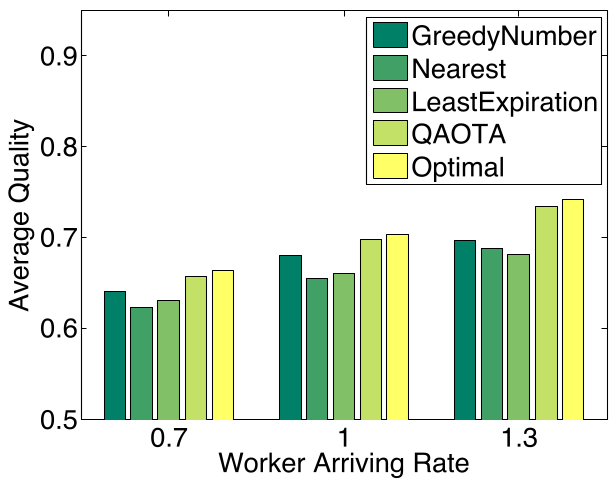 Figure 2: Performance on large synthetic datasets showing QAOTA consistently outperforming Nearest and LeastExpiration heuristics.
Critical Insight & Conclusion
QAOTA proves that quality control doesn't have to be a post-processing step. By integrating probabilistic reliability directly into the routing and assignment logic, platforms can proactively ensure data integrity.
Limitations: The model currently assumes (the crowd is better than a coin flip) and focuses on binary tasks. Future work could expand this to complex real-valued data or multi-stage tasks.
For developers of spatial platforms, the takeaway is clear: stop assigning tasks based on distance. The "quality-per-mile" is the metric that actually scales.
Takeaway: QAOTA bridges the gap between theoretical submodular optimization and the messy, dynamic reality of mobile human sensors.