
Beyond Efficiency: Balancing Quality and Speed in Opportunistic Crowdsourcing
Quality-Aware Task Assignment in Opportunistic Network-Based Crowdsourcing
The paper introduces two novel task assignment schemes, Quality-Aware Task Assignment (QA-TA) and Minimum Quality Threshold Task Assignment (MQT-TA), for mobile crowdsourcing within Opportunistic Networks (ONs). By leveraging Optimal Stopping theory, these methods optimize either task quality or makespan considering worker expertise and intermittent node contacts, outperforming existing greedy baselines.
TL;DR
Mobile crowdsourcing in Opportunistic Networks (ONs) often treats workers as uniform entities, focusing solely on how fast a task can be completed (makespan). This paper breaks that mold by introducing QA-TA and MQT-TA—two algorithms that use Optimal Stopping theory to prioritize worker expertise. They prove that you don't have to sacrifice quality for speed, even in networks where connections are intermittent and unpredictable.
The "Quality" Problem in Opportunistic Networks
Imagine asking a crowd of people to take high-resolution photos of a landmark or survey Wi-Fi signals. In a standard network, you'd just pick the person with the best camera. But in an Opportunistic Network (ON), you can only assign a task when you physically "bump" into a worker.
Current state-of-the-art methods like FTA are greedy: they often hand the task to the first worker they meet just to get it done quickly. The result? Poor quality results from unqualified workers. The challenge is knowing when to pass on a mediocre worker in hopes of meeting an expert later, without missing your deadline.
Methodology: The Logic of Optimal Stopping
The authors solve this by treating task assignment as a mathematical "stopping problem." Instead of a simple greedy choice, the requester calculates the Maximum Expected Reward (in the case of QA-TA) or Minimum Expected Cost (in MQT-TA).
1. QA-TA (Quality-Aware Task Assignment)
This scheme targets the maximize of average quality within a fixed deadline. Using backward induction, the requester compares the value of assigning a task to the current worker (based on their expertise ) against the expected value of waiting for future contacts.
2. MQT-TA (Minimum Quality Threshold)
Here, the goal is reversed: minimize the time taken (makespan) while ensuring every task meets a minimum quality bar . It filters workers into a candidate set and uses cost-functions to decide the fastest path to completion.
 The core recursive formula (1) used to determine the optimal stopping point by comparing current reward against expected future gains.
Experiments and Performance
The researchers tested their algorithms against a Best-possible (Oracle) scenario and the traditional FTA baseline using the Infocom 2005 dataset (41 nodes over 4 days).
Key Findings:
- Quality Boost: QA-TA significantly outperformed FTA in quality, staying remarkably close to the theoretical performance bound—within a 7% gap.
- Efficiency: MQT-TA proved superior in minimizing makespan compared to modified quality-aware versions of legacy algorithms, maintaining a 4% gap from the absolute optimal makespan.
- Deadline Sensitivity: As deadlines increase, the quality of QA-TA improves because the algorithm has more "options" to hold out for an expert worker.
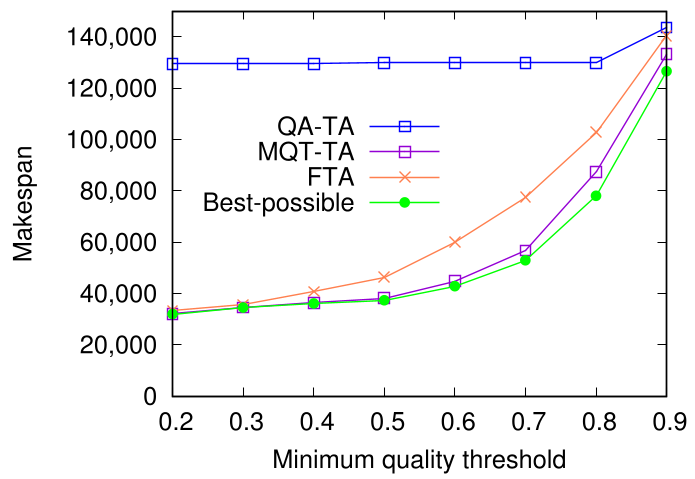 Fig 2. The average task quality increases as the deadline allows for more opportunistic encounters with high-expertise nodes.
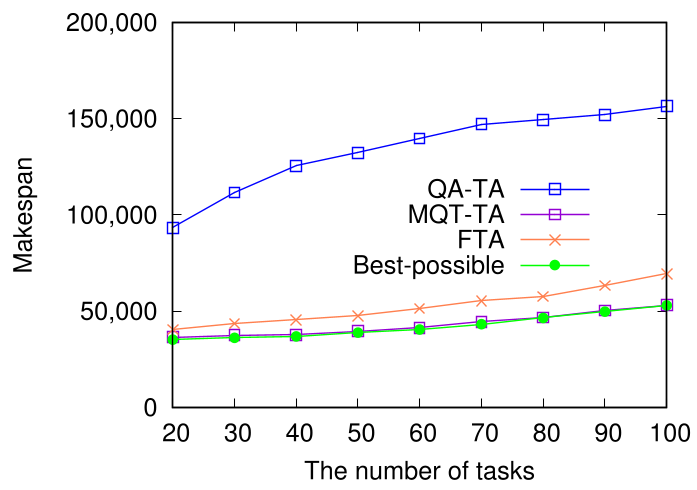 Fig 4. MQT-TA (lower line) effectively keeps the makespan low compared to QA-TA, which purposefully delays tasks to find better workers.
Critical Insight & Future Outlook
The brilliance of this work lies in its application of Optimal Stopping. It moves the field of mobile crowdsourcing away from "first-come, first-served" toward an "intelligent-wait" strategy.
Limitations: The model currently assumes the requester knows the set of contact frequencies in advance. In a real-world, highly dynamic scenario, these frequencies might shift, requiring an online learning component to adjust the stopping criteria in real-time.
Takeaway: For developers of location-based services or IoT data collection systems, this paper provides a robust mathematical foundation for ensuring that "mobile" doesn't mean "low quality."