
Budget-TASC: Optimizing Credibility in the Gig Economy's Physical Frontier
ality and Budget Aware Task Allocation for Spatial Crowdsourcing
This paper introduces Budget-TASC, a novel task allocation approach for spatial crowdsourcing that maximizes result quality under a fixed budget. It uniquely integrates worker reputation with spatial proximity to select the most "credible" contributors for location-based tasks.
TL;DR
Spatial crowdsourcing (like Uber or TaskRabbit) requires workers to be at the right place at the right time. This paper introduces Budget-TASC, an algorithm that balances a limited budget with the need for high-quality results. By treating a worker's "reliability" as a function of both their past performance and their physical distance to a task, it significantly reduces error rates compared to non-spatial or budget-unaware baselines.
The Problem: The High Cost of Physical Presence
In traditional crowdsourcing (like Amazon Mechanical Turk), location is irrelevant. However, in Spatial Crowdsourcing, travel incurs costs and fatigue. Current research faces a dichotomy:
- Volunteer-based models assume workers are self-motivated (ignoring payment).
- Budget-based models treat workers as abstract entities, ignoring that a highly reputable worker 20km away might be less "credible" for a local task than a medium-reputable worker 1km away.
The authors argue that a requester needs to maximize the collective "credibility" of the result without exceeding a set financial ceiling.
Methodology: Ranking via Spatial Credibility
The core innovation lies in the Credibility Formula. A worker's credibility is not a static number; it is their reputation multiplied by a distance-based discount factor .
The Proximity Discount
The further a worker is from the task location , the lower their "effective" reputation becomes. This accounts for the physical friction of spatial tasks.

The Budget-TASC Algorithm
The algorithm follows a strategic selection process:
- Rank: Calculate credibility for all workers and rank them.
- Select: Iteratively pick the best workers while checking two constraints:
- Do they fall within the "acceptance radius" ?
- Does their cost (based on reputation tier) fit the remaining budget ?
- Optimize: It uses a greedy approach to find the set that maximizes total credibility.
Experimental Results
The researchers validated their approach using a subset of the Foursquare dataset for Singapore, involving nearly 14,000 users and 430 venues.
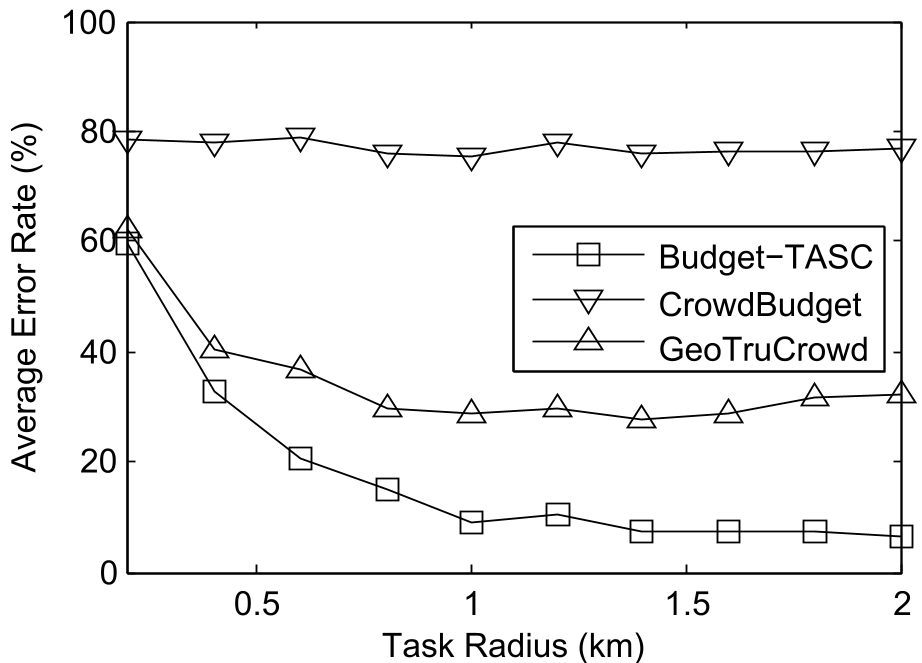
As shown in the figure above, Budget-TASC (the bottom-most line) consistently yields a lower average error rate than GeoTruCrowd (which ignores budget) and CrowdBudget (which ignores space). Even as the task radius increases—making the task "easier" to fill—Budget-TASC maintains its edge by intelligently selecting the best reliability-to-cost ratio.
Critical Insight & Future Outlook
The beauty of Budget-TASC is its simplicity: it treats distance as a signal of reliability. However, from a modern perspective, the model is somewhat static. It assumes worker locations are fixed at time and does not account for workers' future trajectories or competitive bidding between multiple concurrent tasks.
Future Work in this area could involve:
- Dynamic Pricing: Adjusting payments based on real-time demand.
- Path Optimization: Rewarding workers who can complete multiple nearby tasks in one trip.
Overall, this work provides a foundational framework for any platform that needs to manage a mobile workforce under strict financial constraints.