
Precise Localization through the Crowd: A Spatial-Temporal Quality Control Approach
Quality Control for Crowdsourcing with Spatial and Temporal Distribution
The paper introduces a spatial-temporal quality control framework for crowdsourcing, specifically applied to Access Point (AP) localization in indoor Location-Based Services (LBS). It utilizes a filtering-aggregating-feedback pipeline implemented on the MapReduce model to improve localization accuracy and worker credibility assessment.
TL;DR
As Location-Based Services (LBS) grow, crowdsourcing has become the go-to paradigm for mapping the physical world. However, noisy data and "cheaters" pose a massive threat to accuracy. This paper from SJTU introduces a robust framework that filters, aggregates, and provides feedback on crowdsourced data by treating location information as a variable that decays across space and time, achieving over 80% accuracy in AP localization.
The Core Challenge: Noise, Cheaters, and Scale
In indoor LBS, users submit Access Point (AP) IDs and positions to build a global map. But two things go wrong:
- Technical Noise: Smart devices aren't always precise, and wireless interference creates anomalies.
- Incentive Misalignment: Workers may submit the same record repeatedly to farm rewards, effectively "poisoning" the dataset with redundant or false info.
Most current systems fail because they treat every submission with equal weight or fail to scale when data hits the Terabyte range.
Methodology: The Spatial-Temporal Shield
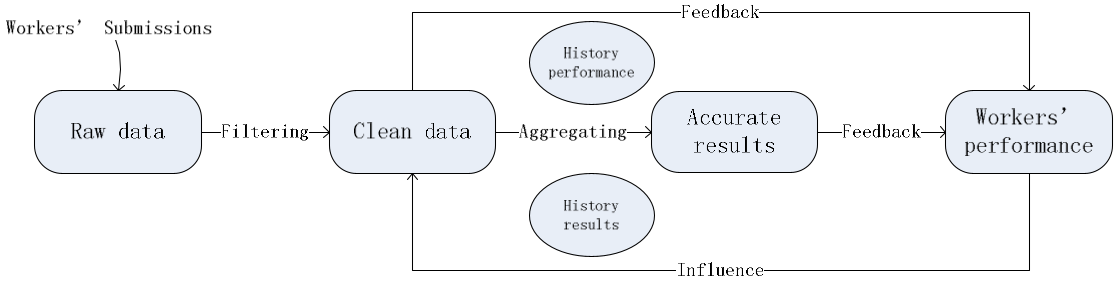
The authors propose a three-stage pipeline (Filtering, Aggregating, and Feedback) powered by MapReduce (Hadoop) to handle industrial-scale data.
1. Spatial Filtering (Reducing Redundancy)
The system identifies "meaningless" records by looking at spatial frequency. If a worker submits the same AP coordinates multiple times within a short period, the value () of those records is exponentially decayed using a shrink factor .
- Insight: In the physical world, an AP’s position is fixed. Frequent identical reports don't add information; they add noise.
2. Temporal Aggregation (Trust Over Time)
The system maintains a credibility score () for each worker.
- High Credibility workers: Their submissions are accepted completely ().
- Mid-range workers: Their submissions are accepted partly, and the system "augments" the data by generating close semantic neighbors to see if a consensus can be reached.
- Low Credibility workers: Data is discarded.
3. Majority Decision Approach (MDA) on MapReduce
Instead of a simple vote, the aggregation uses a weighted majority decision. The weight of a "vote" for an AP location is the product of the record's value and the worker’s credibility.
This MapReduce implementation ensures that even with massive traffic, the server can group millions of records by apid:pos and find the "Truth" by identifying the highest cumulative quality score.
Experimental Results: Accuracy vs. Efficiency
The team simulated 1,000 workers and 1,500 APs over 30 days.
- Accuracy Leap: Without these controls, accuracy plummeted below 30% as cheaters dominated the system. With the Quality Table and Filtering, accuracy climbed and stabilized above 80%.
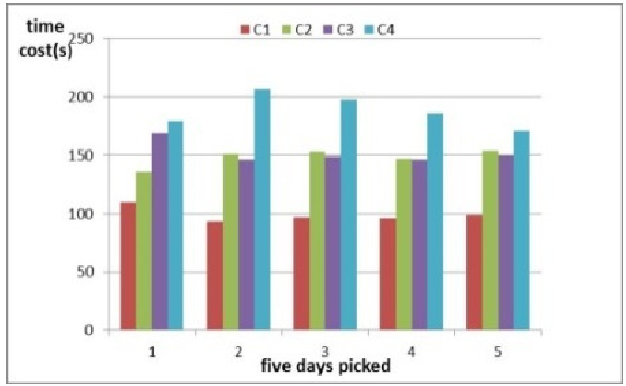
- The Cost of Truth: The improved accuracy comes at a computational price—processing times were 2-3x longer due to the extra filtering and logic steps, though this is mitigated by Hadoop's horizontal scaling.
Critical Analysis & Conclusion
This work demonstrates that "Quality" in crowdsourcing isn't just about a binary "Correct/Incorrect." By utilizing Sliding Window Analysis, the system creates a feedback loop where worker reputation is dynamic—bad actors can redeem themselves over time, and consistent contributors are rewarded with higher influence.
Takeaway: Future crowdsourcing platforms must move away from static reputation systems. By embracing spatial-temporal decay, we can build systems that are resilient to the inherent messiness of human-generated data.
Limitations: The "distance" metric used in the paper is a simplification (Manhattan-style on grids). In complex indoor environments with multiple floors and walls, a more sophisticated signal-propagation model would be needed to define "semantic closeness" more accurately.