
WeChat, Hangout, or Facebook? A Deep Dive into Calling Quality of Experience (QoE)
Quality of experience assessment of calling services in social network
The paper evaluates the Quality of Experience (QoE) of calling services across three major social networks—Facebook, Google Hangout, and WeChat—using both Mobile Networks (3G) and Broadband Networks (BN). It employs a subjective assessment methodology via questionnaires to determine user satisfaction levels regarding audio quality, video quality, and voice quality during video calls.
TL;DR
In the battle of social network calling services, network infrastructure isn't the only factor—the application's architecture matters just as much. This study reveals that WeChat offers superior audio and video experiences on broadband, while Google Hangout maintains better voice stability on mobile networks. Facebook, plagued by background resource consumption, consistently lags in user satisfaction across 3G environments.
The Blind Spot of QoS: Why Hardware Isn't Everything
For years, telecommunication providers have focused on Quality of Service (QoS)—the technical "plumbing" of the internet (latency, jitter, and bandwidth). However, this paper argues that QoS doesn't tell the whole story.
The industry is shifting toward Quality of Experience (QoE), which measures the subjective satisfaction of the human at the end of the line. The authors identify a critical gap: while social network (SN) providers upgrade hardware to boost QoS, they often ignore the application-level "friction" (like Facebook's auto-loading images) that destroys the user experience during a call.
Methodology: Subjective Assessment in the Wild
To bridge this gap, researchers conducted a study in Pakistan involving 62 users (a mix of technical students and general employees). They tested three giants: Facebook, Google Hangout, and WeChat.
The experiment was categorized by two major variables:
- Network Type: 3G Mobile Networks (MN) vs. Broadband Networks (BN).
- Service Type: Pure Audio Calls and Video Calls (further split into voice quality vs. video quality).
Architecture of the Comparison
The study emphasizes that the "heaviness" of an application impacts its calling performance. For instance, Facebook’s integration of a complex newsfeed that constantly syncs data in the background competes for the same limited 3G resources as the voice stream.
Key Findings: The Winners and Losers
1. The WeChat Dominance
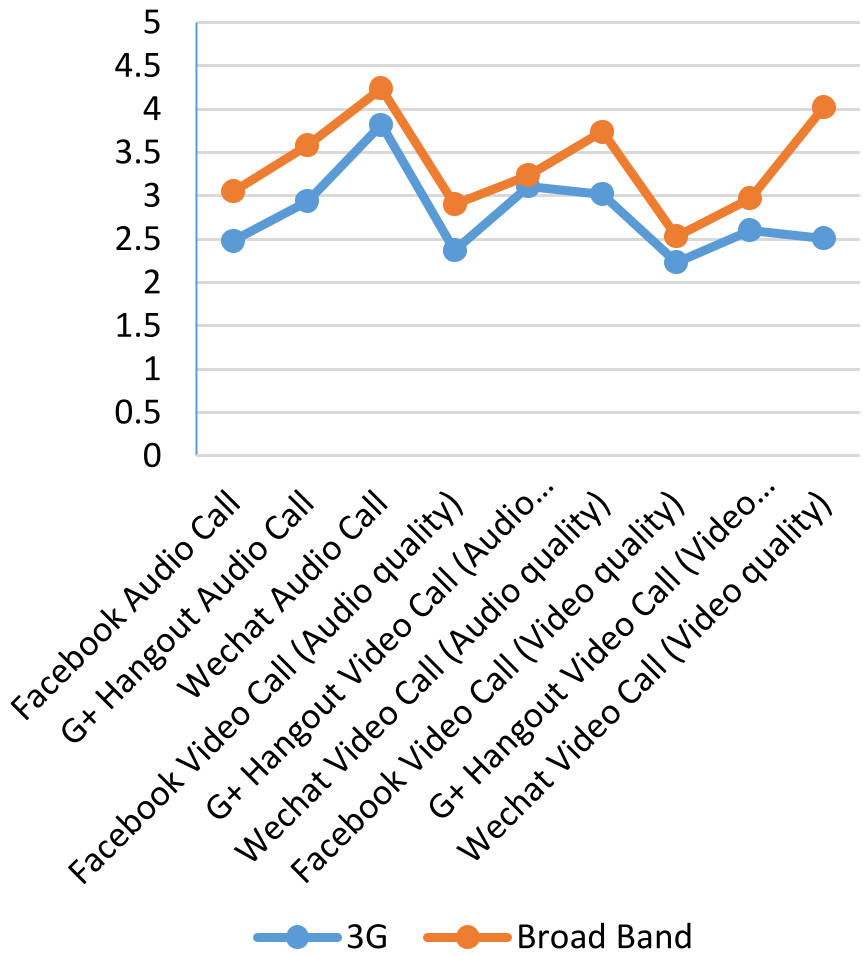
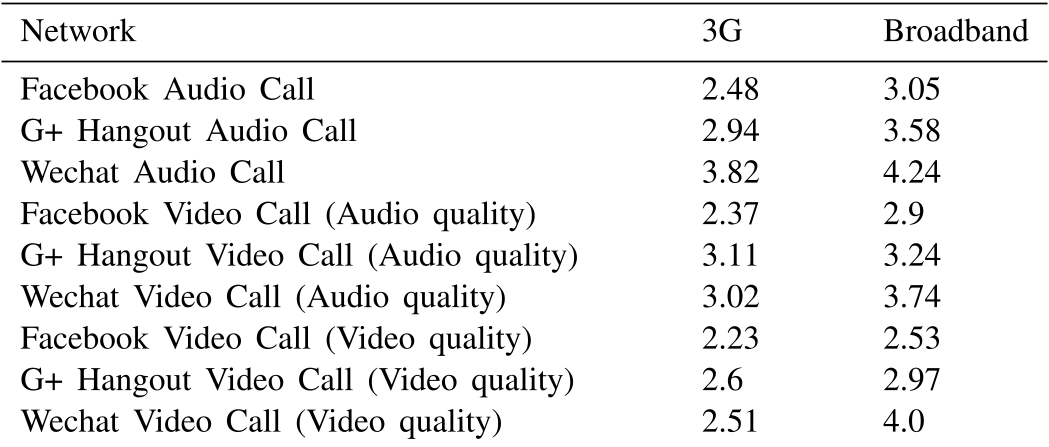
WeChat achieved the highest Mean Opinion Score (MOS).
- Audio Call (Broadband): 4.24 (Excellent).
- Video Quality (Broadband): 4.0 (Good/Excellent). The underlying takeaway is that WeChat’s optimization for broadband environments allows it to provide a "cleaner" stream compared to its competitors.
2. The Facebook Resource Struggle
Facebook consistently ranked lowest on 3G networks.
- Audio Quality (3G): 2.48 (Poor/Fair).
- Video Quality (3G): 2.23 (Poor). The authors noted that the Facebook application is "heavy." Its auto-loading of images and videos shared by friends consumes bandwidth that should be reserved for the live call, leading to significant packet loss and audio roughness.
3. Google Hangout: The Voice Specialist
While WeChat won on broadband, Google Hangout proved its mettle on mobile networks for voice stability during video calls (MOS: 3.11 on 3G), suggesting a more robust audio codec for jitter-prone environments.
| Service Item | 3G MOS | Broadband MOS |
|---|---|---|
| WeChat Audio Call | 3.82 | 4.24 |
| G+ Hangout Audio Call | 2.94 | 3.58 |
| Facebook Audio Call | 2.48 | 3.05 |
Critical Insight: The Application is the Bottleneck
The most profound takeaway from this study is that Network Stability (QoS) ≠ User Happiness (QoE).
Even on a stable 3G connection, an application that prioritizes background data sync (like Facebook) will provide a worse calling experience than a more streamlined app. For developers, the message is clear: if you want to win at real-time communication, you must implement "Call Mode" logic that suppresses non-essential background tasks to protect the media stream.
Future Outlook & Limitations
While this study provides a clear snapshot of user perception, it is limited by a relatively small, male-dominated sample size in a specific geographic region (Pakistan). Future research should explore:
- Automated QoE Mapping: Moving from subjective questionnaires to AI models that predict MOS based on real-time packet headers.
- Impact of 5G: How the massive bandwidth of 5G changes the "background resource" problem noted in this paper.
In conclusion, for users in low-bandwidth regions or on 3G networks, Google Hangout remains a reliable choice for voice, while WeChat stands as the king of high-fidelity broadband communication.