
Establishing the "Social Contract": A Quality Model for Networks of Web Services
A quality model for social networks populated with web services
The paper proposes a Quality of Social Network (QoSN) model designed for Social Web Services (SWS) to evaluate and select networks based on non-functional criteria. It introduces a decentralized framework using Secure Multi-Party Computation (SMC) to calculate robustness and trust scores without compromising the private performance data of individual services.
TL;DR
As Web Services begin to "socialize" to improve discovery and composition, they face a paradox: to collaborate, they must expose themselves to potential competitors. This paper introduces QoSN (Quality of Social Network), a mathematical framework and cryptographic protocol that allows Web Services to evaluate the safety of a network before joining. By using Secure Multi-Party Computation (SMC), services can verify a network's robustness and trust levels without ever revealing their private operational data.
Background: When Services Get Social
The evolution of Web 2.0 has led to the rise of Social Web Services (SWS). Unlike static APIs, SWS establish contacts, form collaborative groups, and navigate competition. However, joining a network is risky. Much like a person joining a new social media platform, a Web Service must worry about:
- Privacy: Will the network authority leak my non-functional performance data?
- Robustness: How well can this network defend against malicious peers?
- Fairness: Am I being treated equally compared to my competitors?
The Problem & Research Intuition
Existing models focus on Quality of Service (QoS)—how the service performs for the user. But in a socialized world, we need to measure the Quality of the Network (QoSN)—how the environment protects its members.
The authors argue that a SWS should only join a network if it meets specific safety thresholds. But there is a catch: to calculate the network's average safety, members usually have to report their own "attack failure rates" to an authority. This creates a new vulnerability. The authors’ insight was to use Secure Multi-Party Computation (SMC) to perform this audit blindly.
Methodology: The QoSN Framework
The paper defines four pillars of QoSN, focusing specifically on Robustness and Trust.
1. Robustness Criteria
Robustness is measured by the ratio of failed attacks to total attacks within the network. In a competition network, this ensures that a service’s sensitive details (like publications or patents in the scientific consortium scenario) are not disclosed to unauthorized competitors.
2. Trust (Authority & Group)
Trust is decomposed into:
- Authority Trust: The belief that the network admin won't leak private credentials.
- Group Trust: The belief that other members won't leak shared collaborative secrets to outsiders.
3. Cryptographic Computation (SMC)
To compute these without a "Trusted Third Party," the authors utilized the FairPlay project. They wrote secure functions in SFDL (Secure Function Definition Language) that compile into boolean circuits.
 Conceptualizing the Social Web Service ecosystem where services interact via specialized networks.
Experimental Validation
The authors built a Java simulator to track how networks evolve under three policy cases. The key metric was the IDS (Intrusion Detection System) accuracy of the member services.
- Case 1 (Strict): Both SWS and the Network require high quality. Result: High stability and robustness.
- Case 3 (Relaxed): Networks allow anyone to join. Result: "Weak" services with poor security migrate to high-quality networks and "infect" the environment, dragging down the overall QoSN.
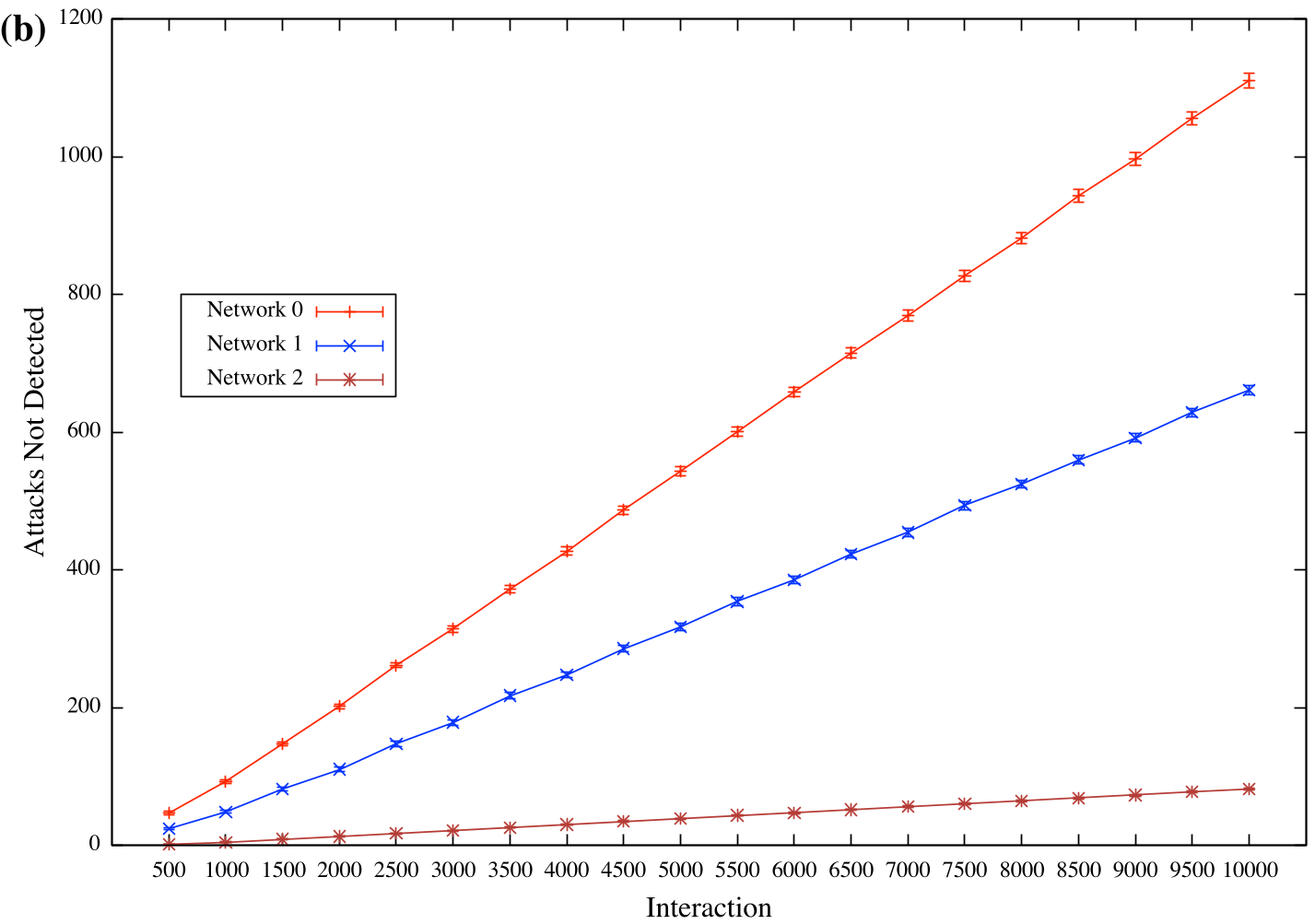 Simulation results showing the relationship between Robustness and the number of undetected (successful) attacks.
Deep Insight & Conclusion
This paper provides a rigorous foundation for what we now see in Decentralized Trust environments. The most profound takeaway is that Network Quality is an emergent property of its members. If a network does not have an "admission bar" based on verified robustness (calculated via SMC), it is doomed to a "race to the bottom" where poorly secured services compromise the safety of everyone else.
Limitations & Future Work
While the Robustness and Trust metrics are robust, the Fairness and Traceability criteria remain theoretical in this specific paper. Future research is needed to implement these more complex social behaviors into the cryptographic computation layer.