
QuantCloud: Revolutionizing Quantitative Finance with Data-Driven Big Data Execution
QuantCloud: Enabling Big Data Complex Event Processing for Quantitative Finance Through a Data-Driven Execution
The paper introduces QuantCloud, an integrated big data platform designed for Quantitative Finance (QF) that pipelines complex event processing using a data-driven execution paradigm. It achieves SOTA-level efficiency by processing Exabyte-level datasets with microsecond latency, specifically handling NYSE tick data for cleaning, aggregating, and ARMA modeling.
Executive Summary
TL;DR: QuantCloud is a high-performance integrated platform that solves the "Big Data" challenge in Quantitative Finance by using a data-driven execution model. It transforms raw market "dirty data" into actionable signals through a sophisticated pipeline of cleaning, aggregation, and modeling, achieving sub-microsecond latency and throughput in the millions of messages per second.
Background: Within the academic and industrial intersection of finance and tech, this work represents a major leap in Complex Event Processing (CEP). It moves beyond simple parallelization to a task-dependency-aware execution model, positioning itself as a robust alternative to traditional tools like Matlab for high-frequency trading (HFT) research.
The "Zettabyte" Problem in Finance
The finance industry no longer measures data in Terabytes; we are entering the era of Zettabytes. With US market transactions increasing 50x in the last decade, the bottleneck isn't just storing the data—it's processing the dependencies. An Autoregressive-moving average (ARMA) model cannot run until the log returns are calculated, which in turn cannot run until the tick data is cleaned. Traditional sequential or simple time-based schedulers leave CPU cores idling while waiting for upstream data.
Methodology: The Data-Driven Engine
The core innovation is the Data-Driven Execution Paradigm. Instead of a fixed schedule, the system treats the entire financial workflow as a directed graph where nodes are tasks and edges are data flows.
1. Architectural Logic
QuantCloud partitions the system into three distinct layers:
- Server: Manages time-series data storage with hashing and compression.
- Client: The "Brain" where the data-driven processing module resides.
- User: A simple XML-based portal for task submission.
2. The Hybrid Scheduler (HSched)
The system employs two logic types:
- TSched (Time-Dependent): Used for root nodes (data fetching) to prevent overwhelming the consumer.
- DSched (Data-Dependent): Used for downstream processing. A task is triggered only when its input data queue is marked "dirty" (ready).
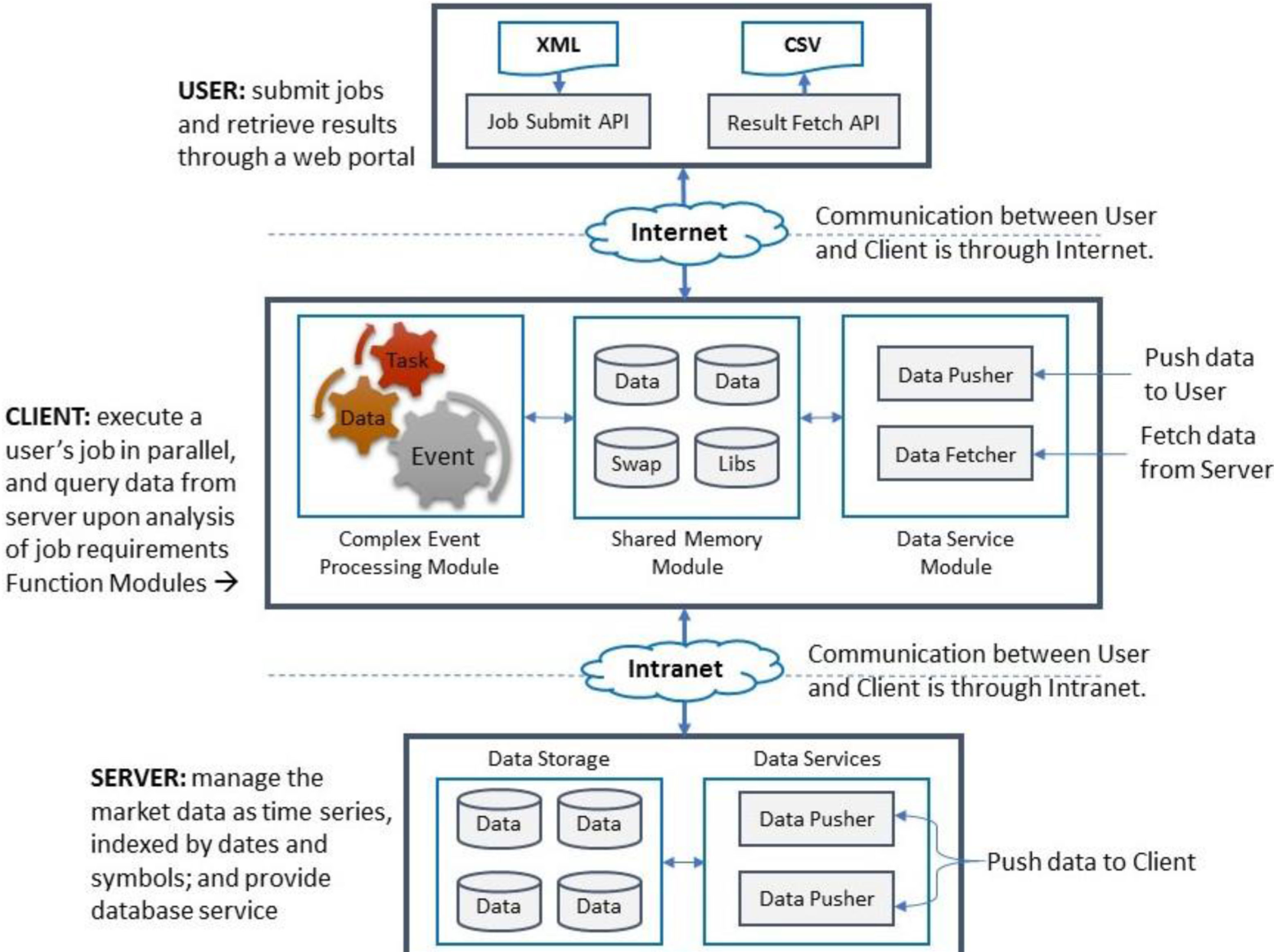 Figure: The QuantCloud architecture separating Data (Server) from Function (Client).
From Raw Ticks to ARMA Models
The authors demonstrate the platform's power through four critical use cases:
- Seasonal Volatility Calculation: Aggregating one-minute bar prices from raw ticks.
- Proprietary Database Integration: Sharing "cooked" data to save resources.
- Moving Window Volatility: Utilizing sample variance and medians for robust estimation.
- ARMA Modeling: Implementing Gauss-Newton optimization for mean-reverting signals.
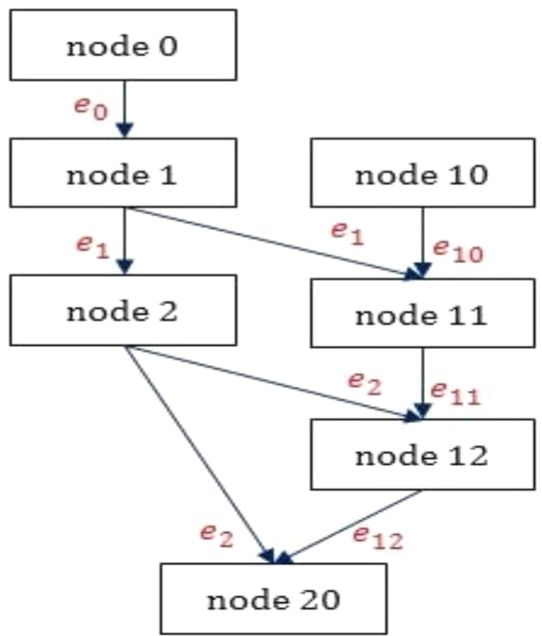 Figure: The collaborative workflow between worker and scheduler threads.
Experimental Performance: Shattering Benchmarks
Testing against New York Stock Exchange (NYSE) TAQ data, the results are staggering:
- Throughput: For BBO (Best Bid/Offer) data, QuantCloud achieved metadata throughput of 2.28 Gbps, nearly hitting the physical limit of SATA 2 storage drives (3 Gbps).
- Latency: Processing latency for individual tick messages remained in the sub-microsecond range.
- QuantCloud vs. Matlab: In ARMA modeling tests, QuantCloud was three orders of magnitude faster than the Matlab Financial Toolbox. While Matlab took over 10,000 seconds for 10 stocks, QuantCloud finished in 10.38 seconds.
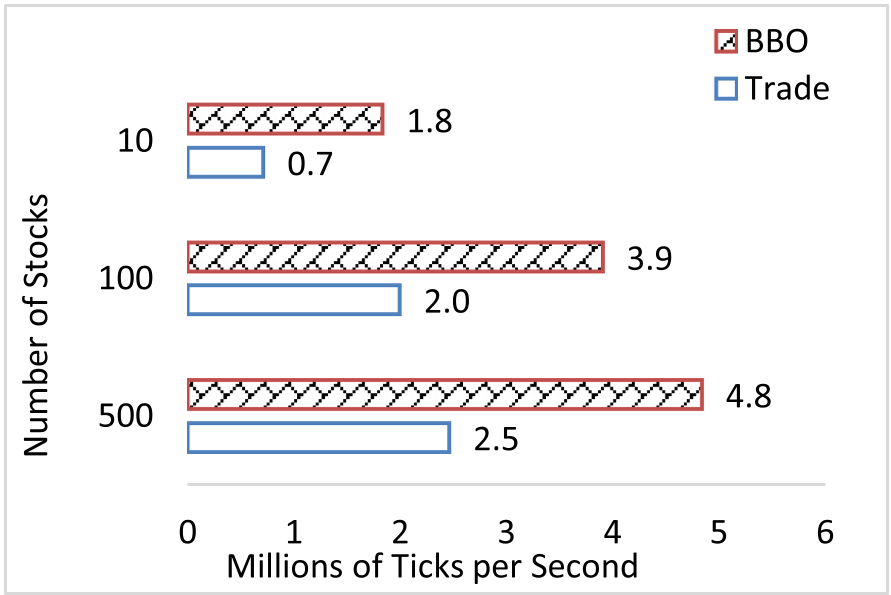 Figure: Throughput results confirming the scalability of the platform as stock volume increases.
Critical Analysis & Future Outlook
Takeaway: QuantCloud proves that "Big Data" in finance is actually a "Big Analytics" problem. By untangling task dependencies, the platform allows financial engineers to focus on model logic rather than the plumbing of parallel execution.
Limitations:
- The current prototype is heavily optimized for C++, which might be a barrier for quants used to Python.
- Full Exabyte-scale testing in a live production environment (vs. historical NYSE traces) remains to be documented.
Future Work: The authors aim to bridge the "Language Gap" by creating template libraries for Python (NumPy) and Matlab callbacks, potentially making QuantCloud the backend engine for the world's most popular financial research languages.