
The Economic Trap of Future Internet Architectures: Why Superior Tech Fails to Deploy
16784_Quantifying Deployability and Evolvability of Future Internet Architectures via Economic Models.
This paper proposes a game-theoretic economic model to quantify the deployability and evolvability of Future Internet Architectures (FIAs). By analyzing decentralized ISP decision-making, the authors identify coordination among critical ISPs as the primary barrier to adoption, explaining the historical success of CDNs versus the stagnation of IPv6 and DiffServ.
TL;DR
Why did IPv6 take decades to gain traction while CDNs exploded overnight? This paper argues that technical superiority is irrelevant if the economics of "coordination" don't line up. By modeling ISPs as rational actors in a game-theoretic framework, the researchers quantify the exact tipping point where a new architecture becomes deployable, citing "coordination difficulty" as the hidden killer of network evolution.
Background: The Evolution Paradox
We live in an era where Netflix streams and IoT devices demand low latency and high security. Yet, the backbone of the Internet—IPv4—is a relic of the 20th century. Proposed replacements like NDN (Named Data Networking) or XIA (eXpressive Internet Architecture) offer massive improvements, but ISPs (Internet Service Providers) are notoriously reluctant to flip the switch. This paper shifts the focus from "How does the protocol work?" to "Why would an ISP pay for it?"
Problem & Motivation: The Coordination Stalemate
The core issue is that Internet traffic is a team sport. For a new functionality (like QoS guarantees) to work, every ISP along a path must participate. This creates a Coordination Failure:
- High Upfront Cost: Upgrading hardware and software is expensive.
- Uncertain Gains: An ISP only profits if everyone else on the path also upgrades.
- Risk Aversion: If a neighbor doesn't deploy, the early adopter loses their investment without gaining functionality.
Methodology: The Architecture Deployment Game
The authors model the network as a Strategic Game. Each ISP weighs the potential revenue share against the Launching Cost.
1. Revenue Sharing via Shapley Value
To solve the "Who gets what?" problem, the authors use a proposal-agreement process that converges to a Shapley Value. This mathematical approach ensures that ISPs with high "bargaining power"—those who are critical to many traffic flows—receive a larger share of the new architecture's profits.
2. The Potential Function
The researchers identify a "Potential Function" () that summarizes the collective state of the network. An architecture only reaches "Full Deployment" if the potential of all ISPs deploying is higher than the potential of doing nothing.
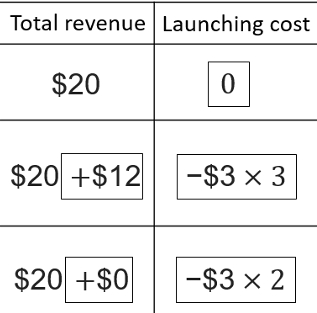 Fig 1: A simple 3-ISP chain demonstrates how a lack of full-path participation leads to zero revenue improvement, discouraging individual investment.
Key Insights: Why Some Tech Wins
The paper provides a quantitative explanation for several industry phenomena:
- Internet Flattening: Giant content providers (Google, Facebook) are bypassing transit ISPs by placing data centers closer to users. This reduces the "Degree of Coordination" (), making it easier to deploy new tech because fewer "critical ISPs" are needed per flow.
- The Success of CDNs: Unlike IPv6, CDNs can be deployed by a single provider at the edge. They don't require coordination from the entire path, leading to a low deployment threshold.
- MPQUIC vs. MPTCP: The model predicts Multipath QUIC will win over Multipath TCP because it encrypts headers, bypassing middleboxes and reducing the number of ISPs that need to "agree" to the protocol.
Experimental Results: Quantifying the Barrier
Using data from the GÉANT (European research network) and a synthesized IPv4 AS-level topology, the authors show:
- The 3.3x Rule: In the GÉANT network, an architecture typically needs to offer over 3 times the benefit relative to its cost before ISPs will naturally coordinate to deploy it.
- Incremental Gains: If an architecture provides some benefit even when only partially deployed (e.g., through tunneling), the barrier to full deployment drops significantly.
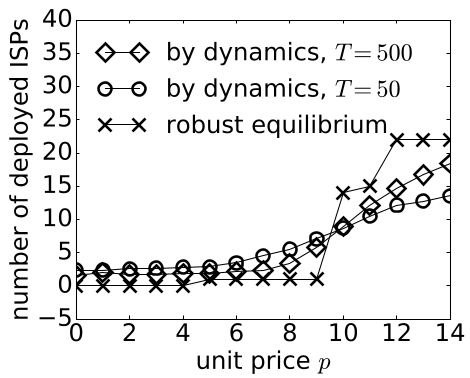 Fig 2: Simulation of Logit-Response Dynamics shows how ISPs eventually reach a 'Robust Equilibrium' as they reason about each other's decisions.
Critical Analysis & Conclusion
The paper concludes with a proposed Coordination Mechanism where a central "coordinator" (like an international body) manages quotes from ISPs to "tip" the network toward a new standard.
Takeaways for Researchers:
- Design for Incrementality: If your protocol requires everyone to upgrade at once, it is likely dead on arrival.
- Focus on the Edge: Architectures that can be deployed near users (like CDN or NAT) have a massive competitive advantage over network-layer protocols.
- Economic Evoluability: "Evolvability" isn't just a technical feature; it's the ability of a protocol to provide ROI at every step of its growth.
Final Thought: The future of the Internet isn't just being written in code; it's being negotiated in contracts.