
Beyond Shortest Paths: Quantifying Influence in Opportunistic Networks via Green’s Function
Quantifying individual communication capability in opportunistic mobile social networks
This paper introduces a novel framework to quantify individual communication capability in Opportunistic Mobile Social Networks (OMSNs) by extending the concept of combinatorial "walks" to dynamic settings using the Green’s function. The method models OMSNs as Time-Evolving Graphs (TEG) and derives a concise matrix-iteration formula to rank nodes based on their information propagation and receiving potential.
TL;DR
In the fragmented world of Opportunistic Mobile Social Networks (OMSNs), traditional "shortest path" metrics fail because a continuous path rarely exists. This paper reformulates node influence as a weighted dynamic walk problem. By applying the Green’s function from statistical physics, the authors create an iterative matrix-based tool that ranks nodes by how much information "flows" through them, accounting for the unique "store-carry-forward" behavior of mobile devices.
The Dynamic Dilemma: Why Static Metrics Fail
In a standard social network (like Facebook), if Node A and Node B are connected, a path exists. In an OMSN—based on Bluetooth or WiFi contacts between moving people—connections are fleeting. The network is essentially a "Time-Evolving Graph" (TEG) where snapshots are mostly empty space and isolated clusters.
The authors identify a critical gap: existing dynamic metrics like Katz Centrality are hindered by an attenuation factor that must be smaller than the reciprocal of the largest eigenvalue of the adjacency matrix. In a dynamic network, this eigenvalue changes constantly, making nearly impossible to tune.
Methodology: Physics-Inspired Connectivity
The core innovation lies in the transition from simple paths to Dynamic Walks and the use of the Green’s function.
1. The Power of Walks
Unlike a path, a walk allows nodes and edges to be revisited. This reflects the reality of OMSNs where information might "loop" within a cluster before a node moves and carries that data to a new partition.
2. Enter the Green’s Function
Instead of a linear attenuation , the authors use the Green’s function approach: The denominator serves a vital purpose: it penalizes long "loops" within a single time snapshot more heavily than "steps" taken across multiple snapshots. This mathematically prioritizes the forward progression of information through time.
3. Iterative Computation
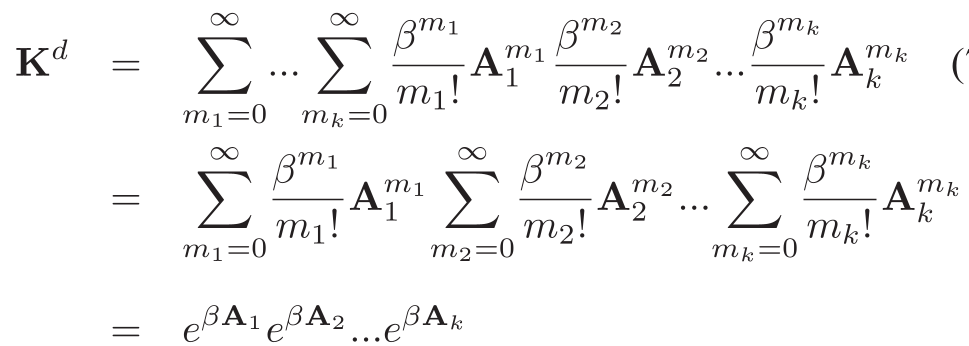
For a sequence of snapshots, the total communicability is the product of the exponentials of each snapshot’s adjacency matrix: This iteration-form allows for real-time updates as new contact data arrives.
Experimental Insights
The researchers tested their formula on four iconic datasets: Reality Mining, SigComm 2009, Mobility 2011, and INFOCOM 2005.
- Propagation Speed: Nodes ranked "Top" by the formula outperformed "Average" and "Bottom" nodes significantly. When the top-ranked node was the source, the message reached the network much faster.
- Receiving vs. Propagating: A fascinating discovery was the asymmetry of influence. In OMSNs, a node's receiving capability (how much it learns) fluctuates much more wildly with new contacts than its propagation capability (how much it spreads).
- Prediction Power: By using historical snapshots, the model successfully predicted which nodes would be influential in future windows, provided the parameter was optimized.
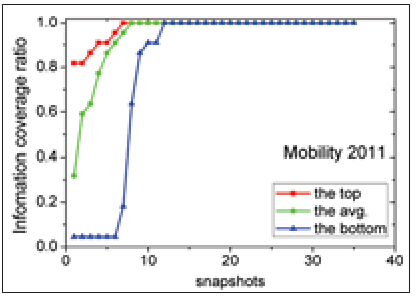 Fig 1: Using high-value Green's function nodes as sources leads to superior message coverage over time.
Critical Insight: The Role of
The parameter is treated as "inverse temperature." In physical terms, a lower (higher temperature/impact) makes nodes more heterogeneous—the gaps between the "super-spreaders" and the average nodes become more pronounced. This insight allows network administrators to adjust the ranking sensitivity based on the "noisy" nature of the environment.
Conclusion & Future Work
The paper successfully moves away from the "static topology" mindset, offering a robust tool for real-world mobile systems. While the computational cost of matrix exponentials can be high for massive networks, the spectral decomposition method proposed in Equation 9 offers a viable path for scalability.
Future Directions: A logical next step is exploring how this Green's function approach handles "malicious" propagation (e.g., mobile viruses) where the objective is to find the optimal nodes to immunize rather than to activate.