
Decoding the Pulse of Nations: Quantifying Political Legitimacy via Twitter
Quantifying Political Legitimacy from Twitter
This paper introduces a computational framework to quantify the "political legitimacy" of a populace using large-scale Twitter data. By combining Latent Dirichlet Allocation (LDA) for topic modeling and sentiment analysis, the authors derive an "L-score" that represents public acceptance of authority, achieving a high Pearson correlation (0.80) with traditional political science datasets.
TL;DR
Is it possible to measure how much a population trusts its government just by analyzing their tweets? This paper suggests the answer is a resounding yes. Researchers from Penn State have developed a method to calculate an L-score (Legitimacy Score) using LDA topic modeling and sentiment analysis. Their findings show that "local" tweets (Geo-tagged) are highly correlated () with official, slow-moving political science reports, potentially revolutionizing how we monitor global political stability in real-time.
Context & Motivation: Moving Beyond Hand-Picked Surveys
In political science, political legitimacy is the holy grail of stability metrics—it's the difference between a government that governs by consent and one that governs by force. Historically, measuring this required painstaking surveys and UN reports that are often years out of date.
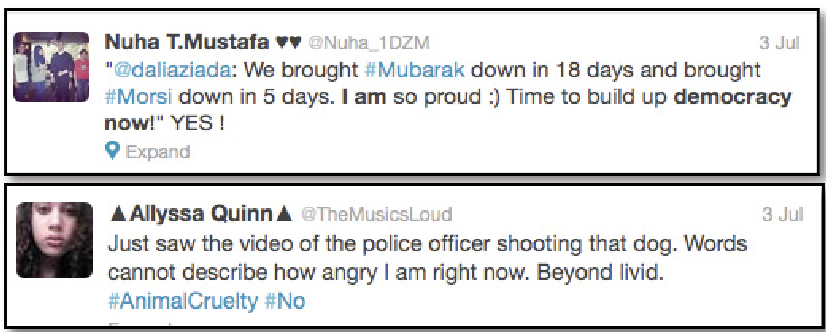
The authors' insight was simple but powerful: If people are unhappy with human rights, justice, or the law, they talk about it on social media. However, a single "angry tweet" isn't enough; legitimacy is multidimensional. One must capture the breadth of issues (democracy, war, economy) and the intensity of the sentiment simultaneously.
Methodology: The L-Score Pipeline
The researchers built a workflow that transforms "terse" 140-character messages into a robust quantitative metric.
1. Topic Vectorization
Instead of simple keyword counting, the authors used Latent Dirichlet Allocation (LDA) to discover latent topics within a political corpus. Each tweet is then projected into this -dimensional space. If a tweet discusses "military" and "voting," it receives weights in the corresponding "War" and "Election" dimensions.
2. The Formula for Legitimacy
The core of the paper is the L-score calculation for a single tweet : Here, represents the "strength" of the topics mentioned, while provides the polarity. A positive sentiment toward legitimacy-related topics increases the score, while negative sentiment decreases it.
Experiments: Geo-fencing vs. Keywords
The study compared two ways of gathering data:
- Geo Dataset: Tweets physically sent from within the country's borders.
- Keyword Dataset: Tweets mentioning the country (e.g., #USA) from anywhere in the world.
The results were striking. The Geo dataset significantly outperformed the Keyword dataset in correlating with ground truth. This suggests that the opinions of citizens on the ground are far more representative of legitimacy than the "global noise" of the international community talking about a country.
SOTA Comparison & Critical Analysis
The authors validated their model against the Gilley Dataset, a standard in the political science community.
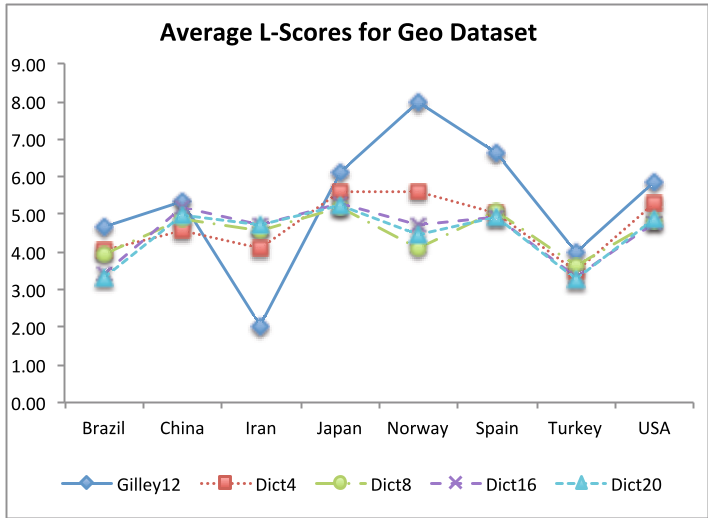
- The Win: A Pearson Correlation of 0.799 (using 4 topics and Geo-data) is remarkably high for social media analysis, which is typically fraught with noise.
- The Nuance: The model struggled with certain countries like Norway. This points to a limitation: the English-only filter. In countries where English is not the primary language for political discourse, the "English-speaking elite" on Twitter may not represent the broader populace.
| Method | Correlation (r) | P-value |
|---|---|---|
| Dict4 (Geo) | 0.799 | 0.017 |
| Dict8 (Keyword) | 0.472 | - |
Deep Insight & Future Outlook
The true value of this work lies in its real-time capability. While traditional L-scores are updated every few years, the Twitter-based L-score can be calculated daily or even hourly. This could act as an "early warning system" for civil unrest or democratic backsliding.
Future Directions: To improve this, one could expand beyond English to local languages and integrate the GDELT database, which tracks global conflicts in over 100 languages. Furthermore, moving from LDA to modern Transformer-based embeddings (like BERT or GPT) would likely solve the "terse text" problem where short tweets don't provide enough context for probabilistic topic models.
Conclusion
This paper successfully bridges the gap between big data analytics and classical political theory. It proves that while a single tweet is just noise, the aggregate of millions of tweets, filtered by geography and analyzed through a multi-dimensional lens, provides a mirror to the political soul of a nation.