
MobTrust: Bridging the Gap Between Physical Proximity and Social Trust
Quantifying trust relationships based on real-world social interactions
The paper introduces MobTrust, an opportunistic sensing system that quantifies trust relationships using smartphones. It extracts a real-world social graph by analyzing physical interactions and applies a hybrid probabilistic model to estimate trust levels between individuals.
TL;DR
Trust is the invisible fabric of society, but can we measure it with the devices in our pockets? MobTrust is an innovative system that moves beyond "social media friends" to quantify trust based on actual physical encounters. By analyzing how long we talk, how often we meet, and even our body orientation, MobTrust builds a real-world social graph with high accuracy, opening new doors for secure, context-aware mobile services.
The Problem with "Digital" Trust
Most modern trust models are built on likes, follows, and online comments. However, research indicates a significant "mismatch" between our online connections and our real-world social circles. Furthermore, existing systems for sensing real-world interactions often require heavy infrastructure like RFID readers or modified phone firmware, making them impractical for large-scale use.
The core challenge lies in context: a person might be a trusted colleague but not a trusted financial advisor. Traditional proximity sensing (like basic Bluetooth pings) cannot distinguish between two people standing back-to-back in a crowded elevator and two friends engaged in a deep conversation.
Methodology: From Proximity to Probability
MobTrust defines trust through a multi-dimensional probabilistic lens. Instead of looking at binary "connections," it evaluates four independent variables derived from smartphone sensors:
- Relative Orientation: Are the users facing each other? Using the social interaction detection enabler, the system models orientation as a Gaussian distribution. Faces-to-face (0°) is generally positive, though extreme directness can sometimes indicate conflict.
- Social Relation: Based on Hall’s Interaction Zones, the distance between users (Public, Social, or Personal space) provides a snapshot of their relationship.
- Frequency: Trust grows with repeated encounters. This is modeled via a Cumulative Density Function (CDF).
- Duration: Long-lasting interactions are strong indicators of high trust levels.
The Analytical Framework
The system merges these features into a hybrid model. The trust probability in a given context is calculated as the product of the individual probabilities for orientation, relation, frequency, and duration:
 Fig 1: Information flow from raw sensor data to a quantified trust measurement.
Experimental Validation
To test the theory, the researchers conducted a controlled experiment where participants (who were initially strangers) interacted for one hour.
Key Findings
- Graph Accuracy: MobTrust successfully identified which participants "clicked" and which did not interact at all.
- Confidence Weights: Unlike standard graphs, MobTrust weights its edges based on the confidence of the estimation. Relationships with longer interaction durations (e.g., pairs 1-2 and 3-4) showed significantly higher confidence scores (>0.8).
- Ground Truth Match: The system's "Trust Heatmap" closely mirrored the participants' self-reported questionnaires at the end of the session.
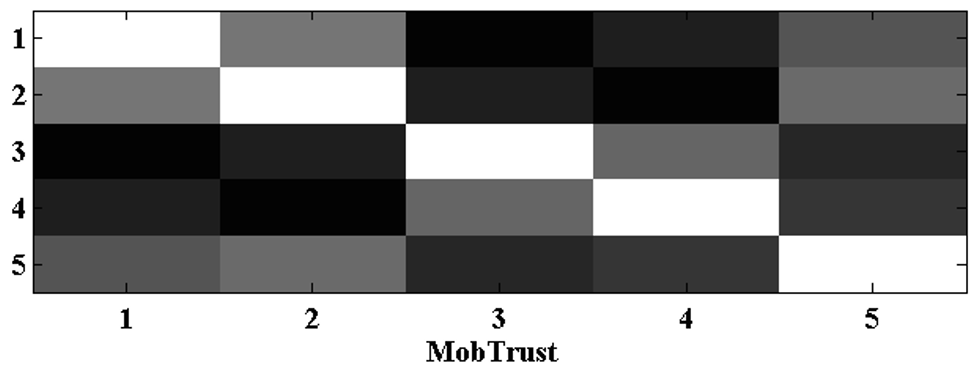 Fig 2: A comparison of self-reported trust (top) vs. MobTrust's inferred trust (bottom). Lighter colors represent higher trust.
Critical Analysis & Future Directions
While MobTrust is a step forward, it currently operates "from scratch" without prior knowledge. The authors acknowledge that a perfect system would likely be a hybrid of real-world and online world data, merging the structure of an OSN with the high-fidelity signals of physical interaction.
Why does this matter? In the future, your phone could use these trust scores to automatically share data with a "trusted" nearby friend during an emergency or adjust security settings when you are surrounded by people you don't know. MobTrust provides the mathematical and technical foundation to turn our smartphones into true sensors of human social dynamics.
Conclusion
MobTrust demonstrates that by combining psychological theory with opportunistic mobile sensing, we can quantify the most human of traits—trust—without the need for intrusive surveillance or specialized hardware.