
Beyond the Headcount: Quantifying Interconnectedness for OSN Valuation
Quantifying Users' Interconnectedness in Online Social Networks - An Indispensible Step for Economic Valuation
The paper introduces a specialized centrality measure based on the PageRank algorithm to quantify user interconnectedness in Online Social Networks (OSNs). This metric serves as a foundational component for the economic valuation of OSNs by capturing the network effects and social capital inherent in user relationships.
TL;DR
In the era of multi-billion dollar acquisitions like Facebook and MySpace, traditional financial models often struggle to justify "staggering" price tags. This paper argues that the true economic value of an Online Social Network (OSN) lies in the interconnectedness of its users. The authors propose an Adapted PageRank algorithm that moves beyond simple follower counts to quantify a user's structural importance, providing a critical first step for rigorous business valuation.
The Valuation Gap: Why Traditional Models Fail
Standard business valuation approaches are designed for predictable industries, not the dynamic, fast-growing world of Internet companies. In OSNs, the "product" is the user base, but more importantly, the relationships between those users.
The paper identifies a crucial blind spot in prior work: Network Effects. A user who generates zero direct revenue might still be incredibly valuable if their presence prevents fifty other revenue-generating users from leaving the platform. This "lock-in" effect is determined by how deeply a user is integrated into the social fabric, a factor that "Degree Centrality" (simple link counting) fails to capture.
Methodology: Adapting PageRank for Social Graphs
The authors establish three core requirements for a valid measure (: Direct contacts, : Indirect contacts, and : Feasibility). After finding that classic measures like Closeness and Betweenness fail these tests, they turn to the logic of Google's PageRank.
The Intuition
Just as a webpage is important if other important pages link to it, a social media user is "interconnected" if they are linked to other well-connected individuals.
The Formula Shift
The original PageRank was designed for the directed web. For OSNs, where friendships are reciprocal (undirected), the authors modified the formula:
Key Change: Unlike the original PageRank, which divides a node's rank by its number of outgoing links, this adaptation removes that divisor. This ensures that in a social context, adding more friends increases your score rather than diluting it.
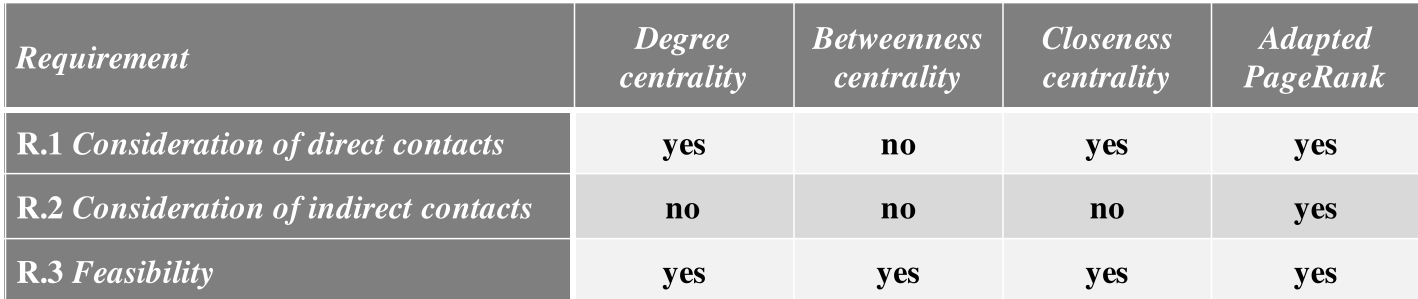 Table: Comparison of how different centrality measures meet the requirements for OSN valuation.
Experimental Illustration
The authors applied their measure to a 9-node network to prove the "Neighbor Quality" effect. As shown in the graph below, even if two users have the same number of friends, the user connected to the "Hub" (Node 3) receives a significantly higher Adapted PageRank score.
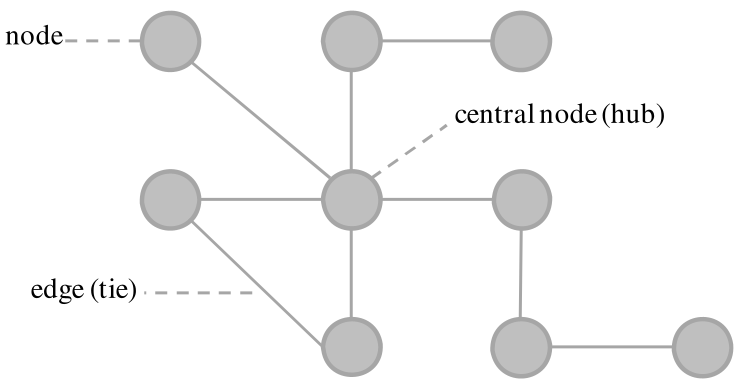 Figure: Exemplary OSN used to demonstrate that Node 4 (connected to Hub 3) is more valuable than Node 9 (connected to minority Node 8).
Critical Insight & Conclusion
While this paper provides a robust mathematical foundation for quantifying structural value, it acknowledges that "interconnectedness" is only one piece of the puzzle. Factors like user activity (login frequency, content creation) and direct revenue must eventually be layered onto this structural score to create a complete "Customer Lifetime Value" (CLV) model.
Takeaway for Research and BizDev
- For Researchers: This work suggests that complexity is a small price to pay for the recursive accuracy of PageRank in social contexts.
- For Investors: Stop looking at daily active users (DAU) in a vacuum. The topology of those users determines whether the network is a "sticky" ecosystem or a transient bubble.
Limitations
The model currently treats all links as equal. Future iterations might need to weight links based on the frequency or strength of interaction to distinguish "close friends" from "acquaintances."