
SSPM: Quantifying Interaction Intelligence in the Social Internet of Things (SIoT)
Quantitative Computation of Social Strength in Social Internet of Things
This paper introduces the Social Strength Prediction Model (SSPM) for the Social Internet of Things (SIoT), a quantitative framework to estimate the intensity of relationships between smart objects. Using human-object interaction data, the model combines entropy-based diversity measures and distance-based spatial features to achieve a high F-measure of 0.77, outperforming the previous SOTA method, DisCor-T.
TL;DR
As the Internet of Things evolves into the Social Internet of Things (SIoT), objects must autonomously form "friendships" to collaborate. This paper presents SSPM (Social Strength Prediction Model), a framework that translates human-object interaction logs into a quantitative "social strength" score. By blending information theory (Renyi Diversity) with spatial geometry (Mutually Nearest Distance), the authors achieve a state-of-the-art F-measure of 0.77 in predicting device partnerships.
Background: From "Smart" to "Social"
The SIoT paradigm shifts objects from passive tools to active social agents. However, building these networks isn't as simple as clicking "Add Friend." Unlike humans, objects don't explicitly broadcast their relationships. We must infer them from co-usage patterns.
The existing hurdle? Most models overlook two critical factors:
- Outliers: A person using a microwave every morning doesn't necessarily mean the microwave is "socially strong" with the toaster; it might just be a rigid habit.
- Sparseness: IoT data is notoriously "leaky." Missing logs make devices appear disconnected when they are actually related.
Methodology: The SSPM Dual-Engine
The authors propose a model that views social strength through two lenses: diversity and distance.
1. The Diversity Engine (Entropy-based)
Static frequency counts are misleading. Instead, the authors use Renyi Entropy.
- The Intuition: If two objects are co-used by many different users, their social connection is "general" and "robust."
- Outlier Control: By tuning the parameter in the Renyi formula, the model can "down-weight" repetitive behavior from a single user (the outlier) that would otherwise skew the social score.
2. The Spatial Engine (Distance-based)
To solve the data sparseness problem, SSPM looks at where interactions happen.
- Mutually Nearest Distance (MND): Instead of just measuring the distance between "centers of mass," MND identifies unique pairs of proximity between object usage points. If two objects are consistently used near each other, they are likely related, even if we lack a massive amount of temporal data.
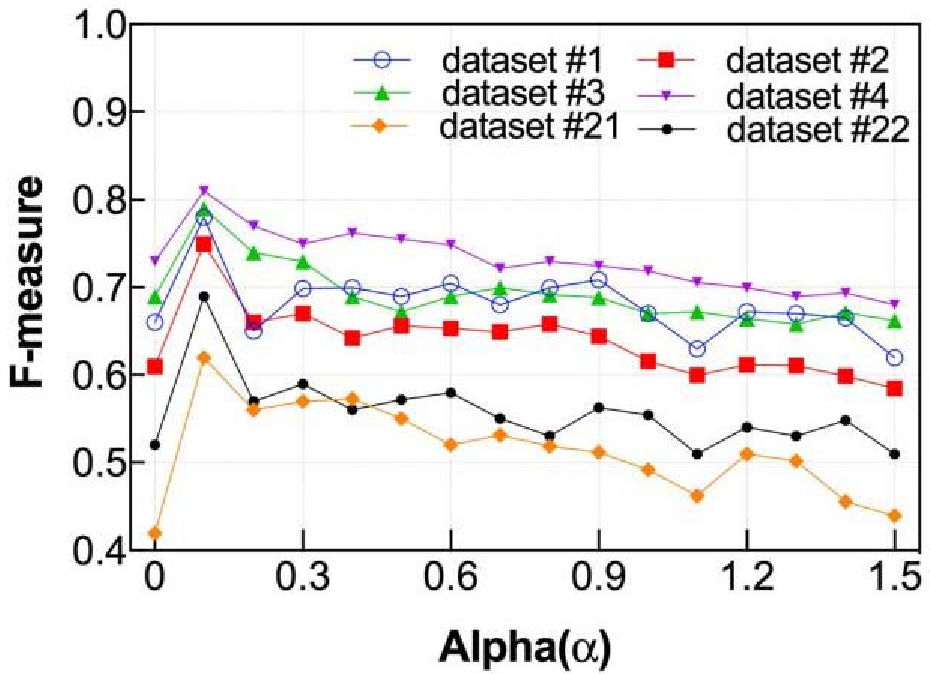 Figure 1: F-measure optimization across varying parameters, showing the peak at for effective outlier management.
Experiments & Results
Testing on the WSU CASAS Smart Home dataset, the authors compared SSPM against baseline metrics (Jaccard, Adamic/Adar) and the recent SOTA, DisCor-T.
Key Findings:
- Optimal Window: A co-usage time interval () of 60 seconds was found to be the "sweet spot" for human-object interactions in home settings.
- Performance Leap: SSPM reached an F-measure of 0.77, notably higher than DisCor-T's 0.73.
- Efficiency: By choosing MND over Earth Mover’s Distance (EMD), the authors kept the complexity at , making it feasible for resource-constrained IoT nodes.
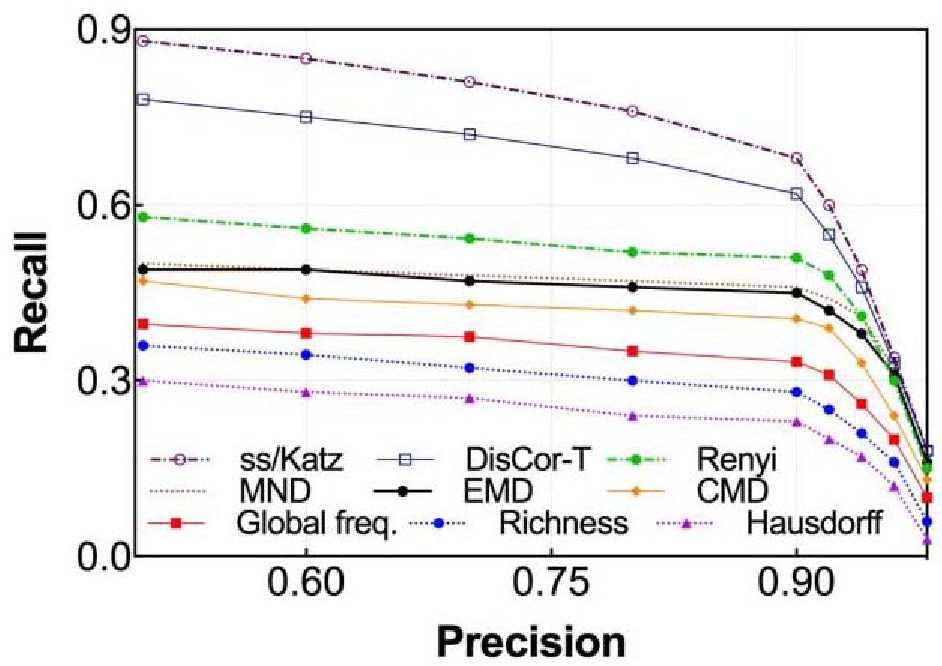 Figure 2: Performance of SSPM across different threshold values , highlighting the consistency across multiple sub-datasets.
Critical Analysis & Conclusion
Takeaway
SSPM proves that social strength in the IoT world isn't just about "how often" objects are used together, but "how diversely" and "how closely" in space. This quantification is the prerequisite for trusted service composition—where your smart car knows which charger to "trust" based on a verified social history.
Limitations & Future Work
While robust, the current model assumes a static social strength. In reality, friendships fade (deterioration) or grow (strengthening) over time. The authors signify that incorporating temporal decay (edge aging) and validating on larger multi-domain datasets (beyond smart homes) are the next frontiers for SIoT research.
Academic Positioning: This work moves beyond qualitative SIoT definitions into rigorous, quantitatively-backed link prediction, merging spatiotemporal Analysis with Information Theory.