
The Architecture of Belonging: Quantifying How Festivals and Spaces Shape Society
Quantitative evaluation of the roles of community events and artifacts for social network formation: a multilayer network model of a community of practice
This paper develops a strategic multilayer network model to quantify how community events (like local festivals) and physical artifacts (public spaces) influence social network formation. Applying game theory to a case study of a Japanese shopping street, the authors demonstrate that periodic community involvement significantly drives long-term social connectivity.
TL;DR
Can a local festival actually change the social fabric of a city? This study proves it by modeling society as a multilayer network. By analyzing a shopping street in Kobe, Japan, researchers found that community events don't just provide fun—they act as a structural catalyst that reduces social isolation and bridges the "generation gap" in daily life through strategic collaboration.
Background: Beyond the Static Graph
In the world of social network analysis, we often visualize friendships as static nodes and lines. However, human relationships are dynamic and contextual. This paper positions itself at the intersection of Game Theory and Sociology, exploring the "CoP" (Community of Practice). It asks: How does collaborating on a temporary project (like a festival) create permanent links in our daily lives?
The Problem: The "Inertia" of Social Bubbles
Most of us live in "social bubbles." Teenagers rarely interact meaningfully with the elderly; shopkeepers rarely collaborate deeply with students. In network science terms, these are High Local Clustering and Low Global Connectivity. Existing models (like ERGMs) describe what these networks look like, but they often fail to explain how specific interventions—like a new park design or a community ritual—change individual decision-making to break these bubbles.
Methodology: The Multilayer CoP Model
The authors propose a dual-layer approach:
- The Daily Life Layer: Links are expensive and require mutual consent (Two-sided Link Formation). Here, people are "myopic"—they only connect if there is an immediate personal benefit.
- The CoP Layer (The Event): Links are formed through roles (Exhibitors vs. Visitors) and Artifacts (The Physical Space). Interaction here is "accidental" but structured by the event’s needs.
Visualizing the Logic
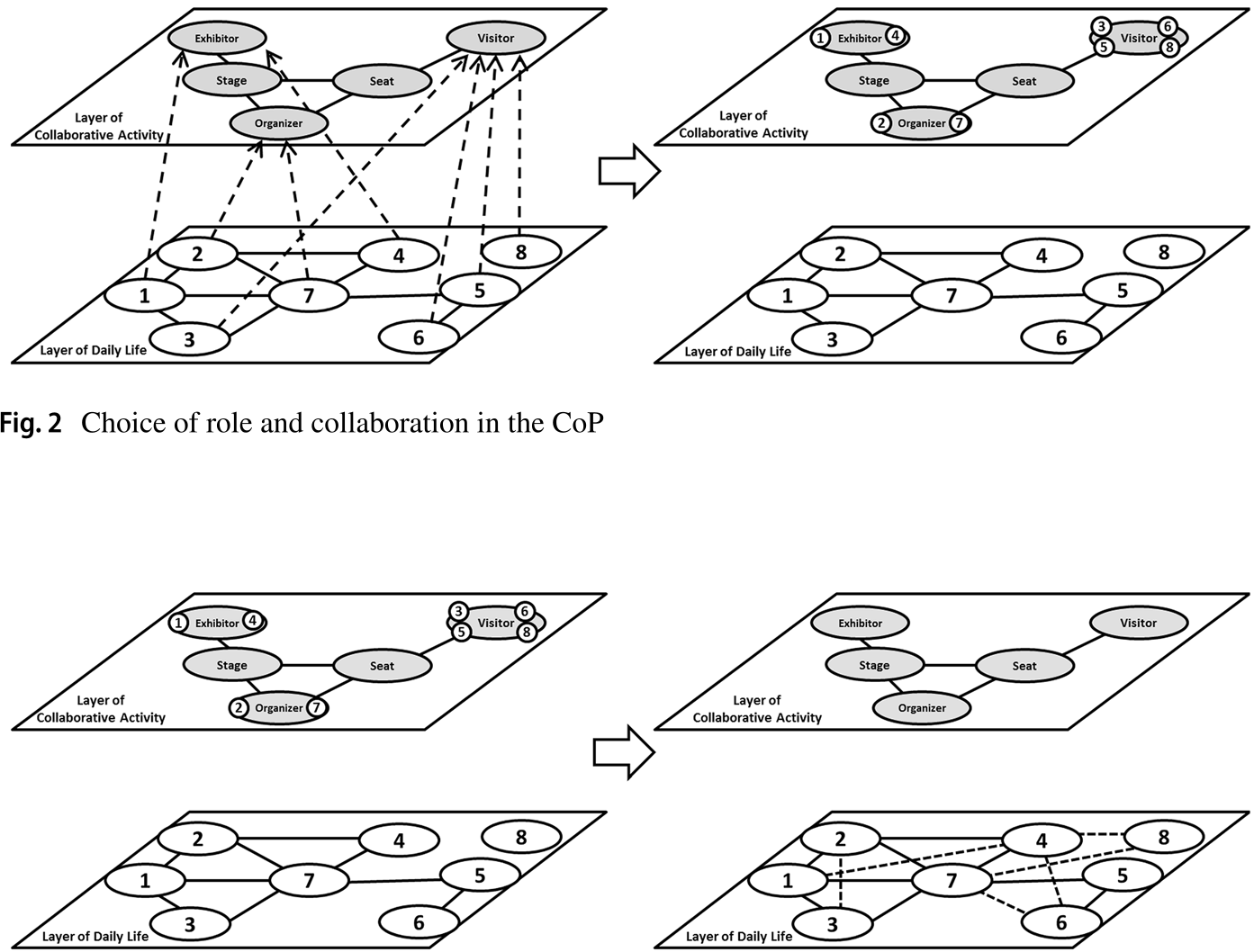 Figure 1: The transition from event-based 'practice' to daily 'interaction'.
The "Secret Sauce" of this study is how it handles artifacts. They treat the shopping street not just as a background, but as a Node in the network. If the street has high ceilings, good visibility, or a "roof that protects from weather," it increases the utility of the CoP node, attracting more participants, which in turn creates more collision points for potential new friendships.
Experiments: The Kobe Case Study
The team targeted the Taisho-suji Shopping Street in Kobe, 11 years after it inaugurated the "Ennichi" festival. Using a survey-based calibration (including a "Willingness to Pay" metric), they simulated the community with and without the festival.
Key Results:
- Breaking Isolation: The festival decreased the number of "isolated nodes" (lonely residents) by 2.3%.
- Generational Bridging: Links between different age groups increased by 1.9%.
- Design Matters: Amazingly, subtle physical factors like the "design and color of the floor" were found to contribute significantly to the total network expansion effect.
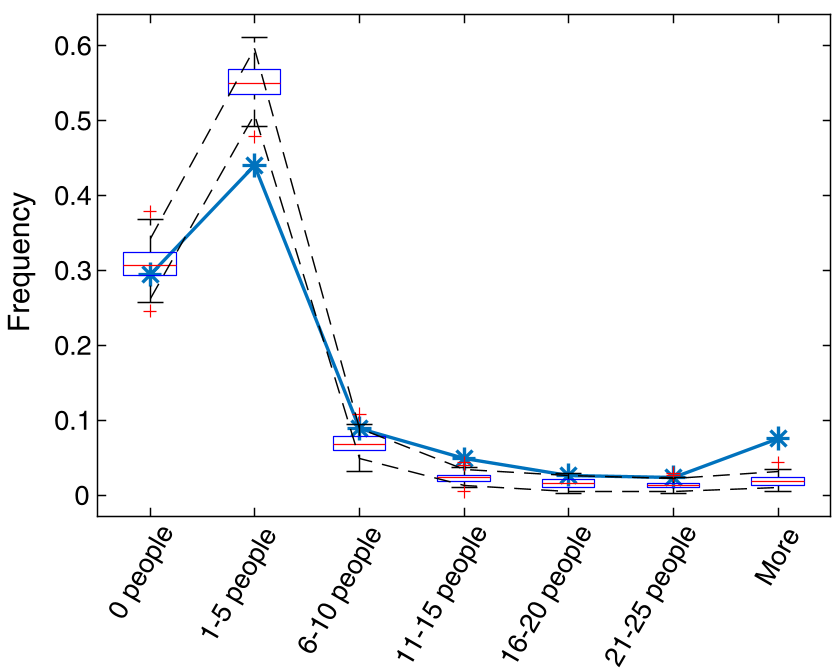 Figure 2: The model’s simulation (box plots) closely mimics the real-world observed social density (blue line).
Critical Insight: The "Artifact" Advantage
The most profound takeaway is that spatial properties have social ROI. When we invest in "wide streets" or "skylight ceilings," we aren't just making a place prettier; we are increasing the probability () that two strangers will strike up a conversation that persists long after the festival lights go out.
Future Outlook & Limitations
While robust, the model currently struggles to capture the role of "Organizers"—the super-connectors of society. Future iterations will likely integrate these "Hubs" to see if the network effect is even larger. For urban planners, the message is clear: the physical design of a public space is directly proportional to the "Social Resilience" of the community it hosts.
Conclusion
This research provides a mathematical bridge between Urban Design and Social Capital. It proves that community events are not just "soft" culture; they are "hard" social engineering tools that can be quantitatively optimized to fight isolation.
Takeaway: The next time you walk through a well-designed public market, remember: that floor color isn't just an aesthetic choice—it's a tool for social cohesion.