
Quantifying the Chaos: A Signal-Processing Approach to Social Media Confusion
A Quantitative Model and Analysis of Information Confusion in Social Networks
This paper introduces the first quantitative model for "Information Confusion" in social networks, borrowing concepts from wireless communications. It proposes the Information-to-Confusion Noise Ratio (ICNR) and solves the optimal information delivery strategy using a non-cooperative game with pricing, achieving Nash Equilibrium to minimize consumer confusion.
TL;DR
What if we treated social media arguments like radio interference? This paper transforms the qualitative frustration of "information overload" into a rigorous mathematical framework. By introducing the Information-to-Confusion Noise Ratio (ICNR), the authors use wireless communication principles and game theory to calculate the exact "intensity" an information provider should use to be heard without causing total chaos.
Key Insight: Confusion isn't just about having too much information; it's about the contradiction and trust levels between sources.
The Motivation: When "More" Means "Less"
In traditional information theory, more data usually reduces uncertainty. In social networks, the opposite is often true. If one friend says a restaurant is great and another says it’s awful, you aren't more informed—you are confused.
The authors identify three drivers of this confusion:
- Source Attributes: How aggressive is the provider?
- Consumer Characteristics: How much "natural dilemma" does the user have?
- Trust Relations: Who does the user believe more?
Existing research acknowledged this "noise" but couldn't measure it. This paper fills that gap by treating supplementary, contradictory information as interference.
Methodology: The Physics of Information
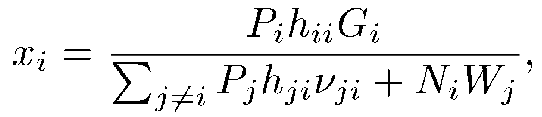
The core of the paper is the ICNR (Information-to-Confusion Noise Ratio). It is mathematically analogous to the SINR used in 4G/5G networks:
The Game of Aggression
The authors model the interaction as a non-cooperative game.
- Power (): Representing a provider's aggression, propaganda, or advertising intensity.
- Pricing (): A penalty for being too aggressive. This could be monetary (ad costs) or emotional (loss of reputation/followers).
Using M-Matrix theory, they prove that a unique Nash Equilibrium exists. This equilibrium tells us the "optimal aggression" level for every provider in the network. If the price of being aggressive is too low, the network becomes a shouting match; if it's too high, the network goes silent (passive).
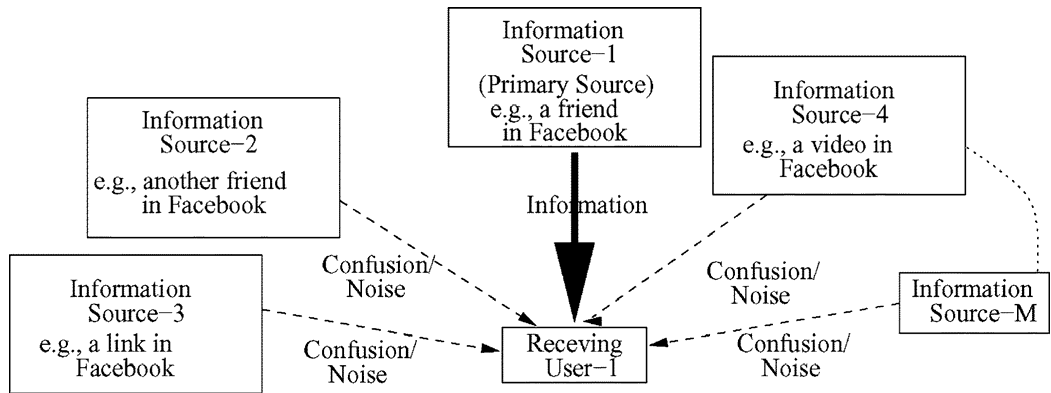 Figure 1: The model of multiple information sources feeding into a single consumer, where non-primary sources act as noise.
Experiments: Twitter and Trust
The researchers validated their model using real-world Twitter data on controversial topics like airport full-body scans.
Key Findings:
- Trust Concentration is Key: In networks where users trust everyone equally (Distributed Trust), confusion levels skyrocket. Information providers oscillate wildly between being "Overly Aggressive" and "Overly Passive."
- Stability in Authority: In networks where one or two sources are highly trusted (Concentrated Trust), the system is much more stable. Providers can use lower intensity and still deliver high "utility" to the consumer.
- The Threshold Effect: Adding "auxiliary resources" (links, citations, pictures) helps reduce confusion, but only up to a point. Beyond a certain threshold, the consumer's "learning capacity" is reached, and more evidence actually increases confusion.
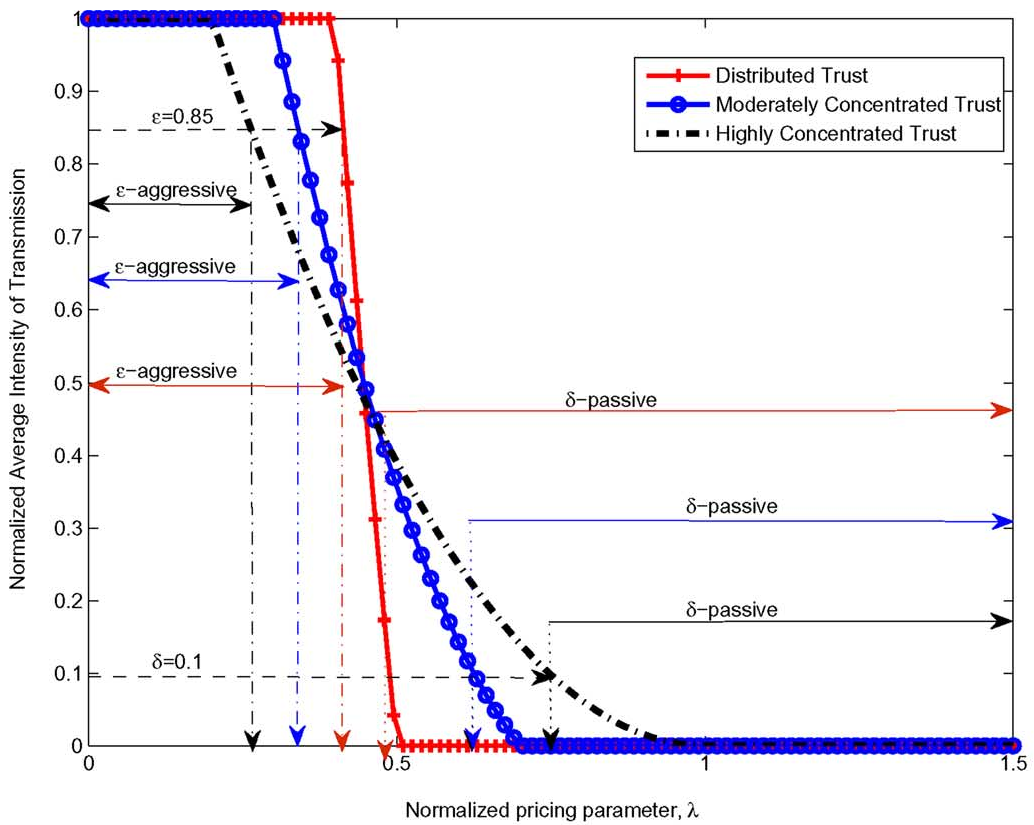 Figure 2: Comparison of pricing vs. utility across different trust scenarios. Highly concentrated trust (middle/bottom) provides much higher utility for lower pricing.
Critical Analysis & Conclusion
Why this matters
This research provides a blueprint for building "healthier" social algorithms. Instead of just filtering spam, platforms could use these formulas to:
- Admission Control: Identify when a discussion group has reached a "confusion threshold" where no new useful information can be absorbed.
- Task Prioritization: Apply the same logic to corporate environments to balance competing workplace distractions.
Limitations
The model assumes "complete information"—meaning everyone knows everyone else’s strategy. In the real world, social nodes often act with hidden motives. Furthermore, the "Contradiction Factor" is difficult to automate perfectly without advanced NLP for sentiment analysis.
Final Takeaway
Information confusion is a manageable physical property. By adjusting the "price" of aggression (through UI friction, fact-checking labels, or algorithmic de-prioritization), we can move social networks from chaotic shouting matches to structured, high-utility exchanges.