
Decoding the Soundtrack of Our Lives: How Context, Mood, and Personality Shape Music Listening
Quantitative Study of Music Listening Behavior in a Social and Affective Context
This paper presents a quantitative study on music listening behavior within social and affective contexts by developing computational models to predict user mood from blog posts and song choices. Using the "LJ40k" dataset from LiveJournal, it uniquely links user-generated text, music emotion recognition (MER), and Big-Five personality traits to model how individuals regulate mood through music.
TL;DR
Music isn't just about what we hear; it's about how we feel and what we are doing. This study by Yang and Liu explores 40,000 real-world data points to prove that while our blog posts are better "mood detectors" than our playlists, the interaction between our personality (Extraversion, Agreeableness) and our current mood creates a predictable pattern of music selection. The goal? A truly context-aware music recommender.
The Missing Link in Music Recommendation
Most Music Emotion Recognition (MER) systems treat songs as static objects: "This is a sad song." But for a listener, a "sad song" serves different purposes. Are you listening to it to amplify your sadness (mood maintenance) or to find comfort (mood regulation)?
The researchers identified a major gap: User Mood Recognition (UMR) has lived separately from MER. By bridging these using the "LJ40k" dataset—a collection of blog posts with explicit mood tags and attached songs—they could finally analyze the tripartite relationship between the person, the context, and the music.
Methodology: The Three Pillars of Affect
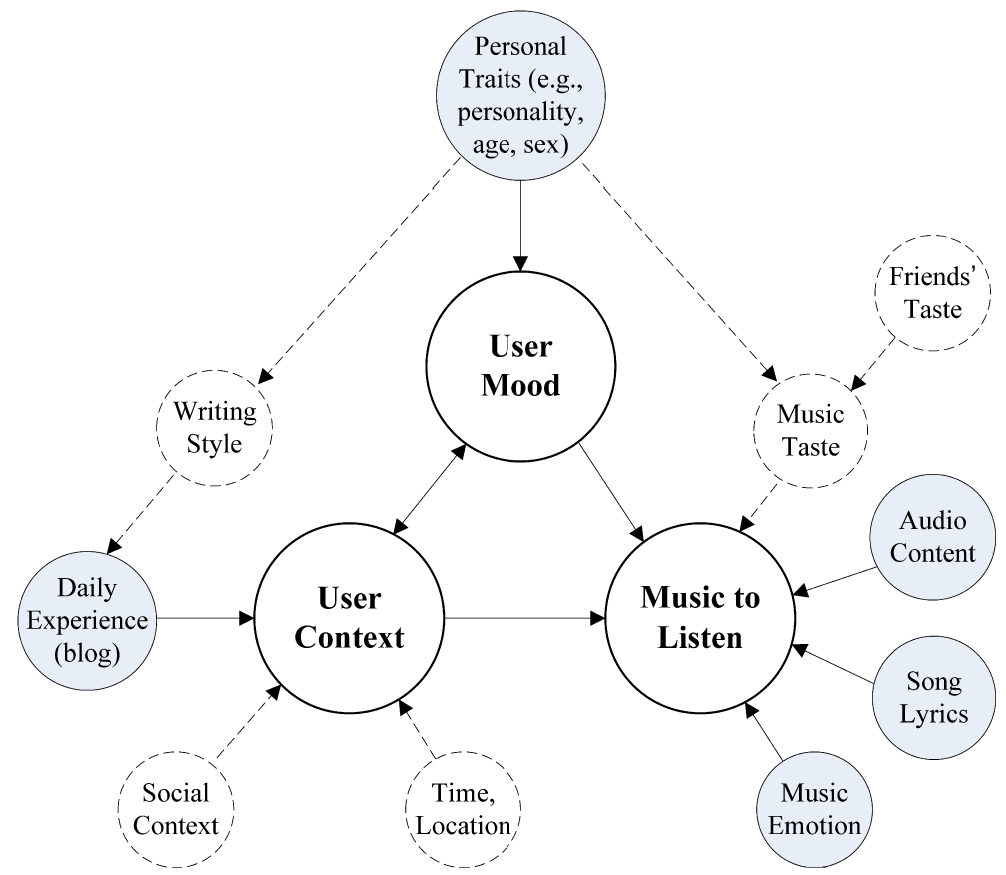
The authors constructed a framework that treats music listening as a result of three interacting forces:
- User Context: Manifested through blog articles (the "Why" and "Where").
- User Mood: The short-term emotional state.
- Music Content: Audio features (Timbre, Energy, Rhythm) and lyrics.
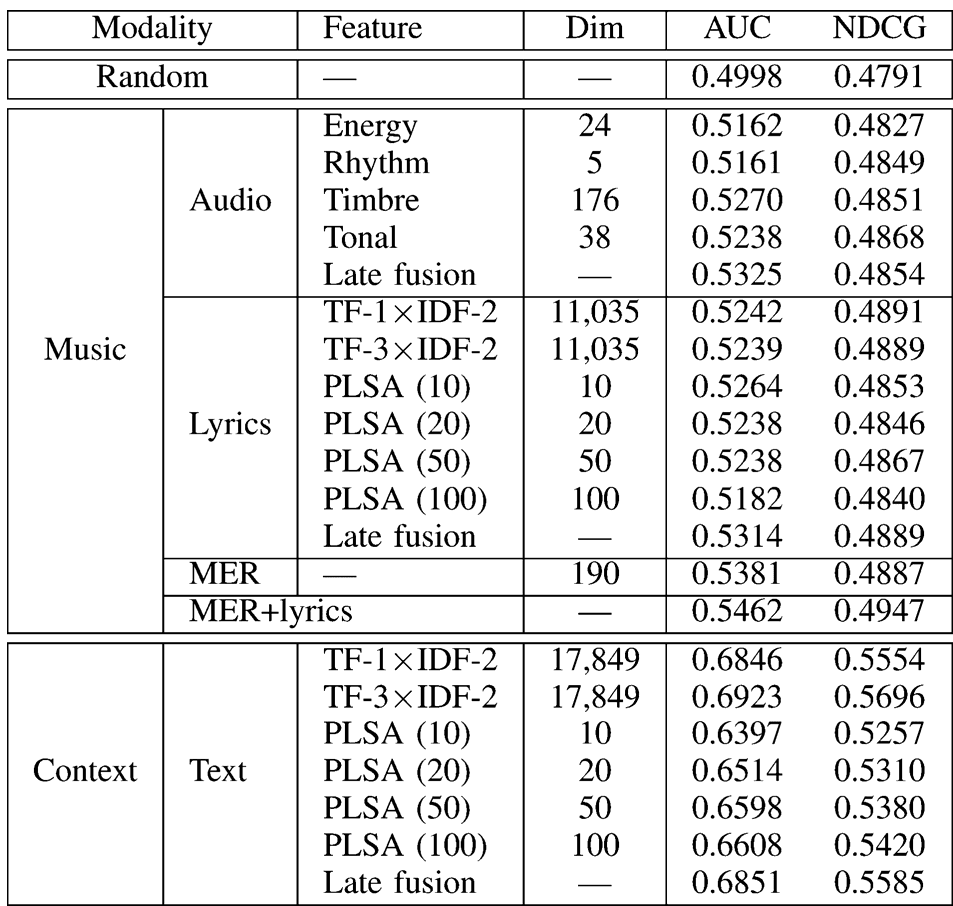
The researchers used Support Vector Machines (SVM) with EasyEnsemble to handle the massive data imbalance (since any specific mood like "Ecstatic" is rare compared to "all other moods"). They extracted 176 timbre features, tonal descriptors, and bag-of-words from lyrics to see which would reveal the blogger's internal state.
Key Finding 1: Blogs Speak Louder Than Beats
The most striking result was the performance gap between context and content.
- Context-Based (Blog Text): Achieved a robust AUC of 0.6851.
- Music-Based (Audio/Lyrics): Struggled to exceed 0.5462.
Why? Because music choice is polysemic. Two people feeling "lonely" might choose polar opposite genres—one might pick a melancholy ballad for company, while another picks high-energy pop to escape the silence. Blog posts, however, are explicit linguistic evidence of the emotional state.
Key Finding 2: The Personality Factor
The study leveraged a "Personality Recognizer" to map bloggers to the Big-Five (OCEAN) traits. They found that personality dictates how we use music to regulate mood:
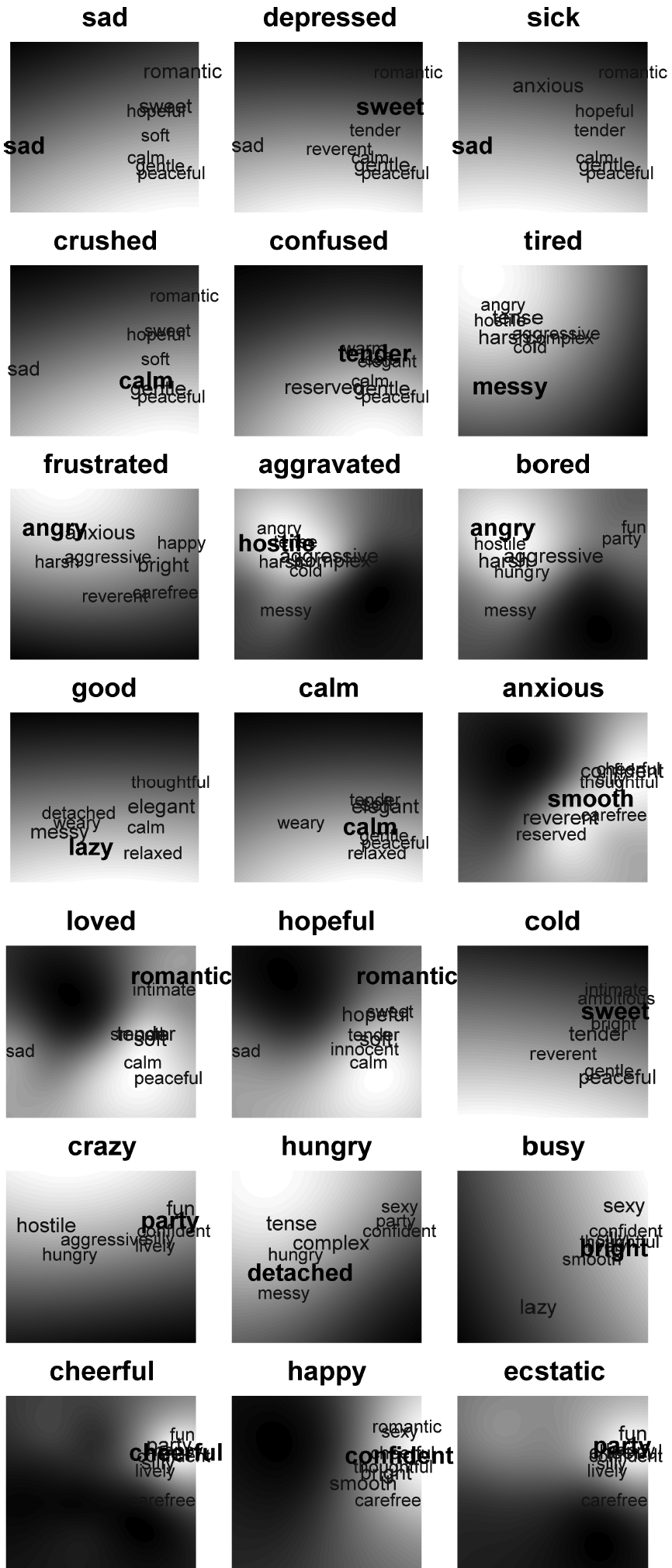
- Extroverts: Significantly more likely to listen to "party" music even when feeling "sick" or "loved."
- Low Agreeableness: Tend to swap "sad" music for "angry" music when feeling lonely, possibly as a defensive emotional mechanism.
- Neuroticism: Contrary to some lab studies, this trait showed less distinct patterns in spontaneous social data, suggesting real-life coping is more complex than a lab test reveals.
Experimental Insights: Mood Congruence vs. Regulation
The data visualized a clear divide in how we "consume" emotion:
- Positive Moods (Happy, Cheerful): We seek Congruence. We play happy music to keep the party going.
- Negative Moods (Frustrated, Bored): We seek Regulation. People often play "angry" music when frustrated to vent, or "peaceful" music to alleviate a "drained" state.
Conclusion & Future Horizon
This study serves as a wake-up call for the music tech industry. To build a recommender that doesn't just play "similar songs" but "the right song," we must:
- Analyze the text: Look at the user's social posts or messages to ground the mood.
- Factor in Personality: An extrovert's "sad playlist" looks very different from an introvert's.
Limitations: The study relies on 30-second audio snippets and text from 2005. Today's multimodal LLMs could likely push these AUC scores much higher by understanding the nuance and sarcasm in modern social media.