
This paper presents a "mixed" Bohmian framework for Cavity Quantum Electrodynamics (CQED) where electrons are treated as ontic point particles with deterministic trajectories, while electromagnetic fields are represented by time-evolving mode coefficients. The authors successfully model complex phenomena like photon partition noise and Rabi oscillations using a unitary Schrödinger equation, demonstrating that "photon creation/annihilation" can be interpreted as quantized energy exchange rather than particle disappearance.
TL;DR
Is a photon a "particle" that pops in and out of existence? This paper argues no. By revisiting Bohmian mechanics, the authors demonstrate that Quantum Electrodynamics (QED) can be fully understood using deterministic trajectories for electrons and continuous field evolutions. They show that "photon detection" is actually the movement of material atoms in a detector, effectively removing the need for the "wavefunction collapse" postulate.
Problem & Motivation: The Ghost in the Atom
In standard physics, we are taught that photons are "created" and "annihilated." This language makes it almost impossible to visualize what is actually happening. If you believe in a realist world where things have positions even when not looked at (the Bohmian view), "creating" a particle feels like magic.
The authors tackle two main misconceptions:
- That Bohmian mechanics can't handle variable particle numbers.
- That the "particle" nature of light (like partition noise) is an intrinsic property of light itself.
Their insight? Photons are not things; they are states. By treating the electromagnetic field as a high-dimensional coordinate and electrons as particles, we can watch energy slosh back and forth like water between tanks, governed by a single, beautiful, unitary Schrödinger equation.
Methodology: The Mixed Ontology
The authors build a framework where the "Beables" (things that actually exist) are:
- Matter (Fermions): Point particles following trajectories.
- Light (Bosons): Coefficients of electromagnetic modes.
They derive a "Bohmianized" version of the light-matter Hamiltonian. Instead of abstract operators in Fock space, they use a configuration space where are electrons, is the light mode, and are the physical pointers of the measuring devices.
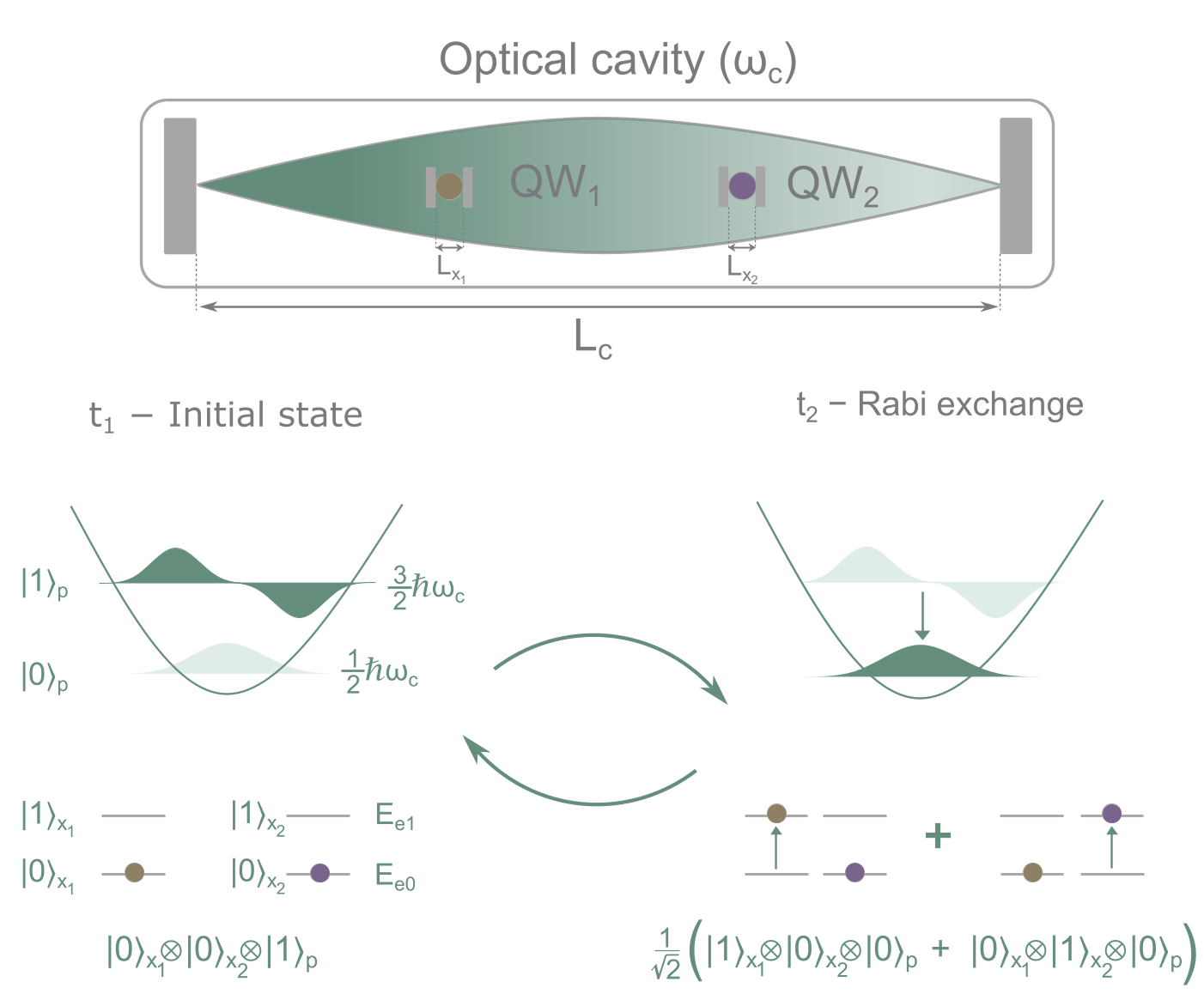 Figure 1: (a) Two electrons in a cavity. (b) The energy exchange (Rabi oscillations) between the field and matter.
Experiments: Solving the Partition Noise Paradox
The most striking part of the paper is the simulation of Photon Partition Noise. When a single "photon" hits two detectors, only one clicks. Orthodox QM says the wavefunction collapses.
The authors show that in a Bohmian simulation:
- Before Measurement: The wavefunction is a smooth superposition. The "photon" energy is shared.
- During Measurement: The system enters an "enlarged configuration space." Because the pointers ( and ) are made of matter, they follow trajectories.
- The Result: The pointer for Detector A moves, OR the pointer for Detector B moves. They cannot both move because the wave packets in the 5D space become disjoint.
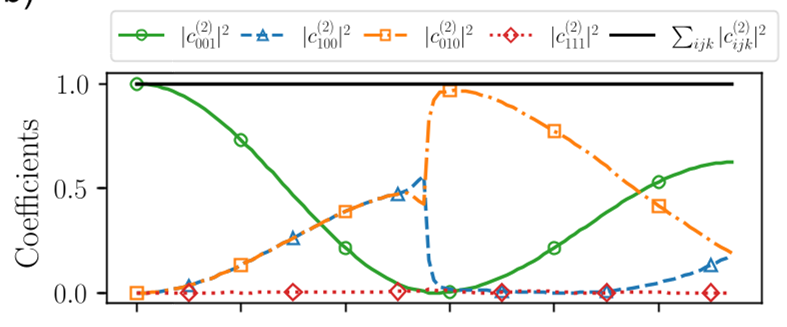 Figure 2: The "Conditional Wavefunction" effectively collapses. Depending on the initial trajectory, the energy is "found" in electron 1 (left) or electron 2 (right).
SOTA Comparison: Why This Matters
Unlike standard QFT which relies on the "Measurement Postulate" (which Bell famously called "unprofessional"), this Bohmian approach is mathematically complete. It recovers the Born Rule () as a statistical consequence of initial conditions (Quantum Equilibrium), not as a separate law of nature.
| Feature | Orthodox QED (Copenhagen) | Bohmian QED (This Paper) | | :--- | :--- | :--- | | Ontology | Ambiguous (Wave-Particle Duality) | Clear (Particles + Fields) | | Measurement | Non-unitary "Collapse" | Unitary Branching | | Photons | Ontic Particles | Quantized Field Energy | | Visuals | Probability Clouds | Deterministic Trajectories |
Critical Insight: The "Fermions-Only" Future
The authors conclude with a radical suggestion: we might not even need ontic fields. Inspired by Wheeler-Feynman's "action-at-a-distance," they suggest that the electromagnetic field itself might just be a mathematical shorthand for how one electron's trajectory influences another's.
Takeaway: This work strips the mystery from Quantum Optics. By showing that "photon" behavior is actually just the behavior of material detectors, it paves the way for a more intuitive, pedagogical, and physically grounded understanding of the quantum world.
The authors have released QC-Slim, a software package to simulate these trajectories, proving that Bohmian mechanics is no longer just a philosophical niche—it's a computational tool.