
This paper presents a rigorous real-valued framework for quantum mechanics based on Kähler spaces, proving it is exactly isomorphic to standard complex quantum theory. By introducing a "symplectic tensor product" (), the authors demonstrate that real numbers fully reproduce all quantum predictions, including the 2021 Renou et al. "falsification" of real quantum theory.
TL;DR
For a century, physicists debated if the imaginary unit was a fundamental requirement of nature or just a mathematical convenience. A 2021 landmark result claimed to prove was necessary by showing "real" quantum mechanics couldn't explain certain multi-party correlations. This paper refutes that claim: the authors show that by using a Kähler-space framework and a symplectic composition rule, real numbers can replicate every prediction of complex quantum mechanics—including the very experiments thought to falsify them.
The Motivation: Is Nature Complex or Just Real but Rotated?
Schrödinger’s equation famously introduced into the heart of physics. While classical mechanics is written in real numbers, quantum mechanics relies on complex Hilbert spaces to describe interference and entanglement.
In 2021, Renou et al. appeared to settle the debate. They proposed a "CHSH3" inequality for a network of three parties where a complex theory would win over a real one. They proved that real quantum mechanics (using standard real tensor products) could only reach a score of ~7.66, while complex theory reached . Experimentalists later confirmed the higher value, seemingly "expelling" real-valued theories from reality.
However, the authors of this paper noticed a fatal flaw: the version of "real quantum mechanics" tested was structurally crippled. It used the standard Kronecker product , which accidentally discarded the very "complex structure" it was supposed to simulate.
Methodology: The Kähler-Space Isomorphism
The breakthrough lies in treating the real space not just as a collection of numbers, but as a Kähler space .
- The Doubling Map: A complex number is represented as a real matrix .
- The Complex Structure : The imaginary unit is replaced by a real matrix , which represents a rotation.
- The Symplectic Product (): Instead of a standard tensor product, the authors use a rule that respects the internal rotation of the subsystems.
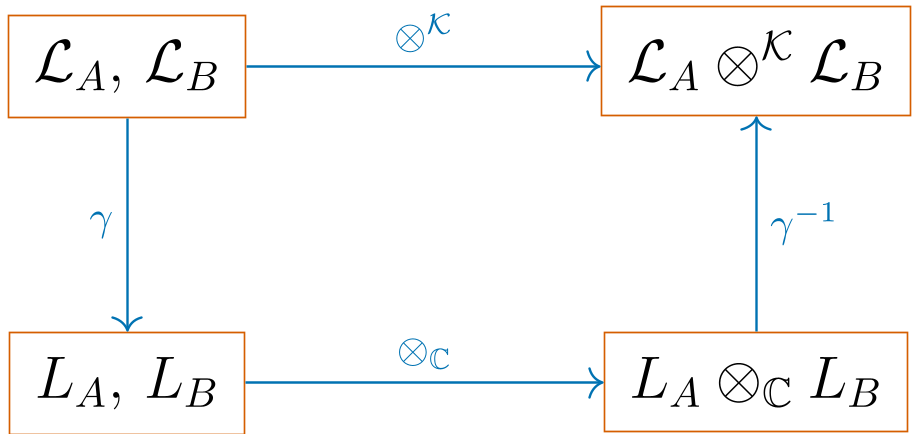 Figure 1: This diagram shows that the Symplectic Composition Rule () is exactly equivalent to performing a complex tensor product and then mapping it back to the real domain.
The authors prove a formal Isomorphism Theorem: Standard Complex QM and Kähler-space Real QM are "monoidally isomorphic." This means they are functionally identical for any physical scenario, no matter how many particles are involved.
Experiments: Overturning the No-Go Theorem
The authors re-calculated the CHSH3 violation using only real matrices within their Kähler framework. By using the correct composition rule, they found that the "real" theory manages to hit exactly.
 Equation: Proof that real-valued Pauli matrices in Kähler space satisfy the same algebraic commutation relations as complex ones.
The reason Renou et al. failed to find this was because their "real" space was "too big." Their methods created spurious extra dimensions that don't exist in standard physics. The Kähler framework prunes these dimensions, keeping the physics pure.
Critical Analysis & Conclusion
The takeaways from this work are profound:
- Complex numbers are an encoding: The imaginary unit is not a "magic" ingredient; it is a compact way to track the geometric relationship between the metric (probabilities) and the symplectic form (phase/interference).
- The "Complex Necessity" was a category error: Previous proofs "falsified" a specific, poorly-constructed real theory, not all real theories.
Limitations: While this provides a perfect mathematical mapping, the complex formulation remains much more elegant for "pen-and-paper" calculations. The real formulation requires doubling the dimensions and using more complex matrix multiplication rules.
Future Outlook: This geometric perspective might lead to new insights in Quantum Information Theory, particularly in understanding the transition from classical to quantum probabilities as a geometric constraint rather than an arbitrary switch in number fields.
Final Verdict: Nature doesn't need complex numbers; it needs the geometry that complex numbers represent. The debate is settled—not by choosing one over the other, but by proving they are two sides of the same coin.