
Precision Viral Marketing: Mastering Influence Maximization for Specific Target Queries
A Query Approach for Influence Maximization on Specific Users in Social Networks
This paper introduces the IMAX Query problem, a novel formulation aimed at maximizing influence on a specific subset of target users within social networks. The authors propose the Independent Maximum Influence Paths (IMIP) expectation model and a corresponding fast greedy-based approximation method to optimize influence spread on targeted nodes.
TL;DR
Influence Maximization (IMAX) has long been the gold standard for viral marketing, but it has a fundamental flaw: it doesn't care who gets influenced. In this paper, Lee and Chung propose IMAX Query Processing, a methodology that allows marketers to specify a set of target users on the fly. By leveraging the Independent Maximum Influence Paths (IMIP) model and specialized Influence Trees, they achieve SOTA accuracy with speeds up to 100x faster than previous heuristics.
The Motivation: Why Global IMAX Fails in the Real World
Imagine you are promoting a high-end female cosmetic product. A traditional IMAX algorithm might suggest "seed" users who have massive global reach—perhaps tech influencers or sports stars—because they maximize the total number of influenced people. However, if those people don't reach your specific target (women or gift-buyers), your marketing budget is wasted.
Existing solutions were either:
- Inflexible: Required pre-defined labels (e.g., "Interest: Cosmetics") before the query started.
- Slow: Used Monte-Carlo simulations that re-calculate everything from scratch for every new campaign.
Methodology: The IMIP Model and Influence Trees
The authors' core "Aha!" moment is that influence in social networks is often dominated by a few high-probability paths. They introduce the Independent Maximum Influence Paths (IMIP).
1. Independent Maximum Influence Paths (IMIP)
Calculating exact influence spread is #P-hard. To solve this, the IMIP model assumes that a node influences another primarily through its strongest independent paths. By focusing on these paths, they turn a complex graph problem into a manageable tree-traversal problem.
2. Identifying Local Influencing Regions
Since targets are specific, why look at the whole graph? The algorithm identifies a "Local Influencing Region" for each target. Only nodes within these regions are considered as candidate seeds. This pruning significantly reduces the search space without sacrificing accuracy.
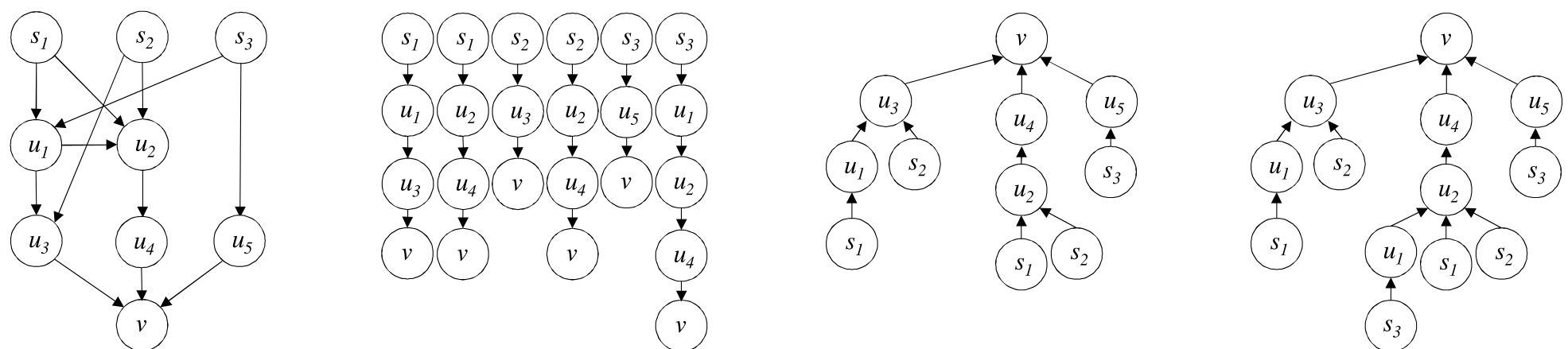 Figure 1: Illustration of how multiple independent paths are transformed into an Influence Tree for efficient probability calculation.
Experiments: Speed Meets Precision
The authors tested their method against heavyweights like PMIA, IRIE, and CELF++ across datasets like Flixster (0.8M nodes, 11.8M edges) and Pokec (1.6M nodes).
Key Performance Identifiers:
- Query Speed: As seen in the charts, IMIP's query processing time is nearly flat regardless of target size, whereas PMIA's cost spikes.
- Scalability: On the Pokec dataset, identifying local regions made the process roughly 6 times faster than a global greedy approach.
- Accuracy: Despite the path simplification, the influence spread achieved was nearly identical to the computationally expensive PMIA method.
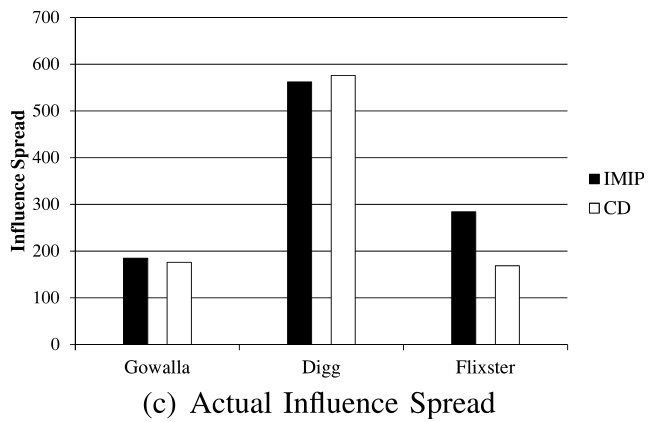 Figure 2: Running time comparison. IMIP (bottom line) maintains significantly lower latency as the seed set size increases.
Critical Insights & Future Work
The beauty of this approach lies in its incremental updating. By using the Influence Tree, when a new seed is selected, the algorithm only updates the marginal gains of affected nodes rather than re-scanning the graph.
Limitations: The model currently relies on the Independent Cascade (IC) model. While the authors mention potential applications to the Linear Threshold (LT) model, the path-independence assumption might be harder to maintain there due to the "threshold" nature of activation.
The Takeaway for Engineers: If you are building a recommendation or marketing engine, stop treating your social graph as a monolithic entity. Localized indexing of "influence regions" is the key to sub-second query responses for targeted campaigns.
Conclusion
Lee and Chung have successfully bridged the gap between theoretical influence maximization and practical, query-driven marketing. Their IMIP model proves that we can trade a negligible amount of "path complexity" for an order-of-magnitude increase in speed.