
TGS Query: Bridging the Gap Between Where You Are and Who You Know
ery Processing in Location-Based Social Networks
The paper introduces the Top-k Geo-Social (TGS) query, a novel query type for Location-Based Social Networks (LBSNs). It presents a system that retrieves the top-k Points of Interest (POIs) based on both spatial proximity to a user and social relevance (popularity among friends), utilizing three distinct processing strategies: Social-First, Spatial-First, and Hybrid.
TL;DR
This research introduces the Top-k Geo-Social (TGS) query, a paradigm shift for Location-Based Social Networks (LBSNs). Instead of just finding the "closest" coffee shop, TGS finds the most popular spots within your social circle that are also within a specific radius. The authors provide a robust framework using a Hybrid approach that merges spatial indexing (R-trees) with social graph filtering to deliver results at scale.
Context & Motivation: Why Spatial Isn't Enough
In the era of Foursquare and Meta, a location is no longer just a coordinate; it is a node in a social graph. Traditional spatial queries are "socially blind"—they treat every user the same. The challenge lies in the computational explosion that occurs when you try to join a friendship graph (millions of edges) with spatial data (millions of points).
If you process the social side first, you might look up thousands of friends who have never visited your current city. If you process the spatial side first, you might find thousands of locations that none of your friends care about. This paper addresses this "mismatch" problem through efficient query pruning.
Methodology: The Three Processing Pillars
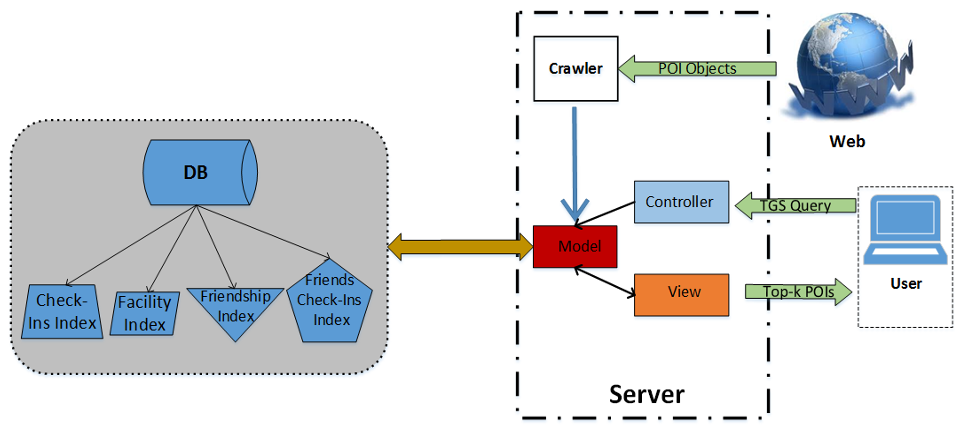
The authors propose a client-server architecture where the server handles the heavy lifting through three distinct algorithmic flavors:
- Social-First: Retrieves friends first, then filters their check-ins by the query radius.
- Spatial-First: Retrieves all POIs in the radius first, then checks which ones were visited by friends.
- Hybrid (The Core Innovation): This approach uses a dual-indexing strategy. It employs an R-tree for spatial indexing and a Grid Partitioning method. By overlaying the check-in summaries of a user's social circle onto a geographic grid, the system can prune entire regions (and the POIs within them) that haven't been visited by friends, and vice-versa.
Experiments & Real-World Application
The system was demonstrated using a massive Foursquare dataset:
- 3.6 Million POIs
- 33 Million Check-ins
- 3.4 Million Friendship relations
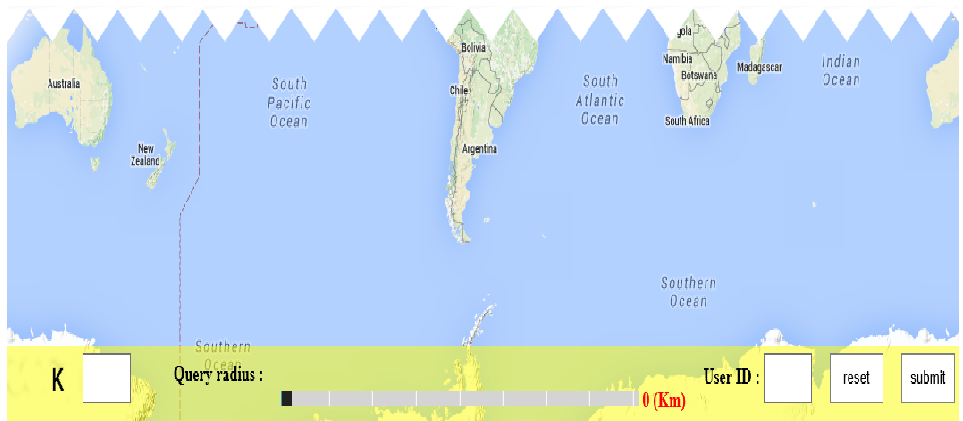
The demonstration interface highlights how the TGS query enriches the user experience. By clicking a location on a Google Maps interface and setting a radius, the system returns not just a list of markers, but a personalized list of "famous places" ranked by his/her unique social circle's behavior.
Critical Insight: Efficiency through Pruning
The true value of this work is the realization that simultaneous pruning is the only way to scale LBSNs. By indexing the "check-in summary" of friends within the R-tree structure itself, the Hybrid approach avoids the O(N) complexity of checking every friend or every local POI. This creates a highly responsive experience even with millions of data points.
Limitations & Future Work
While the TGS query is a major step forward, the current demonstration focuses on a static "Check-in" count. Future iterations would benefit from:
- Recency Weighing: Giving more weight to check-ins from the last month vs. five years ago.
- Social Tie Strength: Weighting a "Best Friend's" check-in more heavily than a distant acquaintance's.
Summary
Sohail et al. have successfully demonstrated that the future of LBSNs lies in the fusion of spatial and social dimensions. Their Hybrid pruning strategy provides a blueprint for building scalable, personalized recommendation engines in a world where data is increasingly geo-tagged and socially connected.