
Bridging the Gap: How Socio-Spatial Graphs Turn Location Logs into Actionable Intelligence
Querying geo-social data by bridging spatial networks and social networks
The paper introduces a Socio-Spatial Network (SSN) framework that bridges social networks (friendship graphs) and spatial networks (geographic adjacency graphs) via "life-pattern edges." It proposes the Socio-Spatial Network Algebra (SSNA), a dedicated query language with novel operators like Bridge and Multi-Bridge, and evaluates its performance across relational (MySQL) and graph (Neo4j) database implementations.
TL;DR
This paper moves beyond simple "check-ins" to propose a rigorous framework for Socio-Spatial Networks (SSN). By connecting social graphs and spatial networks through probabilistic "life patterns," the authors introduce a new algebra (SSNA) that allows querying not just where people are, but the rhythms of how social groups interact with geographic space.
Problem & Motivation: The Silo Effect
In 2010, at the dawn of the Location-Based Social Network (LBSN) boom, researchers faced a technical wall:
- The Social Silo: Friendship graphs (Alice knows Bob).
- The Spatial Silo: Geographic road networks Building A is next to Building B).
Existing systems couldn't easily answer questions like: "Find me the entertainment venues visited by 80% of John Smith's friends at least once a week with 90% confidence." Such queries require a hybrid data model that understands both social ties and spatial hierarchies (e.g., a Cathedral is inside a Neighborhood which is inside a City).
Methodology: Connecting Two Worlds
The core innovation is the Life-Pattern Edge. Unlike a one-off "check-in," a life-pattern edge represents a recurring behavior defined by a tuple: (user, entity, time_pattern, confidence).
1. The Integrated Architecture
The authors visualize the SSN as a tripartite structure:
- Social Network: Nodes (Users) + Friendship Edges.
- Spatial Network: Nodes (Entities) + Adjacency Edges.
- The Bridge: Life-pattern edges linking the two.

2. Socio-Spatial Network Algebra (SSNA)
To query this data, the paper introduces specific operators:
- Bridge(S, TP, c): Shifts the context from social to spatial (or vice versa). E.g., from a set of users to the places they visit.
- MBridge (Multi-Bridge): A powerful similarity operator. It identifies nodes connected to a specific percentage of a target set, enabling "look-alike" modeling for people and places.
Experiments: Graph vs. Relational Battle
The authors implemented the system on both a Graph Database (Neo4j) and a Relational Database (MySQL).
Traversal Performance
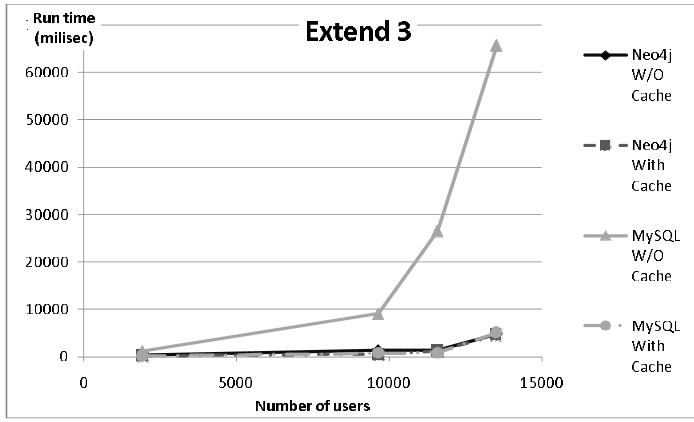
For multi-hop queries (Extend and Bridge), Neo4j demonstrated its "index-free adjacency" advantage. In deep traversals (Extend 3), MySQL's performance degraded exponentially due to the overhead of recursive joins, whereas Neo4j remained relatively stable.
Aggregation Performance
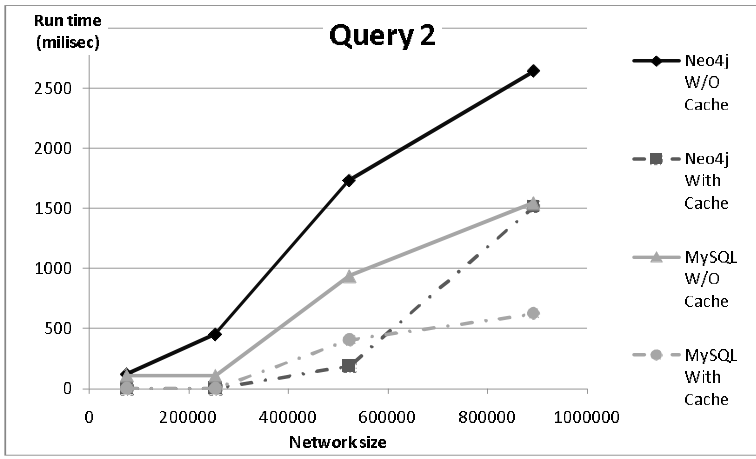
Interestingly, for the Multi-Bridge operator, which requires heavy counting and group-by logic, MySQL held its ground or outperformed Neo4j. This highlights a classic trade-off: graph databases win at "finding the path," but relational engines win at "counting the results."
Critical Analysis & Conclusion
Takeaway
The paper successfully formalizes the intuition that human location history is a "bridge" to social understanding. The SSNA provides a blueprint for modern location-intelligence platforms.
Limitations
- Static Confidence: The confidence value is calculated offline. In modern contexts, we would require a dynamic update mechanism as new sigprints (GPS pings) arrive.
- Privacy: The paper focuses on utility but does not address the significant privacy implications of storing such granular life patterns.
Future Outlook
As we move toward "Smart Cities," the ability to query socio-spatial similarity will be vital for urban planning and hyper-local marketing. The next frontier is likely shifting from this algebraic approach to Graph Neural Networks (GNNs) that can learn these "Life Patterns" automatically from raw data.